15 space story ideas for kids
15 creative space story ideas for kids — each with a free AI prompt to generate the full illustrated story instantly.
✦ Key Takeaways
- •The best space stories for kids ages 1 to 4 are gentle, repetitive, and emotionally safe.
- •For ages 5 to 7, the strongest space stories for kids add adventure, problem-solving, and a touch of humor.
- •Older children usually enjoy kids space stories with deeper world-building, bigger questions, and stronger character growth.
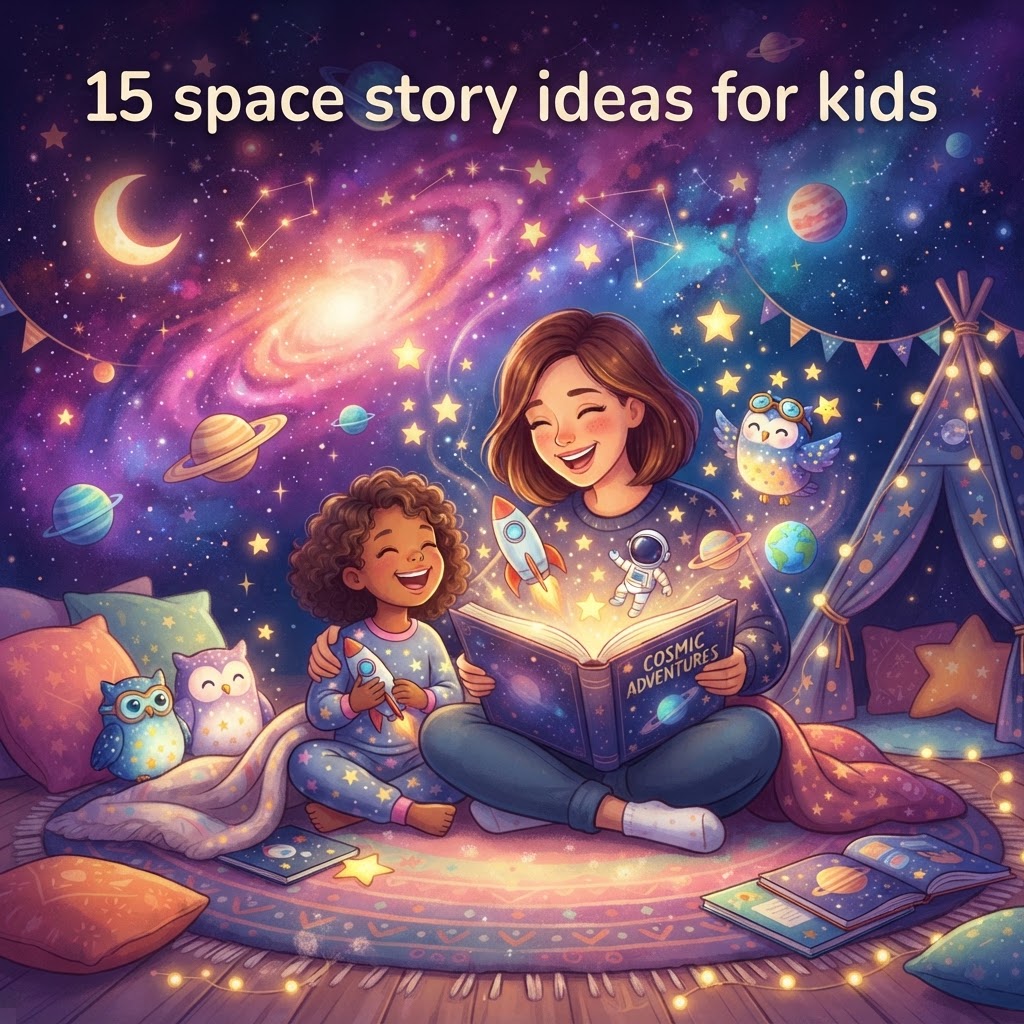
Few themes spark wonder as quickly as space. If you are looking for space story ideas that feel magical, age-appropriate, and easy to turn into bedtime reading, this list gives you 15 creative concepts plus a ready-to-use AI prompt for each one. You can use them as quick inspiration, or create your own personalized bedtime story in minutes with InstaTales. If your child already loves rockets and stars, you may also enjoy this collection of more space-themed story inspiration.
Which space story ideas are best for toddlers and preschoolers?
The best space stories for kids ages 1 to 4 are gentle, repetitive, and emotionally safe. At this age, children love simple plots, familiar routines, and comforting characters they can meet again and again.
1. The Moon’s Missing Blanket
The moon cannot fall asleep because its soft cloud blanket has drifted away. A tiny bunny astronaut helps tuck the moon in before sunrise.
- AI prompt: Write a calm, repetitive bedtime story for a 2- to 4-year-old about a bunny astronaut who helps the moon find its missing cloud blanket. Use simple language, a soothing tone, and a happy ending. Include dreamy illustrations with soft blues, silver stars, and smiling clouds.
2. Rosie Rocket Says Goodnight
A little rocket named Rosie flies around the solar system saying goodnight to every planet. Each planet has one funny bedtime habit.
- AI prompt: Create a short illustrated bedtime story for ages 1 to 3 about a friendly rocket named Rosie who says goodnight to each planet. Use repeated phrases, gentle humor, and a cozy ending back on Earth.
3. The Sleepy Star Parade
One by one, sleepy stars float across the sky on their way to bed. A child counts them and learns each star has its own sparkle song.
- AI prompt: Write a soothing counting story for preschoolers about a parade of sleepy stars heading to bed. Make it rhythmic, warm, and easy to read aloud, with 10 stars and a comforting final page.
4. Nibbles the Alien Learns to Share
A tiny alien visits Earth and discovers that sharing moon cookies makes playtime more fun. The story focuses on friendship and simple social skills.
- AI prompt: Write a gentle kids space story for ages 3 to 5 about a cute alien named Nibbles who learns to share moon cookies with new friends. Keep the plot simple, positive, and full of colorful illustrations.
5. The Planet That Loved Hugs
A lonely little planet drifts through space until nearby comets and stars show it how friendship works. The story reassures young children that everyone can find their place.
- AI prompt: Generate a sweet bedtime story for a 3-year-old about a small planet that feels lonely until it finds friends in space. Use warm emotional language, repetition, and a reassuring ending.
What space stories for kids work well for ages 5 to 7?
For ages 5 to 7, the strongest space stories for kids add adventure, problem-solving, and a touch of humor. Children in this stage enjoy stories where characters try, fail, learn, and succeed.
6. The Lost Rover on Mars
A curious rover gets separated from its team during a dust storm on Mars. With help from a clever child engineer, it finds its way back.
- AI prompt: Write an adventurous story for ages 5 to 7 about a lost rover on Mars and a child engineer who helps guide it home. Include teamwork, simple science facts, and bright red-planet illustrations.
7. Captain Zara and the Floating Library
A young captain discovers a library spaceship where every book opens a new galaxy. She must return a missing story before the whole ship drifts off course.
- AI prompt: Create a fun illustrated story for a 6-year-old about Captain Zara exploring a floating library in space. Include mystery, books, talking robots, and a satisfying ending about responsibility.
8. The Comet Delivery Service
Two siblings run a delivery service on the tail of a friendly comet. Their hardest job is delivering a birthday cake to Saturn without letting it float away.
- AI prompt: Write a playful story for ages 5 to 7 about siblings who deliver packages across space on a comet. Make it funny, fast-paced, and full of imaginative planet details.
9. Pluto’s Surprise Party
Pluto worries that no one remembers it anymore, so its space friends plan a secret celebration. This is a gentle story about inclusion and being valued.
- AI prompt: Write a heartfelt but funny story for young children about Pluto getting a surprise party from the other space objects. Use simple astronomy themes, lots of friendship, and a joyful ending.
10. The Day Gravity Took a Vacation
A class on a field trip to a space station wakes up to find gravity has disappeared. The children must solve clues to turn it back on.
- AI prompt: Generate a lively story for ages 6 to 7 about children on a space station where gravity suddenly stops working. Include floating snacks, teamwork, and a simple mystery to solve.
Which kids space stories are best for ages 8 to 10?
Older children usually enjoy kids space stories with deeper world-building, bigger questions, and stronger character growth. This is also a great age for space story prompts that mix imagination with real science ideas.
11. The Girl Who Mapped a New Constellation
A thoughtful child notices a star pattern no one else has seen and sets out to prove it is real. Along the way, she learns that discovery takes patience and courage.
- AI prompt: Write an inspiring story for ages 8 to 10 about a girl who discovers and maps a new constellation. Blend wonder, persistence, and age-appropriate astronomy details with beautiful night-sky illustrations.
12. Mission to the Whispering Nebula
A young crew travels into a nebula where sounds become visible colors. They must decode the nebula’s “whispers” to help a stranded spacecraft.
- AI prompt: Create a science-fantasy adventure for ages 8 to 10 about children entering the Whispering Nebula, where sound turns into color. Include suspense, teamwork, and vivid cosmic imagery.
13. The Time Capsule on the Moon
A group of friends finds a hidden lunar capsule filled with messages from children of the future. Each message gives a clue about protecting Earth.
- AI prompt: Write an illustrated middle-grade-style story about friends discovering a time capsule on the moon. Include mystery, hope, and gentle environmental themes tied to caring for Earth.
14. Juno and the Planet of Mirrors
On a distant world, every character sees a different version of the same landscape. Juno must learn whose point of view to trust.
- AI prompt: Generate a thoughtful adventure for ages 8 to 10 about a child explorer named Juno visiting a mirror planet where everyone sees things differently. Focus on empathy, critical thinking, and imaginative visuals.
15. The Last Train to Andromeda
A child accidentally boards an intergalactic train that only appears once every hundred years. To get home, they must help passengers from many worlds solve one final cosmic puzzle.
- AI prompt: Write a longer space story idea turned into a full adventure for ages 8 to 10 about a magical train traveling to Andromeda. Include rich world-building, unusual alien passengers, and a clever ending.
How can you turn these space story prompts into full bedtime stories with InstaTales?
It is easy to turn these ideas into finished stories. Start with one prompt, add your child’s name, age, favorite animal, or bedtime need, and let InstaTales generate a personalized version in seconds.
A simple process works best:
- Pick one idea that matches your child’s age and mood.
- Paste the prompt into InstaTales and personalize key details.
- Adjust for tone: sleepy, funny, adventurous, or educational.
- Save favorites in your story library for easy rereading.
- If you want a quicker starting point, browse the built-in story templates.
For families and classrooms, you can also turn these space story prompts into reading or writing activities. Teachers often use them for STEM tie-ins, creative writing, or shared reading through InstaTales for teachers.
Why are space stories so engaging and educational for children?
Space stories are powerful because they combine wonder, language growth, and early science thinking. A well-chosen story can help children build vocabulary, practice prediction, and explore big ideas in a safe, playful way.
Research and education groups support this approach. Reading Rockets highlights how interactive read-alouds build comprehension and oral language. The Center on the Developing Child at Harvard University explains that imagination, memory, and flexible thinking all support developing executive function. And child-friendly astronomy resources from NASA Space Place show just how naturally children connect storytelling with real space learning.
In practice, parents often get the best results by reading slowly, asking one or two open questions, and letting children retell the story in their own words. If your child also enjoys other imaginative themes, you can explore nature story ideas for kids or browse magic-themed story inspiration for variety across the week.
Frequently Asked Questions
What makes a good space story for kids?
A good space story feels age-appropriate, emotionally safe, and full of wonder. Younger children usually prefer simple repetition, while older children enjoy mysteries, adventure, and science details.
How long should a bedtime space story be?
For toddlers, 3 to 5 minutes is often enough. For children ages 5 to 10, 5 to 10 minutes usually works well, especially if the story has clear pacing and a calm ending.
Can AI-generated space stories be educational?
Yes, if the prompt is well designed. AI stories can include accurate, simple science ideas, rich vocabulary, and social-emotional themes while still feeling fun and imaginative.
How do I personalize space story ideas for my child?
Add your child’s name, age, favorite planet, favorite animal, or a real-life challenge like fear of the dark or starting school. Personalized details make the story feel more meaningful and memorable.
Are space stories good for classroom use?
Absolutely. They can support science units, creative writing, vocabulary work, and read-aloud discussions, especially when paired with drawing or simple research tasks.
What if my child wants even more story choices?
That is common, especially once children find a theme they love. Try rotating between space, nature, and fantasy themes, then save favorites so you can revisit the stories that work best at bedtime.
Get a new bedtime story every week
Free, personalized, and delivered to your inbox. No spam, ever.
Ready to Create a Personalized Bedtime Story?
Use our free AI bedtime story generator to create a personalized illustrated story for your child in 30 seconds — no credit card needed.
Popular story types:
Maya Rodriguez
Lead Content Editor & Early Literacy Specialist
Maya is a former early childhood educator and literacy specialist with over a decade of experience helping children develop a love of reading. She leads content at InstaTales, where she writes about the science of storytelling, child development, and how families can use personalized AI stories to build literacy and emotional resilience.
instatales.ai