AI Stories Screen Time: Finding Healthy Balance
Concerned about screen time with AI stories? Here's how to enjoy AI-generated stories while maintaining healthy tech habits.
✦ Key Takeaways
- •AI stories are usually better than passive entertainment, but they are still best used in moderation.
- •The simplest answer is to use AI stories the way you would use a picture book: together.
- •The read together approach means a caregiver stays actively involved before, during, and after the story.
If you feel torn between the magic of personalized AI stories and the worry of “one more screen,” you are not alone. Many parents are asking how AI-generated stories fit into family life, especially when they are trying to reduce overstimulating media and build healthy tech habits.
The good news is that AI stories screen time does not have to be an all-or-nothing issue. When used thoughtfully, AI storytelling can look much more like shared reading than passive entertainment. The key is not just how long a child uses the technology, but how the technology is used, who is involved, and what happens before and after the story.
Is all screen time the same when children use AI stories?
No. A child listening to or reading an AI story with a parent is not having the same experience as a child passively watching fast-paced videos alone. Content quality, pacing, and adult involvement matter a lot.
Child development research has consistently shown that not all screen time affects children in the same way. The American Academy of Pediatrics distinguishes between passive media use and high-quality, interactive media. A personalized story that invites conversation, prediction, and connection is developmentally different from autoplay cartoons or endless scrolling.
That does not mean AI stories get a free pass. If a child is alone on a tablet for long periods, even educational content can become less helpful. But when AI storytelling is used as interactive reading time, it can support:
- Language development
- Imagination and storytelling skills
- Emotional connection with a caregiver
- Attention and listening practice
A useful way to think about kids screen time AI concerns is this: the device matters, but the relationship around the device matters even more.
How do AI stories compare with other kinds of screen time?
AI stories are usually better than passive entertainment, but they are still best used in moderation. In most families, they sit somewhere between reading an e-book and watching a calm educational program.
Compared with many common forms of screen media, AI stories often have a few clear advantages:
- They are slower-paced. Stories unfold through language rather than rapid visual stimulation.
- They can be personalized. Children often engage more deeply when the character, theme, or challenge reflects their interests.
- They can encourage back-and-forth talk. Parents can pause, ask questions, and connect the story to real life.
- They may continue off-screen. A story can lead to pretend play, drawing, or retelling.
That said, there are still trade-offs. A glowing screen at bedtime may interfere with sleep if it replaces a calming wind-down routine. The CDC’s sleep recommendations remind families that good sleep habits are essential for children’s learning, mood, and behavior.
So where do AI stories fit? For many families, they work best as a higher-quality, lower-stimulation option within the screen-time mix. If you want ideas on choosing tools carefully, this guide on how to choose a child-friendly AI story generator can help.
How can parents turn AI stories into shared activities instead of solo screen time?
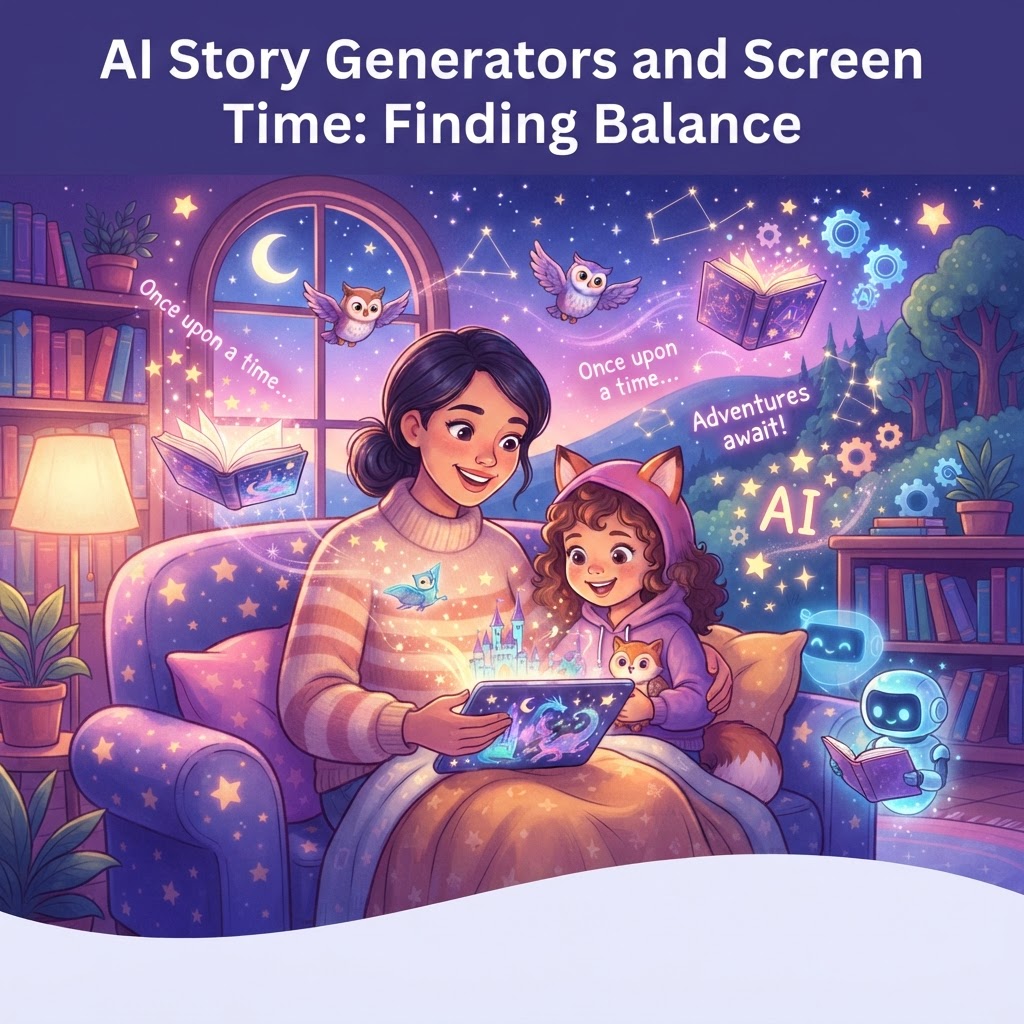
The simplest answer is to use AI stories the way you would use a picture book: together. Shared use turns a screen-based activity into a relationship-based learning moment.
Researchers and early childhood organizations often refer to this as joint media engagement. Children learn more when adults sit with them, comment, ask questions, and connect the content to the child’s world. That is especially true for younger children, who benefit most when media is social, not solitary.
Here are easy ways to make AI stories a shared activity:
- Sit side by side and read the story aloud.
- Let your child choose the character, setting, or theme.
- Pause and ask, “What do you think happens next?”
- Talk about feelings: “Why was the dragon nervous?”
- Extend the story off-screen with drawing, puppets, or pretend play.
You can also reduce the “screen” part of the experience. For example, you might create your own personalized bedtime story, read it once on your phone, and then retell it from memory later. You can also save favorites in your story library for re-reading without constantly generating new content.
When parents do this, AI becomes a storytelling tool, not a babysitter.
What does the “read together” approach look like at home?
The read together approach means a caregiver stays actively involved before, during, and after the story. In practice, it is less about the app and more about turning story time into conversation time.
A simple routine might look like this:
Before the story
Set up the experience with intention. Choose one short story, one calm setting, and one clear purpose, such as winding down before bed or talking about a new school experience.
You might say, “Let’s make a story about a child who feels shy on the first day of soccer.”
During the story
Stay present. Read aloud, use expression, and pause often. Even one or two questions can deepen comprehension and help your child stay engaged.
Good prompts include:
- “How is this character feeling?”
- “What would you do?”
- “Can you find the problem in the story?”
- “Do you remember when that happened to you?”
After the story
Move away from the screen as soon as the story ends. Ask your child to retell the story, act it out, or change the ending. This supports memory, narrative skills, and creativity.
This is one reason many families find AI stories especially useful at bedtime. If you want more ideas for calm evening routines, you may enjoy our guide to using AI stories for bedtime.
What screen time boundaries work best with AI stories?
The best boundaries are clear, predictable, and matched to your child’s age. AI storytelling works well when parents treat it as one part of a healthy media routine, not unlimited access.
The AAP recommends avoiding solo screen media for babies, using high-quality media with adult support for toddlers, and setting consistent limits for older children so screens do not crowd out sleep, movement, play, and family interaction. Their Family Media Plan tool is a practical place to start.
For AI stories, strong boundaries often include:
- Use one story at a time. Avoid endless “just one more” generation loops.
- Choose shared over solo use. Especially for younger children.
- Keep devices out of bed. Bright screens can make sleep harder.
- Turn off notifications and autoplay. Story time should feel calm, not distracting.
- Set device-free parts of the day. Meals, outdoor play, and family conversations should stay protected.
- Review privacy settings. If a tool asks for personal details, keep information minimal and child-safe.
Privacy is part of safe media use, too. If you are evaluating platforms, our parent guide to AI story privacy covers what to watch for.
How can families build healthy tech habits around AI storytelling?
Healthy tech habits come from routines, modeling, and balance. Children do best when AI stories are woven into a rich daily life that includes books, outdoor play, conversation, and sleep.
A balanced family approach might include:
- Reading printed books and AI stories during the same week
- Using AI stories for specific moments, like bedtime or travel
- Letting children help create stories, then moving into off-screen play
- Re-reading favorite stories instead of always seeking novelty
- Modeling calm, intentional device use as an adult
One practical tip is to think in terms of purpose rather than just minutes. Ask yourself:
- Is this story helping us connect?
- Is it calming or overstimulating?
- Is it replacing something important, like sleep or outdoor play?
- Will we talk about it afterward?
If the answers are positive, AI storytelling can fit beautifully into family life. It can even support children with different learning needs when personalized carefully; we explore that more in our article on AI stories for children with different support needs.
The goal is not perfect restriction. The goal is thoughtful use. When families focus on connection, boundaries, and quality, healthy tech habits become much easier to build and sustain.
Frequently Asked Questions
Do AI stories count as screen time?
Yes, if your child is using a phone, tablet, or computer to read or listen, it generally counts as screen time. However, the quality of that screen time matters, and shared, interactive story use is usually more valuable than passive viewing.
Are AI stories better than cartoons for young children?
Often, yes. AI stories are usually slower-paced and more language-rich, especially when a parent reads along and talks about the story. Still, they should not replace sleep, active play, or regular book reading.
What is the best way to use AI stories with toddlers?
Use them briefly and together. For toddlers, the most helpful approach is co-reading, talking about pictures or events, and keeping the experience calm, simple, and limited.
Can AI stories be part of a bedtime routine?
Yes, as long as the technology does not make bedtime more stimulating. Many families do best by keeping the story short, dimming the screen, and ending with off-screen cuddling or retelling.
How much AI story time is reasonable for kids?
There is no single number that fits every family. A good rule is to keep AI stories short, purposeful, and balanced with books, play, movement, and sleep, while following age-appropriate AAP guidance.
Should children use AI story apps on their own?
For younger children, shared use is usually best. Older children may use them more independently, but clear boundaries, privacy safeguards, and regular parent involvement still matter.
Ready to Create a Personalized Bedtime Story?
Use our free AI bedtime story generator to create a personalized illustrated story for your child in 30 seconds — no credit card needed.
Popular story types:
Maya Rodriguez
Lead Content Editor & Early Literacy Specialist
Maya is a former early childhood educator and literacy specialist with over a decade of experience helping children develop a love of reading. She leads content at InstaTales, where she writes about the science of storytelling, child development, and how families can use personalized AI stories to build literacy and emotional resilience.
instatales.ai