AI Stories for Sibling Rivalry That Really Help
Sibling rivalry getting you down? AI-generated stories about sibling relationships can help your kids get along better.
✦ Key Takeaways
- •Stories can reduce sibling conflict because they let children practice empathy and problem-solving at a safe distance.
- •A useful sibling story teaches cooperation by showing a shared goal, balanced roles, and a believable repair moment.
- •The teamwork story framework works best when you build the story around one shared challenge and one moment of repair.
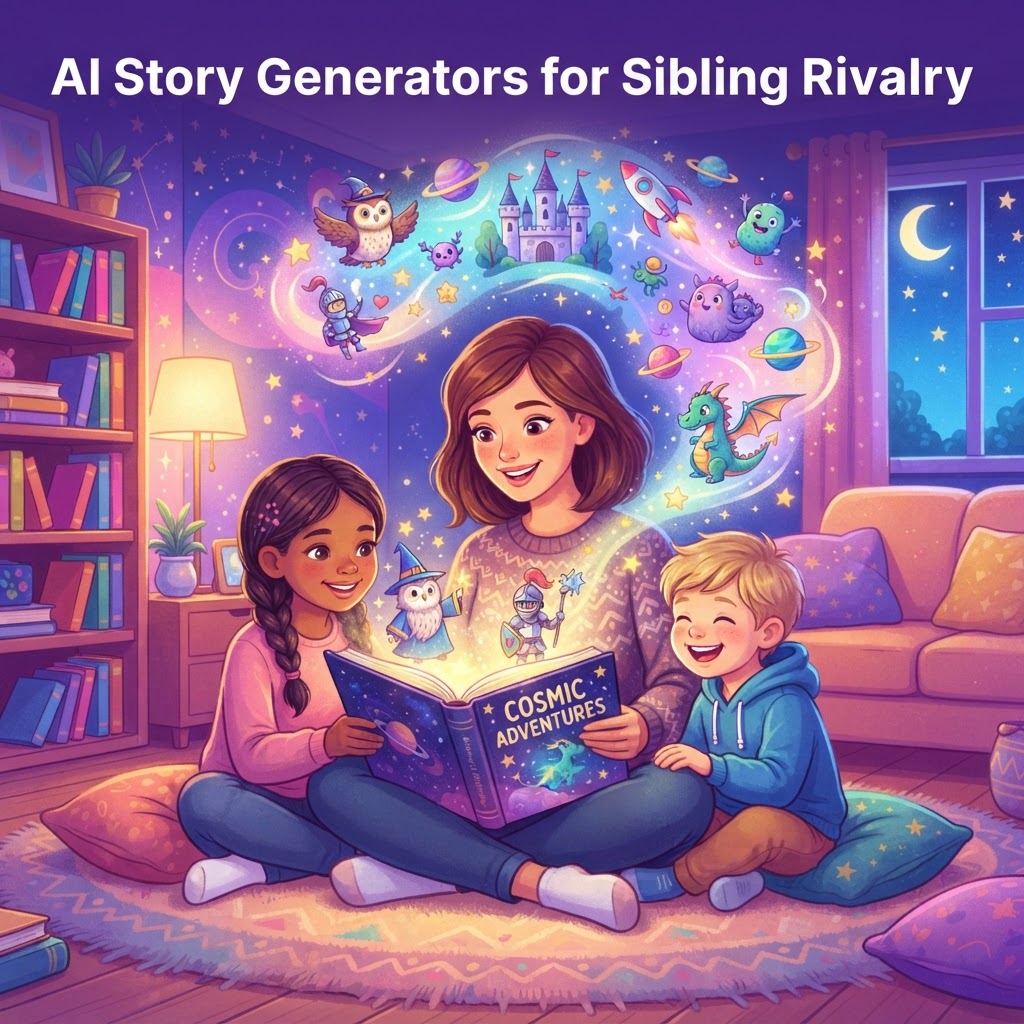
Parents looking for ai stories for sibling rivalry usually want something simple: fewer fights, more teamwork, and a calmer bedtime. The good news is that stories can help. When children hear a story about characters who argue, repair, and solve a problem together, they get a safe, repeatable model for how siblings can treat each other.
That is where personalized AI stories can be especially useful. Instead of a generic tale, you can create brothers and sisters stories that sound like your family, reflect your children’s ages and personalities, and gently teach the exact skills they need most.
Why can stories reduce sibling conflict?
Stories can reduce sibling conflict because they let children practice empathy and problem-solving at a safe distance. A child may resist a lecture, but they will often listen to a fox, astronaut, or dragon who learns to share, wait, or apologize.
Sibling rivalry is also normal. The American Academy of Pediatrics notes that conflict between siblings is common, especially when children are tired, competing for attention, or still learning self-control. What matters most is not eliminating every disagreement, but helping children build repair skills.
Research supports this approach. Developmental psychologist Judy Dunn’s work showed that sibling relationships are a major training ground for social understanding. Research by Laurie Kramer has also found that children can be taught better sibling interaction skills, including cooperation and emotional understanding. In other words, kids do not simply “grow out of” rivalry on their own. They benefit from practice.
That is why sibling stories AI tools can be helpful. A personalized story can show:
- how each child feels
- what caused the conflict
- what calm repair looks like
- how siblings can succeed together
The Child Mind Institute makes a similar point: children need coaching, not just correction. Stories are one gentle form of coaching.
What makes a sibling story actually teach cooperation?
A useful sibling story teaches cooperation by showing a shared goal, balanced roles, and a believable repair moment. If one child is always the “good one” and the other is always the “problem,” the lesson usually backfires.
The best stories for sibling harmony include a few core elements:
- A shared mission: The siblings must solve one problem together.
- Different strengths: One child may be brave, another careful, another funny, another observant.
- A small conflict: The disagreement should feel familiar, like taking turns, being left out, or wanting the same thing.
- Named feelings: Children learn more when the story puts words to emotions like jealous, frustrated, proud, or worried.
- Repair and reconnection: The ending should include an apology, a kind gesture, or a fresh try.
This matters because children learn from what they see modeled. If a story only says, “Be nice to your sister,” it is too abstract. If it shows, “Maya felt left out, Ben noticed, and they made a plan to build together,” the lesson becomes concrete.
For younger children, keep the language simple and repetitive. For older children, add more emotional nuance and a slightly more complex conflict.
How can you use the teamwork story framework?
The teamwork story framework works best when you build the story around one shared challenge and one moment of repair. In practice, that means turning rivalry into a mission the siblings can only complete together.
Here is a simple framework you can use when you create your own personalized bedtime story:
The teamwork story framework
-
Start with a shared goal.
Give the siblings one mission: find a lost toy, help a baby animal, bake a cake, finish a treasure map, or save storytime. -
Give each child a unique strength.
One child may be fast, another thoughtful, another kind, another good at noticing clues. This reduces comparison and helps each child feel valued. -
Add a realistic bump.
Include a common sibling trigger such as interrupting, grabbing, bossiness, or wanting the same role. -
Show the repair clearly.
Use one or two lines children can copy in real life: “You go first, then me,” “I did not like that,” or “Let’s try together.” -
End with shared success.
The siblings should solve the problem as a team, not because an adult suddenly fixes everything.
If you want a quicker start, pre-made story templates can make this easier. The key is not fancy plotting. It is giving children a repeatable script for cooperation.
What are five sibling story prompts that work well?
The most effective prompts are specific, warm, and centered on teamwork. Good prompts for ai stories for sibling rivalry turn everyday friction into an adventure with a clear emotional lesson.
Try these five prompts:
-
The Lost Blanket Rescue
“Write a bedtime story about two siblings who both want Mom’s attention, but then they work together to find their little brother’s missing blanket. Make each child helpful in a different way, include one disagreement, and end with a calm apology.” -
The Treasure Map with Three Helpers
“Create a story featuring all my children on a treasure hunt at home. Each child should have a special strength. Include a moment where one child feels left out, then show the others inviting them back in.” -
The Dragon Who Learned Turns
“Write a playful story about brothers and sisters taking turns riding a friendly dragon. One child gets frustrated about waiting. Model kind words, fairness, and a happy shared ending.” -
The Team Bakery Challenge
“Make a story about siblings baking a birthday cake together. One wants to lead, one wants to decorate, and one makes a mess. Show how they solve the conflict through listening and teamwork.” -
The Nighttime Space Mission
“Write a calming bedtime story where siblings are astronauts who must help each other fix their spaceship before sleep. Include gentle language, cooperation, and a peaceful ending.”
These prompts also work well if you are pairing sibling harmony with routines like sleep-training stories, since many sibling conflicts show up when children are tired.
How do you create stories featuring all your children?
To create one story that includes all your children, give each child equal emotional importance, even if their roles differ. Children notice quickly when one sibling always gets the exciting part and another is only there to “learn a lesson.”
A few practical rules help:
-
Use real strengths, not labels.
Instead of “the difficult one” and “the easy one,” try “great at noticing details,” “brave in new places,” or “good at making people laugh.” -
Rotate who starts the story.
One night the older child begins the adventure. Another night the younger child spots the key clue. -
Match the plot to age gaps.
A toddler can be the one with the important cuddle, sound, or discovery. An older child can handle the more complex task. -
Include real family details.
Favorite stuffed animals, pajamas, nicknames, or shared routines make the story feel true. -
Protect each child’s dignity.
Do not retell a humiliating real conflict word for word. Soften it, generalize it, and keep the tone hopeful.
If your family is multiracial, multilingual, blended, or culturally diverse, make sure those identities are reflected respectfully. Thoughtful representation helps every child feel seen, which is why guidance on cultural representation in AI stories matters here too.
And when you find a story that works, save it in your story library so you can reread it during future rough patches. Repetition helps the lesson stick.
When do AI stories for sibling rivalry work best?
AI-generated sibling stories work best before predictable conflict and after children are calm. They are most effective as teaching tools, not as emergency conflict management in the middle of shouting.
Good times to use them include:
- bedtime, when children are more receptive
- after a conflict has cooled down
- before transitions like school pickup or playtime
- before holidays, travel, or family gatherings
- when a new baby or new routine changes the family dynamic
You can also use stories preventively. For example, if siblings fight every morning over toys, read a short story the night before about characters sharing a special object. If one child often feels replaced, create a story about siblings discovering that being on the same team gets them more attention, not less.
For children under 10, repetition matters. The CDC’s guidance on social and emotional development reminds parents that children learn these skills over time through modeling and practice. One story will not transform sibling dynamics overnight, but a pattern of calm, consistent storytelling can make a real difference.
Frequently Asked Questions
Are AI stories for sibling rivalry a replacement for discipline?
No. Stories are a teaching tool, not a substitute for clear family rules and adult guidance. They work best alongside limits, coaching, and calm follow-through.
What age do sibling stories AI tools work best for?
They can work well from toddlerhood through about age 10, with the format adjusted for age. Younger children need simpler plots and repetition, while older children benefit from more realistic feelings and dialogue.
Should the story copy a real fight exactly?
Usually not. It is better to soften the situation and keep the child from feeling exposed or blamed. Use the emotional theme of the conflict, not a word-for-word replay.
How often should we read brothers and sisters stories?
Two to four times a week is enough for many families, especially during a rough season. Re-reading the same story can be more effective than constantly making new ones because children learn through repetition.
What if one child refuses to listen to a sibling story?
That is common, especially if the child feels singled out. Try making the story more playful, less direct, and more balanced so every child sees themselves as capable and valued.
When should parents get more support for sibling conflict?
If sibling conflict includes frequent aggression, intense fear, or one child consistently dominating the other, extra support may help. Talk with your pediatrician, a child therapist, or your school team if the pattern feels beyond everyday rivalry.
Get a new bedtime story every week
Free, personalized, and delivered to your inbox. No spam, ever.
Ready to Create a Personalized Bedtime Story?
Use our free AI bedtime story generator to create a personalized illustrated story for your child in 30 seconds — no credit card needed.
Popular story types:
Maya Rodriguez
Lead Content Editor & Early Literacy Specialist
Maya is a former early childhood educator and literacy specialist with over a decade of experience helping children develop a love of reading. She leads content at InstaTales, where she writes about the science of storytelling, child development, and how families can use personalized AI stories to build literacy and emotional resilience.
instatales.ai