Best Bedtime Stories for 2-Year-Olds (With Examples)
Looking for the best bedtime stories for your 2-year-old? Here's what works at this age — themes, length, and 10 example story ideas you can generate tonight.
✦ Key Takeaways
- •The best toddler bedtime stories are short, simple, and sensory-rich.
- •Repetition is one of the most powerful tools in toddler storytelling — and it's backed by developmental science.
- •Familiar, gentle themes are consistently the most effective for this age group.
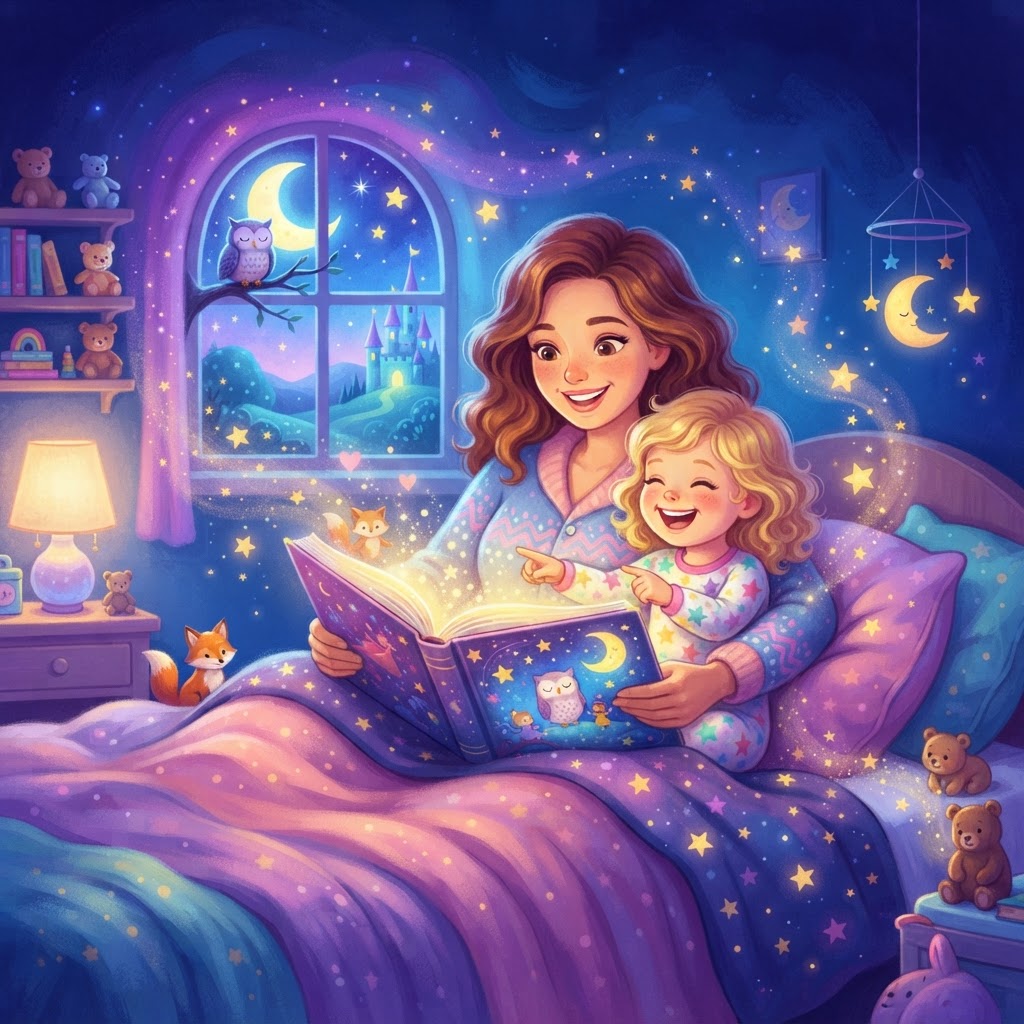
If you've ever tried to settle a wired two-year-old at bedtime, you know the challenge. Too much stimulation and they're bouncing off the walls. Too little engagement and they're calling for water, a hug, or anything to delay sleep. The right bedtime story hits a sweet spot — calm but interesting, simple but satisfying. This guide covers exactly what makes bedtime stories for 2-year-olds work, which themes land best at this age, what to avoid, and 10 story ideas you can use tonight.
What Makes a Bedtime Story Great for a 2-Year-Old?
The best toddler bedtime stories are short, simple, and sensory-rich. At this age, children have an average attention span of roughly 2–5 minutes, so a story that runs 2–3 minutes at read-aloud pace is the sweet spot — typically 150–250 words.
Two-year-olds are also still building language rapidly. According to the American Academy of Pediatrics, most children this age know 50 or more words and are beginning to string two-word phrases together. Stories that use simple vocabulary, short sentences, and vivid sensory words — soft, warm, fluffy, shhh — match where their brains are developmentally.
Key qualities to look for:
- Short sentences (5–8 words each)
- Repetition — the same phrase or sound appearing 2–3 times
- A clear, single-thread plot (one thing happens, then another)
- A calm, sleepy ending that signals bedtime is near
- Familiar characters like animals, babies, or versions of the child themselves
Why Is Repetition So Important in Stories for Toddlers?
Repetition is one of the most powerful tools in toddler storytelling — and it's backed by developmental science. Research from the University of Edinburgh on early language acquisition shows that repeated exposure to words and phrases deepens vocabulary retention and gives children a sense of mastery and predictability.
When a 2-year-old hears "and then the little bear said goodnight" for the third time in a story, they anticipate it. They might even say it with you. That participation builds confidence, language skills, and a calming ritual all at once.
Good repetition in toddler stories looks like:
- A recurring phrase ("And so the bunny hopped on...")
- Sound effects that repeat (drip, drip, drip or shhhh)
- A character who does the same action in each scene
Which Story Themes Work Best for 2-Year-Olds?
Familiar, gentle themes are consistently the most effective for this age group. Two-year-olds find comfort in the recognisable — things they've touched, seen, and felt during their own day.
The best themes for stories for toddlers at age two include:
- Animals doing human things — a bear going to bed, a duck having a bath
- Bedtime routines — brushing teeth, putting on pyjamas, saying goodnight to toys
- Gentle nature scenes — rain falling, stars appearing, the moon rising
- Simple adventures — a short walk in the park, finding a butterfly
- Emotions and comfort — feeling sleepy, being hugged, feeling safe and loved
These themes work because they reflect the toddler's own world. A story about a puppy who can't find his blanket is immediately relatable. A story about a dragon battling a wizard is not — and can actually disrupt the calming effect you're aiming for at bedtime.
What Should Parents Avoid in Bedtime Stories for Two-Year-Olds?
Avoid anything that introduces fear, overstimulation, or unresolved tension. The goal at bedtime is nervous system regulation, and the wrong kind of story can do the opposite.
Specific things to steer clear of:
- Scary characters or monsters, even in a "friendly" framing — 2-year-olds don't yet have the cognitive tools to fully distinguish pretend from real
- Complex plots with multiple characters — these require working memory that isn't fully developed yet
- Cliffhangers or unresolved endings — they create anxiety rather than calm
- Loud, action-heavy language — words like crash, bang, and run fast activate rather than settle
- Stories that are too long — anything over 5 minutes risks losing their attention or overstimulating them
According to Zero to Three, toddlers regulate emotions partly through predictable routines. A bedtime story should feel like part of that routine — consistent, safe, and warm.
What Are 10 Story Idea Starters for Toddler Bedtime Stories?
Here are 10 specific bedtime stories for 2-year-olds you can use as prompts tonight — whether you're telling them yourself or using an AI story generator like InstaTales:
- The Sleepy Bunny — A little bunny who can't stop yawning goes through her bedtime routine before finally curling up in her burrow.
- The Moon's Goodnight — The moon says goodnight to each animal in the meadow, one by one, until everyone is asleep.
- Bear's Lost Blanket — A small bear looks for his favourite cosy blanket and finds it just in time for bed.
- Rain on the Roof — A child listens to raindrops falling while getting cosy under the covers.
- The Little Duck's Bath — A baby duck splashes, gets dry, and waddles off to sleep in her nest.
- Stars Coming Out — The stars appear one by one in the sky while a child counts them from her window.
- Puppy Says Goodnight — A puppy says goodnight to each member of the family before curling up in his basket.
- The Sleepy Garden — Flowers close their petals and butterflies find leaves to rest on as the sun goes down.
- Teddy Bear's Bedtime — A child tucks in her teddy bear and realises she's getting sleepy too.
- The Owl Who Loved the Night — A gentle owl glides quietly through the night sky as everyone below drifts off to sleep.
Each of these works well with simple, repetitive language and a calming, sleep-cued ending.
How Can InstaTales Help with Personalised Toddler Stories?
InstaTales generates custom bedtime stories tailored to your child's age, interests, and bedtime needs — and for 2-year-olds, it's especially useful. When you select the toddler age group and choose the Lullaby story type, InstaTales automatically adjusts the language complexity, sentence length, and pacing to suit where your child is developmentally.
You can add your child's name, their favourite animal, or a beloved toy — and the story becomes instantly more engaging and personal. For a two-year-old who loves ducks, "the sleepy duck" becomes their duck, which makes the winding-down process smoother.
Parents who use personalised stories consistently report that the ritual itself — the same app, the same cosy routine — becomes part of the sleep signal for their toddler.
A Sample Mini-Story for a 2-Year-Old
Here's a short example of what a well-crafted bedtime story for two-year-olds looks and feels like:
Little Pip the puppy was sleepy. His eyes went blink... blink... blink. He said goodnight to his bowl. "Goodnight, bowl." He said goodnight to his ball. "Goodnight, ball." He said goodnight to the moon outside the window. "Goodnight, moon." Then Pip curled up in his soft, warm basket. He closed his eyes. And the whole house went quiet. Goodnight, Pip.
Notice the repetition ("Goodnight, ___"), the simple vocabulary, the sensory word (soft, warm), and the slow, deliberate ending. This is the structure that works.
Frequently Asked Questions
How long should a bedtime story be for a 2-year-old?
A bedtime story for a 2-year-old should last around 2–3 minutes at a calm read-aloud pace, which typically means 150–250 words. Shorter is almost always better at this age — toddlers have limited attention spans and too much stimulation before sleep can delay settling.
What are the best topics for toddler bedtime stories?
The best topics are ones your child already knows — animals, daily routines, nature, and simple emotions like feeling sleepy or loved. Familiarity creates comfort, which is exactly what you want at bedtime. Avoid fantasy or adventure themes that could overstimulate.
Is it OK to use AI-generated stories for toddlers?
Yes, when used thoughtfully. AI story tools like InstaTales let parents customise stories to their child's age and interests, which increases engagement. The key is to review the story before reading and maintain the cosy, shared ritual of reading together — the technology should support that connection, not replace it.
How does repetition in stories help toddler development?
Repetition helps toddlers predict what comes next, which builds language skills and emotional regulation. It also gives children a chance to participate — saying the repeated phrase along with you — which boosts confidence and vocabulary acquisition in the 18-month to 3-year window.
Should 2-year-olds have the same story every night?
Many toddlers actively prefer the same story repeated for days or weeks — and this is developmentally healthy. Repetition provides comfort and predictability. If you'd like some variety without losing that sense of familiarity, personalised AI stories with a consistent character or format can offer the best of both worlds.
What's the difference between a lullaby story and a regular bedtime story?
A lullaby story is specifically paced and structured to calm a child toward sleep — using slower language, softer imagery, and a wind-down arc that ends with the character sleeping. A regular bedtime story might have a more active plot. For 2-year-olds especially, lullaby-style stories are almost always the better choice at lights-out time.
The right story at the right time can transform bedtime from a battle into one of the best parts of the day. If you'd like to try a personalised story for your toddler tonight, InstaTales generates age-appropriate bedtime stories in seconds — just add your child's name and their favourite animal, and you're ready to begin.
Get a new bedtime story every week
Free, personalized, and delivered to your inbox. No spam, ever.
Ready to Create a Personalized Bedtime Story?
Use our free AI bedtime story generator to create a personalized illustrated story for your child in 30 seconds — no credit card needed.
Popular story types:
Maya Rodriguez
Lead Content Editor & Early Literacy Specialist
Maya is a former early childhood educator and literacy specialist with over a decade of experience helping children develop a love of reading. She leads content at InstaTales, where she writes about the science of storytelling, child development, and how families can use personalized AI stories to build literacy and emotional resilience.
instatales.ai