Best curious bedtime stories for 10-year-olds
Discover the best curious bedtime stories for 10-year-olds — themes, tips, and story ideas that will delight your child at bedtime.
✦ Key Takeaways
- •Curious stories for 10 year olds work well because children this age are ready for deeper ideas, richer plots, and meaningful questions.
- •They feel satisfying because they match a 10-year-old’s natural drive to explore while still giving emotional closure before sleep.
- •For most 10-year-olds, the ideal bedtime story length is about 10 to 20 minutes.
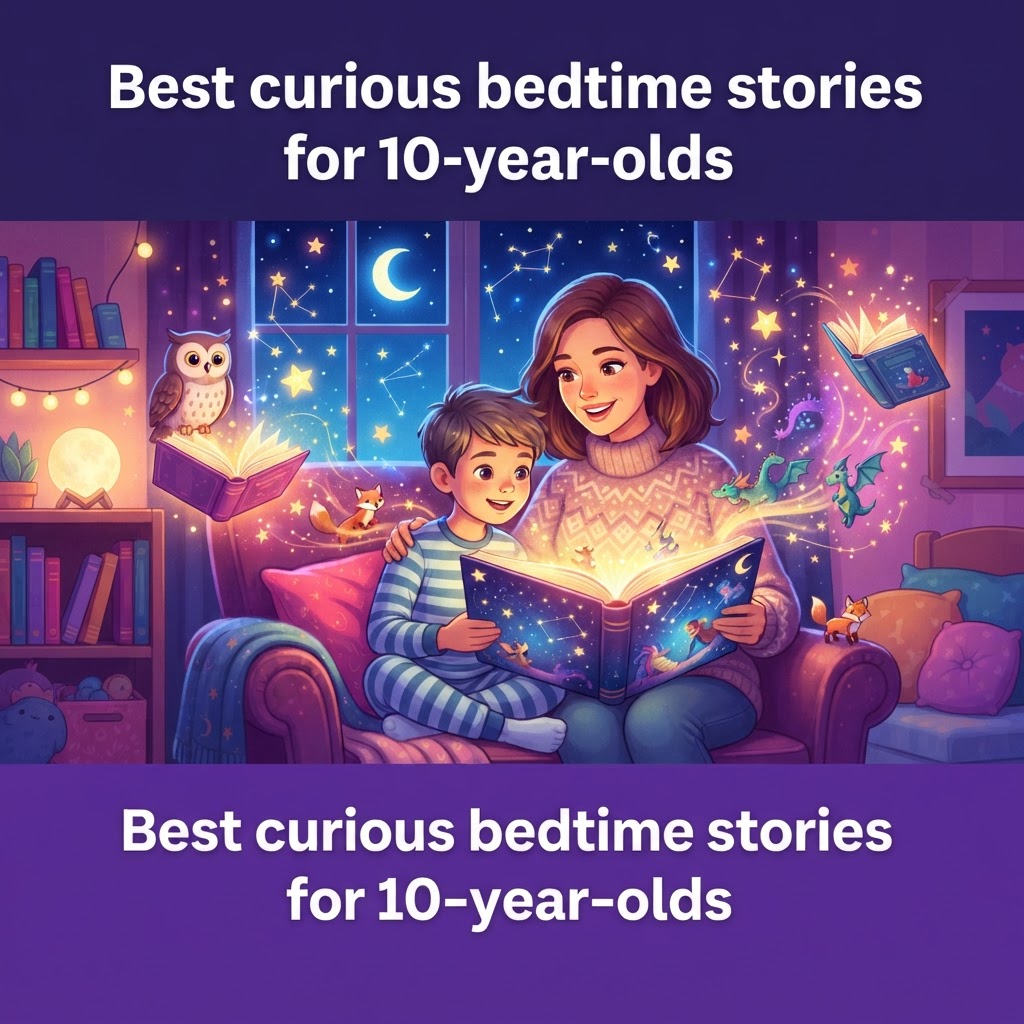
If your child asks “Why?” right up until lights-out, you are in a wonderful stage of parenting. At age 10, many children are hungry for answers, patterns, mysteries, and “what if” ideas, which is why curious bedtime stories can be such a strong fit. The best bedtime stories for 10 year olds do more than soothe; they spark thinking, invite questions, and end the day with warmth, wonder, and a sense of discovery.
What makes curious bedtime stories a great fit for 10-year-olds?
Curious stories for 10 year olds work well because children this age are ready for deeper ideas, richer plots, and meaningful questions. They still love imagination, but they also want logic, clues, and stories that respect how much they already know.
Around age 10, children are in the heart of middle childhood. According to the CDC’s guidance on middle childhood, kids at this age are building independence, social awareness, and stronger problem-solving skills. Many can follow layered plots, track motives, and enjoy stories where the main character investigates, experiments, or wonders about the world.
This is also an age when executive function is growing. The Harvard Center on the Developing Child explains that skills like attention, planning, memory, and flexible thinking develop over time. In story terms, that means 10-year-olds can enjoy:
- mysteries with clues
- “how does this work?” questions
- cause-and-effect storytelling
- characters who test ideas
- endings that solve a puzzle without feeling too heavy
In practice, I often see 10-year-olds respond best when a story treats curiosity as a strength, not as a problem. They like characters who notice odd details, ask brave questions, and learn something new by the end.
Why do curious stories for 10 year olds feel so satisfying at bedtime?
They feel satisfying because they match a 10-year-old’s natural drive to explore while still giving emotional closure before sleep. A curious story says, “Your questions matter,” which is deeply reassuring for this age.
Many parents assume bedtime stories must be very simple or very sleepy. In reality, older children often settle better with stories that gently engage their minds. A small mystery, a surprising fact, or a thoughtful question can help shift a child away from the noise of the day and into focused listening.
The key is balance. Good kids curious stories offer wonder without overstimulation. They may include a puzzle, discovery, or unusual setting, but they should still feel emotionally safe and end on a calm note.
Curious stories also support language and learning in a natural way. When a child hears new vocabulary in context, makes predictions, or connects story events to real life, they are doing meaningful literacy work without feeling pressured. If your child also enjoys learning-based narratives, you may like these educational bedtime stories.
How long should bedtime stories for 10 year olds be?
For most 10-year-olds, the ideal bedtime story length is about 10 to 20 minutes. That is usually long enough for a satisfying plot, but short enough to support a calm bedtime routine.
In word count, that often means:
- 1,000 to 2,000 words for a full bedtime read
- 600 to 900 words for a quick weeknight story
- a chapter format if your child enjoys longer story arcs
The right length depends on your child’s energy level, reading stamina, and bedtime schedule. Some 10-year-olds want one complete story every night. Others enjoy a serial story with a new clue or discovery in each chapter.
The American Academy of Pediatrics emphasizes the value of consistent bedtime routines, and story length plays a big role in that consistency. If stories drag on too long, bedtime can feel tense. If they end too quickly, older children may feel unsatisfied.
A helpful rule: end with resolution, comfort, and one final image of safety. Even a curiosity-driven plot should close the day gently.
Which themes work best in curious bedtime stories?
The best themes combine wonder, problem-solving, and emotional safety. Ten-year-olds love stories that let them explore big ideas while staying grounded in a child-friendly world.
Strong themes for curious bedtime stories include:
- Mild mysteries: a missing map, a strange sound, a coded message
- Nature and science wonder: stars, insects, weather, oceans, inventions
- Hidden histories: an old attic object, a family recipe, a town tradition
- Perspective-taking: seeing the world through someone else’s eyes
- Fantasy with rules: magical worlds that still make sense
- Kindness and ethics: curiosity that leads to empathy, not just answers
For some children, curiosity blooms most in imaginative settings. If that sounds like your child, these fantasy adventures can pair beautifully with a question-driven bedtime routine. Others enjoy stories where discovery leads to reflection, much like these moral bedtime stories.
A useful test for parents is simple: does the theme invite your child to wonder, predict, or connect, without making bedtime feel like homework? If yes, it is likely a good fit.
What should parents avoid in kids curious stories before sleep?
Avoid stories that are too intense, too confusing, or too unresolved for the hour before bed. Curiosity is helpful at bedtime; overstimulation is not.
At age 10, many children can handle more complexity than younger kids, but bedtime is still a sensitive transition. Try to avoid:
- frightening suspense that is never resolved
- graphic danger, loss, or disaster
- sarcasm-heavy humor that turns mean
- stories packed with too many side plots
- endings that raise anxiety instead of settling it
- trivia dumps that feel more like lessons than stories
Another common issue is pace. A story can be intellectually rich and still feel calm. If every paragraph introduces a new twist, your child may become more alert instead of more relaxed.
I also recommend avoiding stories that shame curiosity. When a character is mocked for asking questions, children may absorb the message that wondering is annoying or unsafe. Better stories show curiosity paired with respect, patience, and care for others. Parents looking for gentler emotional tones may also enjoy themes centered on kindness and courage in related bedtime reading.
What are five curious bedtime story ideas for 10-year-olds?
The best story ideas give a child something to discover and a comforting reason to keep listening. These five prompts are designed to feel intriguing without becoming too intense.
1. The library book that changes its final page
A 10-year-old checks out a book that ends differently each night. To solve the mystery, they must notice a pattern hidden in the librarian’s questions.
2. The rooftop garden where plants whisper facts
Each plant shares one small truth about the natural world, but one of the facts seems impossible. The child has to figure out whether the plant is wrong, joking, or protecting a secret.
3. The clockmaker’s daughter and the missing minute
In a quiet town, one minute disappears from every day. A curious child investigates tiny clues and learns how people spend time, waste time, and cherish time.
4. The museum sleepover with one unlocked exhibit
During a class sleepover, one exhibit opens after dark. Inside is a trail of objects that reveals a forgotten story from the town’s past.
5. The map drawn by moonlight
A child notices that a plain notebook page turns into a map only under moonlight. The map leads not to treasure, but to five questions that help the child understand their neighborhood in a new way.
If your child likes personalized stories, InstaTales can help you create your own personalized bedtime story using their name, favorite interests, and the exact kind of mystery or wonder they enjoy. You can also save favorite stories in your story library so a child can revisit beloved discoveries again and again.
How can parents use InstaTales to create better curious bedtime stories?
Parents can use InstaTales to match story content to a child’s age, interests, and bedtime needs. That matters because 10-year-olds are not all curious about the same things.
One child may want astronomy, maps, and codes. Another may love animals, inventions, or forgotten family stories. Personalized storytelling lets you shape a story around what already lights your child up.
A strong prompt for a curious bedtime story might include:
- your child’s age
- one favorite interest
- a calm but intriguing setting
- a gentle mystery or question
- a cozy ending
For example: “Write a bedtime story for a 10-year-old who loves space, libraries, and puzzles. Make it curious, warm, and not scary.” That kind of direction helps produce a story that feels thoughtful and bedtime-ready.
Personalized tools are especially helpful for families building a consistent reading habit. You can rotate themes, revisit favorite characters, and keep stories fresh without losing the comfort of routine.
Frequently Asked Questions
What are the best curious stories for 10 year olds?
The best curious stories for 10 year olds include a question, puzzle, or discovery that unfolds in a safe and satisfying way. Themes like mysteries, science wonder, maps, hidden histories, and gentle fantasy tend to work especially well.
Are bedtime stories for 10 year olds still important?
Yes, absolutely. Ten-year-olds still benefit from shared reading because it supports connection, vocabulary growth, listening skills, and a calm bedtime routine.
What makes a story a curious bedtime story?
A curious bedtime story centers on wondering, noticing, asking questions, or solving a small mystery. It invites thinking, but it still ends with comfort and emotional closure.
Can curious stories help reluctant readers?
Yes. Many reluctant readers engage more easily when a story gives them a problem to solve or a clue to follow, because curiosity naturally pulls attention forward.
Should curious bedtime stories be educational?
They can be, but they should feel like stories first. The strongest kids curious stories teach through plot, character, and discovery rather than sounding like a lesson.
Ready to Create a Personalized Bedtime Story?
Use our free AI bedtime story generator to create a personalized illustrated story for your child in 30 seconds — no credit card needed.
Popular story types:
Maya Rodriguez
Lead Content Editor & Early Literacy Specialist
Maya is a former early childhood educator and literacy specialist with over a decade of experience helping children develop a love of reading. She leads content at InstaTales, where she writes about the science of storytelling, child development, and how families can use personalized AI stories to build literacy and emotional resilience.
instatales.ai