Can AI Write Good Children's Stories? What Parents Should Know
Can AI really write stories kids love? We break down the quality, safety, and educational value of AI-generated children's stories — with real examples.
✦ Key Takeaways
- •A good children's story isn't just words on a page.
- •Today's AI story generators are built on large language models (LLMs) — the same technology behind tools like ChatGPT.
- •This is where the honest answer gets interesting.
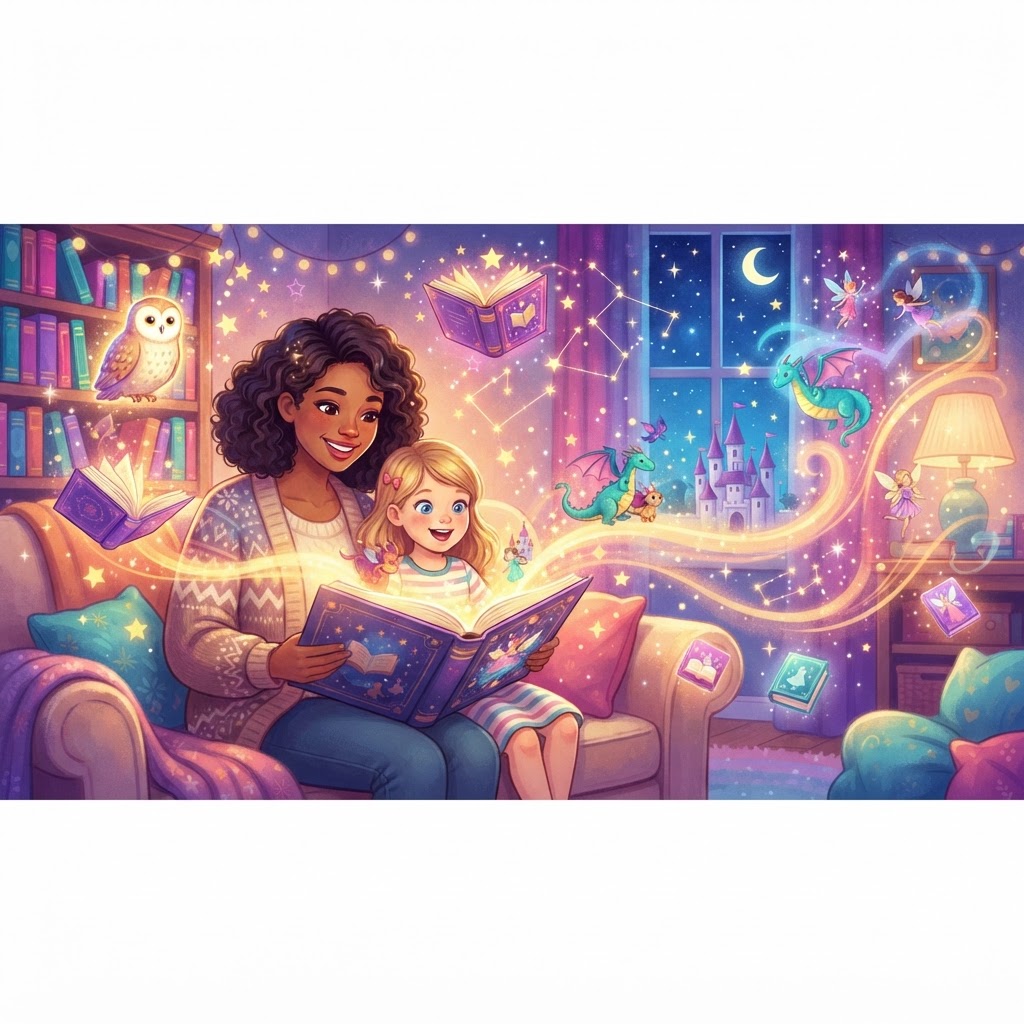
If you've ever watched your child beg for "just one more story" at bedtime, you know how powerful a good story can be. Now imagine having an endless supply of personalised tales, ready in seconds. That's the promise of AI-generated children's stories — and it's one that understandably raises questions. Can an algorithm really craft something your five-year-old will love? Is it safe? Is it good? These are fair questions, and they deserve honest answers — not marketing fluff.
What Actually Makes a Children's Story "Good"?
A good children's story isn't just words on a page. Child development researchers identify several key qualities: age-appropriate vocabulary, a clear narrative arc, emotionally resonant characters, and often a gentle moral or takeaway. According to the American Academy of Pediatrics, shared storytelling builds language skills, empathy, and emotional regulation in children from infancy onward.
For toddlers, that means simple sentences, repetition, and concrete imagery. For a seven-year-old, it means a bit of tension, a character who faces a real problem, and a satisfying resolution. The "goodness" of a story is surprisingly technical — and it's exactly the kind of structured output that modern AI handles better than most people expect.
How Do Modern AI Systems Actually Write Stories?
Today's AI story generators are built on large language models (LLMs) — the same technology behind tools like ChatGPT. These models are trained on vast libraries of text, including children's literature, and learn the patterns that make stories work: sentence rhythm, dialogue flow, cause-and-effect plotting, and vocabulary level.
When you ask an AI to write a story for a four-year-old about a nervous puppy starting school, it doesn't randomly generate words. It draws on internalized patterns from thousands of similar stories to produce something that feels right for that age and theme. The result isn't a copy of any existing story — it's an original synthesis shaped by your specific prompt.
Platforms like InstaTales go further by layering personalization on top: the child's name, age, interests, and even fears can be woven into the narrative, making the story feel genuinely made for them.
Where Does AI Storytelling Genuinely Shine?
This is where the honest answer gets interesting. AI excels in several areas that matter for children's stories:
- Consistency of tone: AI doesn't get tired, distracted, or accidentally introduce vocabulary a three-year-old can't follow.
- Personalization at scale: A human author can't write a new story every night starring your child and their pet hamster. AI can.
- Structural reliability: LLMs are very good at beginning-middle-end story structure, which is foundational for narrative comprehension in young children.
- Thematic flexibility: From dragons to dinosaurs to dealing with a new sibling, AI can match content to whatever a child needs emotionally that night.
Research from the National Literacy Trust consistently shows that children who are read to regularly — regardless of the source of those stories — develop stronger reading skills and a more positive relationship with books. The consistency AI enables can genuinely support that.
Where Does AI Fall Short — and How Is That Being Fixed?
Honest answer: AI isn't perfect. Early AI-generated stories could feel flat — characters without real personality, plots that resolved too neatly, or language that slightly missed the developmental mark. Here's a quick before/after that illustrates the difference:
Before (basic prompt, unrefined output):
"Lily went to school. She was scared. Her teacher was nice. She felt better. The end."
After (age-calibrated, personalized prompt with good parameters):
"Lily clutched her lunchbox so tightly her knuckles went white. The school doors looked enormous — like the mouth of a friendly giant, she thought. But then she saw it: a small yellow butterfly perched on the doorstep, as if waiting just for her. 'Maybe,' Lily whispered, 'brave things are small too.'"
The second version uses sensory detail, a child-appropriate metaphor, and an emotionally resonant takeaway. That quality jump comes from better prompting and better systems.
Modern platforms address the remaining gaps through human editorial oversight, curated prompt engineering, and continuous model refinement. No responsible AI story platform ships raw model output without some layer of quality filtering.
Are AI-Generated Stories Safe for Children?
Safety is non-negotiable, and it's right to ask. Responsible AI story platforms operate with multiple layers of content moderation:
- Input filtering: Prompts are screened to prevent inappropriate themes from entering the generation pipeline.
- Output moderation: Generated stories are checked against content guidelines before being delivered.
- Age-gating parameters: The model is instructed to operate within specific developmental and content constraints based on the child's age.
InstaTales, for example, builds safety constraints directly into its generation system — content is always age-appropriate, violence-free, and reviewed against child-safety standards. Parents also retain full control: they see what's generated before it becomes a bedtime story.
It's also worth noting that the Internet Watch Foundation and similar organizations have pushed the AI industry toward clearer child safety standards in generated content, a push that responsible platforms are actively responding to.
Does Personalization Actually Help Children Engage More?
Yes — and there's solid developmental reasoning behind this. Children are egocentric learners, particularly under age seven. When they hear their own name in a story, or recognize their favourite toy as a story prop, their narrative engagement spikes. They're not just passive listeners; they become participants.
Personalized stories also offer a unique therapeutic value. A child anxious about a doctor's visit can hear a story where they are the brave character who gets through it. A child grieving a pet can process that loss through a gentle narrative built around their experience. This isn't just anecdote — it aligns with established principles of bibliotherapy, the use of literature to support emotional development and healing.
How Can Parents Use AI Stories Responsibly?
AI stories work best as a complement to — not a replacement for — human connection at bedtime. Here's a practical framework:
- Read together: Even with AI-generated content, the bonding ritual of a parent reading aloud matters. Don't outsource the voice.
- Preview first: Take a moment to read the story before bedtime. Most platforms let you do this easily.
- Use it to start conversations: A good AI story about sharing or fear can be a springboard for real talk with your child.
- Vary the diet: Mix AI-generated stories with classic picture books, library trips, and made-up stories of your own.
InstaTales is designed with exactly this philosophy — it's a tool that supports the bedtime ritual, not one that replaces the parent in it.
Frequently Asked Questions
Can AI really write stories that are appropriate for very young children?
Yes, when properly calibrated. Modern LLMs can adjust vocabulary complexity, sentence length, and concept difficulty based on a child's age. Platforms designed specifically for children — rather than general-purpose AI tools — include additional guardrails to ensure developmental appropriateness.
Are AI-generated stories original, or do they copy existing books?
AI-generated stories are original outputs, not reproductions of existing texts. They're created by synthesizing learned patterns, not by retrieving or copying stored content. Each story is unique to the prompt that generates it.
How do I know an AI story platform is safe for my child?
Look for platforms that are transparent about their content moderation process, offer parental preview of stories, and explicitly state their child-safety policies. Responsible platforms will have clear terms around age-appropriate content and data privacy.
Can AI stories replace bedtime reading with a parent?
They shouldn't, and the best platforms aren't designed to. The relational value of a parent reading aloud — voice, touch, shared attention — is irreplaceable. AI stories are best used as a supplement that keeps the story ritual going even on tired nights.
Do children actually enjoy AI-generated stories?
Many do, particularly when the stories are personalised. Children are generally less concerned with who wrote the story than with whether it's engaging, funny, or emotionally satisfying. A well-crafted AI story starring their own name and favourite character can be a genuine hit.
Is there research supporting the use of AI in children's education?
Early research is promising, though the field is young. What's well-established is that storytelling frequency and personalisation both improve literacy outcomes — and AI can increase both. Educational technologists are actively studying AI's role in reading development, with initial findings pointing toward meaningful benefits when AI tools are used thoughtfully alongside human educators and caregivers.
The honest answer to "can AI write good children's stories?" is: yes, with caveats, and those caveats are shrinking. The technology has moved well past the point of producing robotic, generic output — and purpose-built platforms are raising the bar further every month. If you're curious what a personalised bedtime story for your child actually looks and sounds like, InstaTales lets you try one tonight — no commitment, just a story made for your child, ready when you need it.
Ready to Create a Personalized Bedtime Story?
Use our free AI bedtime story generator to create a personalized illustrated story for your child in 30 seconds — no credit card needed.
Popular story types:
Maya Rodriguez
Lead Content Editor & Early Literacy Specialist
Maya is a former early childhood educator and literacy specialist with over a decade of experience helping children develop a love of reading. She leads content at InstaTales, where she writes about the science of storytelling, child development, and how families can use personalized AI stories to build literacy and emotional resilience.
instatales.ai