Cats stories for kids: tales and fun facts
Delightful cats stories for kids — plus real fun facts woven into each tale. Perfect for young animal lovers who love a good story.
✦ Key Takeaways
- •Cats stories for kids work well at bedtime because they feel both gentle and interesting.
- •The best stories about cats mix a simple plot with one or two true facts children can remember.
- •You can turn any of these ideas into unique, age-appropriate cat tales in just a few steps.
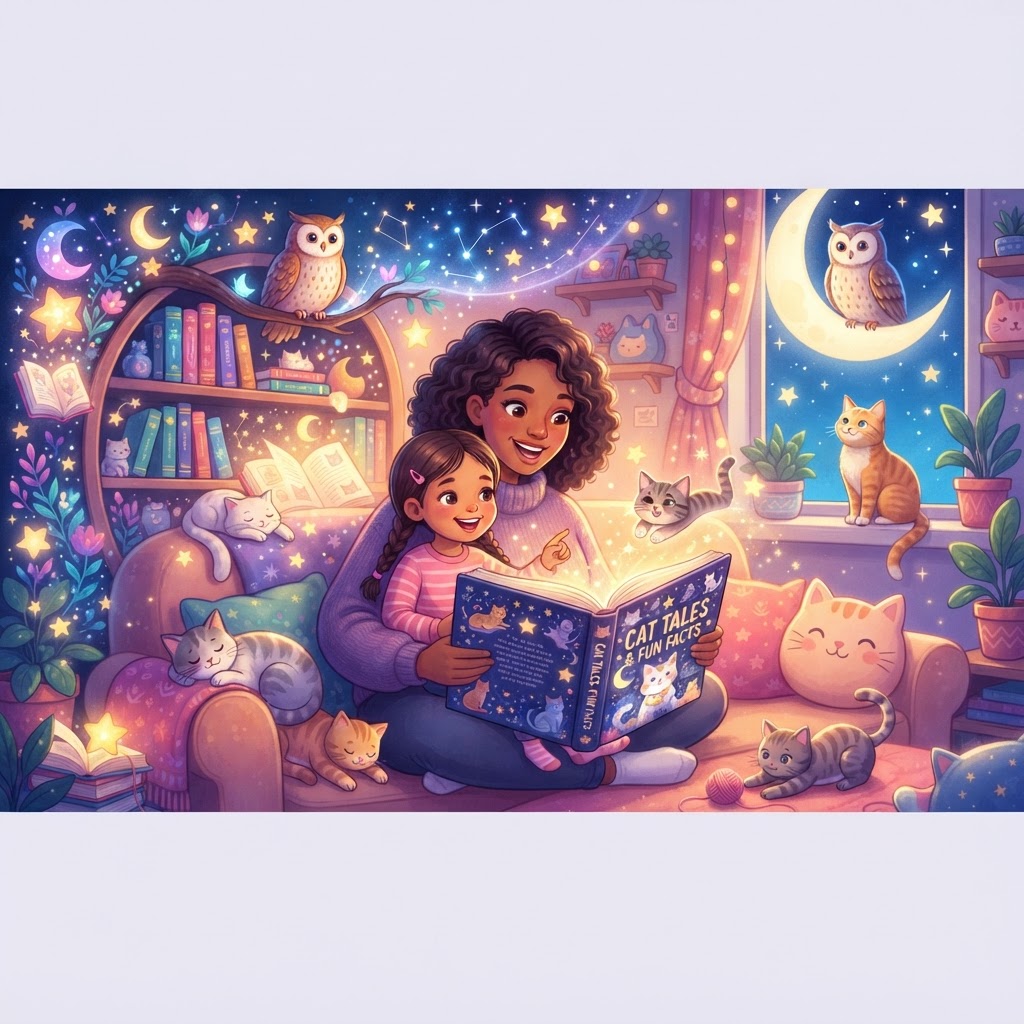
If your child asks for cats stories for kids, you have a wonderful chance to blend comfort, imagination, and real learning. Cats are familiar enough to feel cozy at bedtime, yet mysterious enough to spark curiosity — which makes cats bedtime stories, cats tales children enjoy, and other stories about cats especially engaging for ages 1-10.
Why are cats stories for kids such a strong bedtime choice?
Cats stories for kids work well at bedtime because they feel both gentle and interesting. Children recognize cat behaviors like purring, stretching, hiding, and curling up to sleep, so they can follow the story easily while still learning something new.
Shared reading also has real developmental value. The American Academy of Pediatrics recommends reading aloud from infancy because it supports language development, attention, and parent-child bonding. Research on dialogic reading by Grover Whitehurst and colleagues also shows that asking simple questions during stories can strengthen vocabulary and comprehension.
Animal-themed tales are especially useful because they invite conversation. After a story, you can ask, “Why did the cat hide there?” or “What real fact did we learn?” If your child loves animal adventures in general, these dog story ideas and more educational story ideas can extend the fun.
What are some delightful cats stories for kids that also teach real animal facts?
The best stories about cats mix a simple plot with one or two true facts children can remember. Below are six story concepts you can tell, adapt, or turn into personalized cat adventures.
Moonlight Whiskers and the Garden Gate
- Story concept: A shy kitten wants to explore a moonlit garden, but only when she learns to trust her whiskers can she squeeze safely through the gate and find a sleeping butterfly.
- Real cat facts to weave in: Cats use their whiskers to sense nearby spaces and changes in air movement. Their whiskers help them judge whether they can fit through a gap, according to the Cornell Feline Health Center.
- AI prompt: “Write a calm bedtime story for a 4-year-old about a kitten named Moonlight who uses her whiskers to explore a garden at night and learns bravery.”
Pepper and the Purr Puzzle
- Story concept: Pepper thinks purring is a secret song. She travels around the house asking other animals what it means and discovers that purrs can show comfort, connection, and calm.
- Real cat facts to weave in: Cats often purr when they feel content, but they may also purr when they want comfort. Kittens begin purring very early in life, which helps them connect with their mother.
- AI prompt: “Create a sweet 5-minute story about Pepper the cat discovering why cats purr, with a warm bedtime ending and simple language for ages 3-6.”
Milo and the Sunrise Treasure
- Story concept: Milo wakes before everyone else to follow a trail of sparkling dew drops to a hidden treasure: a nest of baby robins he quietly protects until the gardener arrives.
- Real cat facts to weave in: Cats are often most active at dawn and dusk, not the middle of the day. They also sleep for many hours, which surprises children who see their pet napping so often, as noted by International Cat Care.
- AI prompt: “Write an adventure story about a cat named Milo who loves early mornings, includes the fact that cats are active at dawn, and ends peacefully.”
Saffron the Library Listener
- Story concept: In a tiny library, Saffron the orange cat helps children find lost books by listening for the softest rustle behind shelves and cushions.
- Real cat facts to weave in: Cats have excellent hearing and can detect very soft, high sounds. Their ears move independently, which helps them locate where a sound is coming from.
- AI prompt: “Generate a gentle story about Saffron, a library cat with amazing hearing, helping children find a missing storybook.”
Captain Pebble and the Rooftop Rescue
- Story concept: Captain Pebble imagines he is a sky sailor. When a toy bird gets stuck on a low roof, he uses careful balance, patience, and a smart jump to bring it back.
- Real cat facts to weave in: Cats are known for balance and a “righting reflex,” which helps them turn their bodies during a fall. That said, real cats should always be kept safe around windows and high ledges.
- AI prompt: “Tell a playful but safe story about Captain Pebble, a brave cat who rescues a toy from a roof and learns the importance of being careful.”
Nori and the Secret Scent Trail
- Story concept: Nori thinks a new blanket in the house feels strange, so she rubs her cheeks on it and follows a scent trail that leads her to a surprise nap party with the family.
- Real cat facts to weave in: Cats have scent glands on areas like their cheeks and use them to mark places as familiar. Smell is a big part of how cats understand their environment.
- AI prompt: “Write a cozy bedtime story about Nori the cat making a new blanket feel safe by using scent, for a child age 5.”
How can you turn these cats bedtime stories into personalized InstaTales adventures?
You can turn any of these ideas into unique, age-appropriate cat tales in just a few steps. Personalization matters because children engage more deeply when the story includes their name, favorite animal, or familiar routines.
Here is a simple method to create your own personalized bedtime story:
- Pick one cat concept, like Moonlight the explorer or Saffron the library cat.
- Add your child’s name, age, and favorite setting, such as a garden, school, spaceship, or grandma’s house.
- Include one true cat fact you want the story to teach.
- Choose the tone: sleepy, funny, adventurous, or reassuring.
- Use story templates if you want a quick starting point.
A strong prompt might look like this:
“Write a 6-minute bedtime story for a 6-year-old named Ava about a gentle grey cat who is active at dawn, helps a robin family, and learns to be kind and quiet.”
When you find a version your child loves, save it in your story library so you can re-read it later. Repetition is not a problem — in early childhood, it is often how language and confidence grow.
How can parents and teachers use stories about cats to build language and curiosity?
Stories about cats become more educational when adults pause, ask, and connect the tale to real life. Even a short conversation before or after reading can turn a fun story into a language-rich learning moment.
Try these simple strategies:
- Ask prediction questions: “What do you think the cat will do next?”
- Highlight one fact only: “Today we learned cats use whiskers to sense space.”
- Invite retelling: “Can you tell the story back in your own words?”
- Add play: draw the cat’s adventure or act out the purring scene.
- Compare animals: “How is a cat different from a dog at bedtime?”
This kind of back-and-forth supports oral language, memory, and comprehension. Early childhood organizations such as NAEYC consistently emphasize that young children learn best through warm interaction, repetition, and playful conversation.
How can you keep cats tales children love fresh over time?
The easiest way to keep cat stories engaging is to change one element at a time. Children often enjoy familiar structure, so you do not need a completely new story every night.
You can refresh cats tales children already love by changing:
- the cat’s name
- the setting
- the problem to solve
- the real fact included
- the child’s role in the adventure
For example, Milo can search for treasure in a garden one night, then help in a classroom the next. If you want more inspiration, browse the InstaTales blog for themed ideas and seasonal prompts.
Frequently Asked Questions
What age are cats stories for kids best for?
Cat stories work well from toddlerhood through early elementary years. For ages 1-3, keep them short and repetitive; for ages 4-10, add more plot, humor, and real cat facts.
Are cats bedtime stories good for learning?
Yes, especially when they include one simple fact and a short discussion after reading. Children often remember information better when it is attached to a character and a story.
How long should stories about cats be at bedtime?
For toddlers, 2-5 minutes is often enough. For children ages 5-10, 5-10 minutes usually works well, depending on energy level and bedtime routine.
Can AI-generated cat stories still feel personal?
Absolutely. When you add your child’s name, favorite places, fears, or interests, AI stories can feel surprisingly warm and familiar. The best prompts also include the child’s age and the emotional tone you want.
What are the easiest cat facts for children to remember?
Simple, concrete facts stick best. Good examples are that cats use whiskers to sense space, often sleep many hours a day, and are usually most active at dawn and dusk.
How often should we reread the same cat story?
As often as your child asks for it. Re-reading supports comprehension, vocabulary, and emotional security, which is why repeated cats bedtime stories can be so effective.
Get a new bedtime story every week
Free, personalized, and delivered to your inbox. No spam, ever.
Ready to Create a Personalized Bedtime Story?
Use our free AI bedtime story generator to create a personalized illustrated story for your child in 30 seconds — no credit card needed.
Popular story types:
Maya Rodriguez
Lead Content Editor & Early Literacy Specialist
Maya is a former early childhood educator and literacy specialist with over a decade of experience helping children develop a love of reading. She leads content at InstaTales, where she writes about the science of storytelling, child development, and how families can use personalized AI stories to build literacy and emotional resilience.
instatales.ai