Hebrew Stories for Kids: Benefits, Ideas & Tips
Delightful Hebrew stories for kids — perfect for bilingual families, language learners, and heritage language preservation.
✦ Key Takeaways
- •Hebrew stories for kids are worth reading because they build language through emotion, repetition, and routine.
- •Stories in Hebrew support language development by giving children repeated, understandable input.
- •Hebrew children stories help families stay connected to culture because they carry values, memories, and shared references.
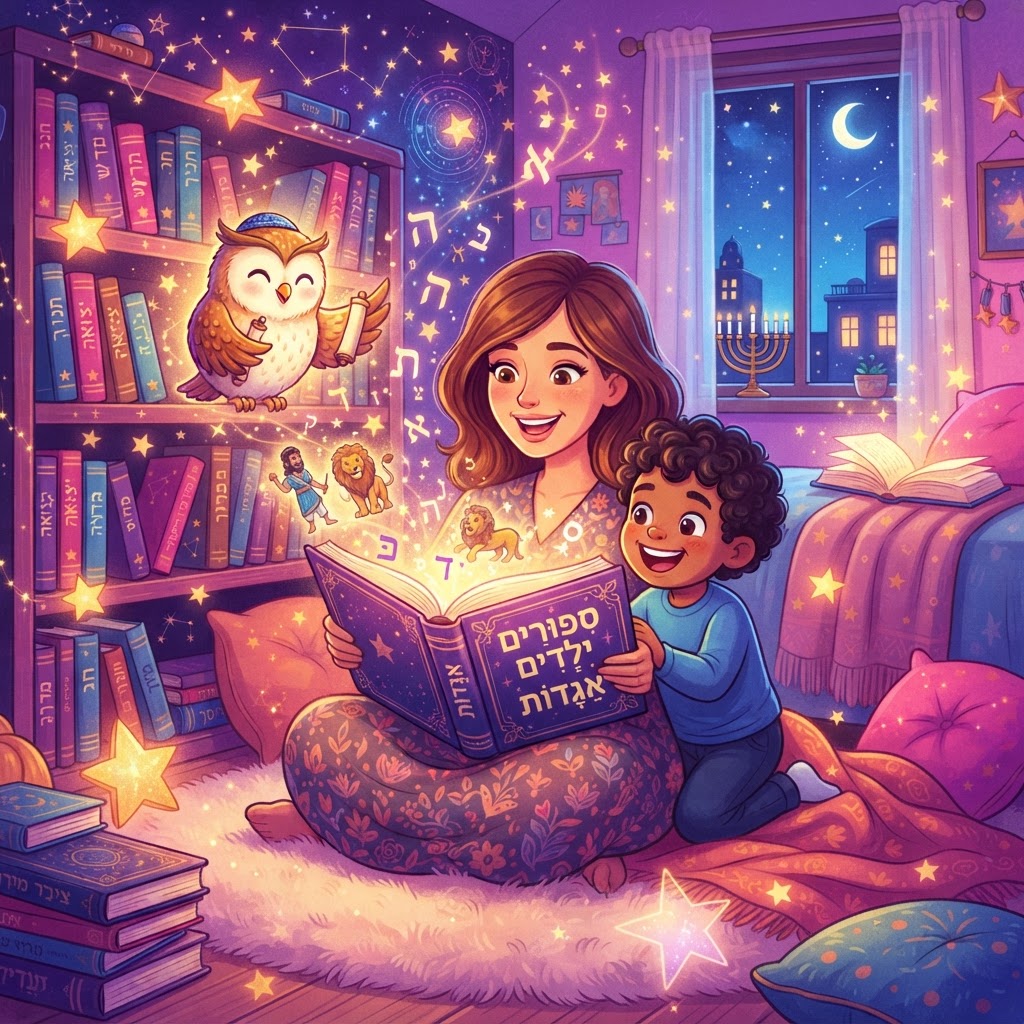
Hebrew stories for kids can do more than entertain at bedtime. They help children hear the rhythm of the language, build a warm connection to family and culture, and make Hebrew feel alive in everyday life. For bilingual families, heritage learners, and parents who simply want more stories in Hebrew, shared reading can become one of the easiest and most joyful habits to start.
Whether you are fully fluent, learning alongside your child, or mixing Hebrew with English at home, the goal is not perfection. The goal is meaningful, repeated exposure. A short, cozy story told often can support language growth, emotional bonding, and a child's sense of identity.
Why are Hebrew stories for kids worth reading?
Hebrew stories for kids are worth reading because they build language through emotion, repetition, and routine. When a child hears Hebrew in a safe, loving moment, the language becomes associated with comfort, curiosity, and connection.
This matters for both fluent and non-fluent families. Children learn language best when words are tied to faces, actions, and feelings. A bedtime story about a sleepy cat, a family dinner, or a trip to the park gives Hebrew real meaning.
For many families, Hebrew children stories also support heritage language preservation. They keep family phrases, cultural references, and holiday traditions active across generations. A grandparent's favorite word, a Shabbat scene, or a familiar song inside a story can make a child feel part of something bigger than themselves.
Research supports this approach. The American Speech-Language-Hearing Association explains that learning more than one language does not confuse children and can be a healthy part of development.
How do stories in Hebrew support language development and cognitive growth?
Stories in Hebrew support language development by giving children repeated, understandable input. They also support thinking skills because stories ask children to remember characters, predict events, and connect words to meaning.
When children hear the same story several times, they begin to notice:
- New vocabulary
- Sentence patterns
- Sounds and rhymes
- Story order: beginning, middle, and end
- Emotional words like happy, worried, excited, and calm
This repeated input is especially helpful for young learners. A child does not need to understand every word to benefit. They learn through context, pictures, tone of voice, and repeated phrases.
Bilingual education research also points to broader benefits. A review published on NCBI notes that bilingual experience can support cognitive flexibility and attention control, although the effects vary by child and environment. In simple terms, using two languages gives the brain regular practice switching, noticing, and sorting meaning.
Story time also builds executive function in a natural way. The Harvard Center on the Developing Child describes executive function as the set of skills children use to focus, remember, and manage impulses. Listening to a story, waiting for what happens next, and retelling favorite parts all give those skills practice.
Why do Hebrew children stories help families stay connected to culture?
Hebrew children stories help families stay connected to culture because they carry values, memories, and shared references. Language is not just vocabulary. It also holds humor, family habits, traditions, and ways of seeing the world.
A simple story in Hebrew can introduce children to:
- Shabbat routines
- Israeli landscapes like the desert or the sea
- Hebrew names and expressions
- Jewish holidays and symbols
- Respect, kindness, courage, and community
For families in the diaspora, this can be especially meaningful. Children may not hear Hebrew all day, so story time becomes a consistent bridge to identity. Even a five-minute story can remind a child, “This language belongs to me too.”
This is also why Hebrew bedtime stories work so well. Bedtime is calm, predictable, and emotionally rich. That makes it one of the best times to pass on both language and belonging.
What kinds of Hebrew bedtime stories work best for ages 1-10?
The best Hebrew bedtime stories are short, warm, and matched to a child’s age and language level. The right story feels easy enough to follow but interesting enough to ask for again.
Ages 1-3
For toddlers, choose stories with:
- Repetition
- Animal sounds
- Bedtime routines
- Simple actions like sleeping, washing, hugging
- One idea per page or scene
At this age, hearing familiar phrases matters more than plot. Repeated lines like “לילה טוב” or “הנה הירח” help children join in.
Ages 4-6
Preschoolers enjoy:
- Gentle adventure
- Clear problems and happy endings
- Rhyming or patterned language
- Family and friendship themes
- Stories that invite questions
This is a great age for bilingual storytelling. You can tell part in Hebrew and explain key moments in English.
Ages 7-10
Older children often like:
- More detailed plots
- Humor and mystery
- Cultural themes
- Nature, travel, or school stories
- Character growth
For this group, stories in Hebrew can include a few new words each night. You can pause to ask what they think a word means from context before explaining it.
If your family is raising children with more than one heritage language, you may also enjoy our guide to Portuguese stories for kids for ideas you can adapt across languages.
What are five simple Hebrew story ideas you can try tonight?
The easiest Hebrew story ideas are familiar, visual, and personal. When children know the setting or topic, they can focus more on the language.
-
The Alef-Bet Garden
A child finds a magical garden where each flower grows into a Hebrew letter. Every letter unlocks a new word, like מים, ירח, or שלום. This works well for early learners who are starting to notice the Hebrew alphabet. -
Grandma’s Shabbat Soup
A child helps a grandparent gather ingredients, stir the pot, and welcome guests. This story supports family vocabulary, food words, and cultural connection. -
The Little Boat on the Kinneret
A small boat feels nervous on the water but learns to trust the wind, the stars, and a friendly bird. This is a soothing choice for Hebrew bedtime stories because the setting is calm and rhythmic. -
Tamar and the Lost Moon
Tamar notices the moon is missing and searches through rooftops, olive trees, and sleepy streets to find it. This kind of bedtime quest is ideal for repetition and soft suspense. -
The Lion Who Couldn’t Roar “Laila Tov”
A playful young lion wants to say good night properly to all his friends but keeps mixing up the words. Children love the humor, and it gives them a reason to repeat bedtime phrases.
A good rule is to keep the core plot simple and personalize the details. Use your child’s name, favorite animal, neighborhood, or interests. That is often what turns a nice story into one they want every night.
How can parents use InstaTales to create personalized Hebrew stories?
Parents can use InstaTales to create personalized Hebrew stories by choosing age-appropriate prompts, family themes, and the Hebrew language option. This makes it much easier to offer children fresh, meaningful stories without starting from scratch each night.
Here is a simple way to begin:
- Start with create your own personalized bedtime story and choose your child’s age, interests, and favorite themes.
- Ask for a story in Hebrew or a bilingual Hebrew-English version if your child is still learning.
- Use story templates when you want a quick bedtime setup, such as “gentle sleep story,” “holiday story,” or “adventure with family.”
- Save favorites in your story library so children can revisit beloved stories again and again.
- If you are using stories in a school or Hebrew program, explore InstaTales for teachers for classroom-friendly ideas.
A practical tip: if you are not fully fluent, prompt the story to include simple Hebrew, short sentences, and English transliteration. You can also ask for a mini glossary at the end. That makes the story easier to read aloud with confidence.
For families exploring multilingual reading routines, the InstaTales blog also offers guides to stories in other languages and practical literacy tips.
How can adults make Hebrew story time easier if they are not fluent?
Adults do not need perfect Hebrew to make story time effective. Children benefit most from consistency, warmth, and repeated exposure, not from flawless pronunciation.
Try these simple strategies:
- Read slowly and naturally
- Repeat the same story for several nights
- Mix Hebrew and English when needed
- Use gestures, pictures, and facial expressions
- Focus on a few key words each time
- Invite children to repeat one phrase, such as “לילה טוב” or “בוא נלך”
It also helps to keep expectations realistic. If your child hears three new Hebrew words tonight and remembers one tomorrow, that is progress. Small, steady exposure works.
Many parents find success with a “one story, three layers” approach:
- First read: enjoy the story
- Second read: point out a few Hebrew words
- Third read: ask the child to fill in repeated phrases
That rhythm keeps story time relaxed while still supporting learning.
Frequently Asked Questions
What age should children start listening to Hebrew stories?
Children can start hearing Hebrew stories from infancy. Even babies benefit from the sound, rhythm, and emotional connection of language during shared reading.
Do children get confused by hearing two languages?
No, hearing two languages does not confuse most children. Major child language organizations note that bilingual exposure is a normal and healthy part of development.
Should Hebrew stories be fully in Hebrew or bilingual?
Either can work well. Fully Hebrew stories offer immersion, while bilingual stories can reduce frustration and help children follow the meaning more easily.
How long should a Hebrew bedtime story be?
For toddlers, 3-5 minutes is often enough. Older children may enjoy 7-12 minutes, especially if the story includes humor, suspense, or a familiar character.
Can teachers use Hebrew stories in class?
Yes, Hebrew stories are excellent for vocabulary, listening, and cultural learning. Short personalized stories also work well for mixed-level groups, partner reading, and simple follow-up activities.
Explore More Stories
Ready for more? - free AI bedtime story generator
Get a new bedtime story every week
Free, personalized, and delivered to your inbox. No spam, ever.
Ready to Create a Personalized Bedtime Story?
Use our free AI bedtime story generator to create a personalized illustrated story for your child in 30 seconds — no credit card needed.
Popular story types:
Maya Rodriguez
Lead Content Editor & Early Literacy Specialist
Maya is a former early childhood educator and literacy specialist with over a decade of experience helping children develop a love of reading. She leads content at InstaTales, where she writes about the science of storytelling, child development, and how families can use personalized AI stories to build literacy and emotional resilience.
instatales.ai