Imagination Development Stories for Kids
Want to help your child develop imagination? Discover how stories naturally build this skill — and how to maximize the benefit.
✦ Key Takeaways
- •Stories are powerful because they ask children to build a world in their minds.
- •Stories activate several brain and thinking skills at once.
- •Research shows that storytelling supports imagination by building language, social understanding, and flexible thinking.
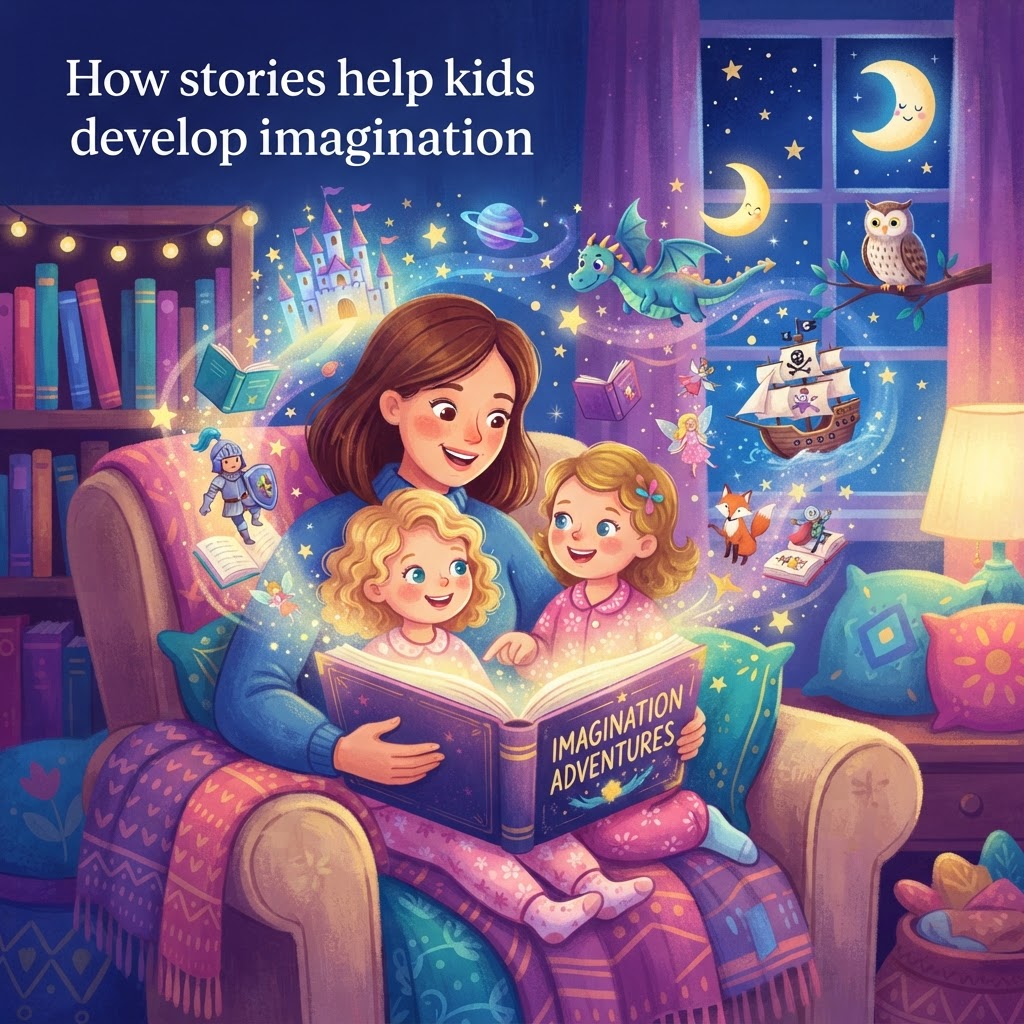
A child does not need a toy in hand to explore a castle, sail to the moon, or talk to a friendly bear. Stories for imagination do that work beautifully. When children listen to or read stories, they practice making pictures in their minds, predicting what happens next, and connecting new ideas to what they already know. That is why imagination and storytelling are so closely linked in healthy child development.
Why are stories so powerful for imagination?
Stories are powerful because they ask children to build a world in their minds. Unlike passive entertainment, a story invites a child to picture characters, settings, feelings, and possibilities that are not physically in front of them.
This mental world-building is a core part of imagination. When a child hears, “The rabbit tiptoed through a sparkling forest,” they are not just processing words. They are combining memory, emotion, and sensory ideas to create something new.
That matters because imagination supports much more than play. It also helps with:
- problem-solving
- empathy
- flexible thinking
- language growth
- creative expression
In other words, the best imagination development stories do more than entertain. They give children repeated practice in thinking beyond the here and now.
What cognitive skills do stories activate in children?
Stories activate several brain and thinking skills at once. They strengthen mental imagery, language processing, memory, perspective-taking, and prediction.
When children follow a story, they build what researchers often call a mental model. They keep track of who is in the story, where events are happening, what each character wants, and what might happen next. That is sophisticated thinking, even in very young children.
Shared reading research supports this idea. In an MRI study, Hutton et al. found that preschoolers with richer home reading environments showed greater activation in brain areas tied to narrative comprehension and mental imagery during story listening. This helps explain why reading aloud is so valuable for imagination growth. The Harvard Center on the Developing Child also highlights how back-and-forth language experiences build strong foundations for learning.
Stories also strengthen theory of mind, which is the ability to understand that other people have thoughts, feelings, and beliefs different from our own. When children wonder, “Why is the fox hiding?” or “How does the girl feel now?” they are practicing imagination in a social and emotional form.
What does research say about imagination and storytelling?
Research shows that storytelling supports imagination by building language, social understanding, and flexible thinking. The evidence is especially strong for shared reading and active story discussion.
A few important studies stand out:
- Whitehurst et al. (1988) found that dialogic reading—where adults ask questions and invite children to talk about the story—improved preschoolers’ language skills more than passive read-alouds alone.
- Mar et al. (2006) reported that greater exposure to narrative fiction was associated with stronger social understanding. In simple terms, stories may help children practice understanding minds, motives, and emotions.
- Nicolopoulou et al. (2015) found that storytelling and story-acting in preschool classrooms supported gains in oral language, early literacy, and self-regulation.
These findings fit what many educators see every day. Children who hear and retell stories often become more inventive in pretend play, more expressive in language, and more confident in creating their own ideas.
For families who want trusted literacy guidance, Reading Rockets offers practical, research-based tips on reading and language development. The NICHD reading-aloud guidance is also a helpful resource for turning story time into a stronger learning experience.
How can parents use stories to build imagination every day?
Parents can build imagination best by making story time interactive, flexible, and joyful. You do not need a perfect voice or a long routine. What matters most is helping your child think beyond the page.
Here are 5 practical strategies that work well:
-
Pause and ask open questions.
Try questions like, “What do you think is behind the door?” or “What would you do if you met that dragon?” Open questions stretch imagination more than yes-or-no questions. -
Invite children to change the story.
Ask your child to swap the setting, add a character, or choose a new ending. A farm can become outer space. A puppy can become a unicorn. This simple shift turns listening into active creating. -
Connect the story to real life.
Say, “This reminds me of when you felt nervous at the park,” or “What would our family pack for this adventure?” Real-life links help children use imagination in meaningful ways. -
Re-read favorites and extend them.
Repetition is not boring for children. It gives them a safe structure for deeper imagining. After re-reading, ask them to invent “the next chapter.” -
Encourage retelling through play.
Use stuffed animals, drawings, blocks, or puppets to act out the story. Retelling helps children organize ideas and create new versions of what they heard.
If your child is also working on related literacy skills, these strategies pair well with our guides to stories that build listening skills, stories that strengthen comprehension, and how stories support storytelling skills.
What kinds of stories are best for imagination development?
The best stories for imagination are the ones that leave space for a child to think, picture, and contribute. That can include picture books, oral stories, bedtime tales, folktales, and personalized stories.
Different ages often benefit from different story features:
Ages 1-3
- simple plots
- strong rhythm and repetition
- familiar routines with small surprises
- clear emotional cues
Ages 4-6
- playful “what if” adventures
- animal characters
- stories with problems to solve
- chances to predict what happens next
Ages 7-10
- richer world-building
- character motivation
- humor and twists
- opportunities to discuss themes and alternate endings
A useful rule is this: the story should be understandable, but not fully finished in the child’s mind. A little mystery, possibility, or choice is what helps imagination expand.
How can InstaTales support imagination development?
InstaTales can support imagination by making stories personal, repeatable, and easy to adapt to your child’s interests. Personalized stories often hold attention better because children already care about the characters, themes, or settings.
A simple way to begin is to create your own personalized bedtime story using your child’s favorite ideas. If they love dinosaurs, space, princesses, trucks, or shy little rabbits, start there. Familiar interests lower the entry barrier and free up more mental energy for imagining.
To get the most benefit, use InstaTales actively:
- Let your child choose one or two story details, such as the setting or helper character.
- Pause during the story to ask prediction questions.
- Revisit favorites in your story library and invite your child to compare versions.
- Use the platform to spark drawing, pretend play, or story retelling after reading.
- In classrooms, explore InstaTales for teachers to support creative prompts, literacy centers, or small-group storytelling.
If you want more ideas, browse the InstaTales blog for reading routines, literacy tips, and age-based story guidance.
The key is to treat AI as a creative tool, not a replacement for connection. Children get the strongest imagination boost when an adult reads with warmth, responds to their ideas, and leaves room for wonder.
Why does imagination matter beyond story time?
Imagination matters because it helps children think flexibly in everyday life. The same mental skill used to picture a forest full of talking owls can later help a child solve a problem, write a story, comfort a friend, or imagine a better solution.
That is why imagination and storytelling deserve a regular place in family routines. A few minutes of rich story time can support language, emotional growth, and creativity all at once.
For many families, the goal is not to raise a child who simply listens well. It is to raise a child who can imagine possibilities. Stories are one of the most natural ways to do that.
Frequently Asked Questions
At what age do stories start helping imagination?
Stories can support imagination from infancy. Even babies begin forming mental connections from rhythm, voice, repetition, and simple images, while toddlers start imagining actions, feelings, and familiar scenes.
Do picture books or audio stories work better?
Both can help, but they support imagination in slightly different ways. Picture books offer visual support, while audio stories often require children to create more mental imagery on their own.
Is repeating the same story still good for imagination?
Yes. Repetition helps children notice new details, predict events, and build confidence. Once they know the story well, they are often more ready to invent changes and extensions.
How long should story time be to build imagination?
Short, consistent story time is often enough. For many children, 10 to 20 minutes of engaged reading or storytelling can be more effective than a longer session with little interaction.
Can AI-generated stories really support creativity?
Yes, if they are used thoughtfully. AI stories can boost creativity when adults personalize them, ask open-ended questions, and treat them as a starting point for conversation, play, and retelling.
What should I do if my child seems passive during story time?
Make the story more interactive. Offer choices, ask prediction questions, or invite your child to change one detail in the plot so they become a co-creator instead of just a listener.
Explore More Stories
Ready for more? - free AI bedtime story generator
Get a new bedtime story every week
Free, personalized, and delivered to your inbox. No spam, ever.
Ready to Create a Personalized Bedtime Story?
Use our free AI bedtime story generator to create a personalized illustrated story for your child in 30 seconds — no credit card needed.
Popular story types:
Maya Rodriguez
Lead Content Editor & Early Literacy Specialist
Maya is a former early childhood educator and literacy specialist with over a decade of experience helping children develop a love of reading. She leads content at InstaTales, where she writes about the science of storytelling, child development, and how families can use personalized AI stories to build literacy and emotional resilience.
instatales.ai