Phonics Development Through Stories
Want to help your child develop phonics? Discover how stories naturally build this skill — and how to maximize the benefit.
✦ Key Takeaways
- •The connection is simple: stories help children hear patterns in spoken language, and phonics helps them map those sounds to print.
- •Stories strengthen phonics by building the mental skills that reading depends on.
- •Research shows that stories are helpful for phonics, but they work best alongside direct teaching of letter-sound relationships.
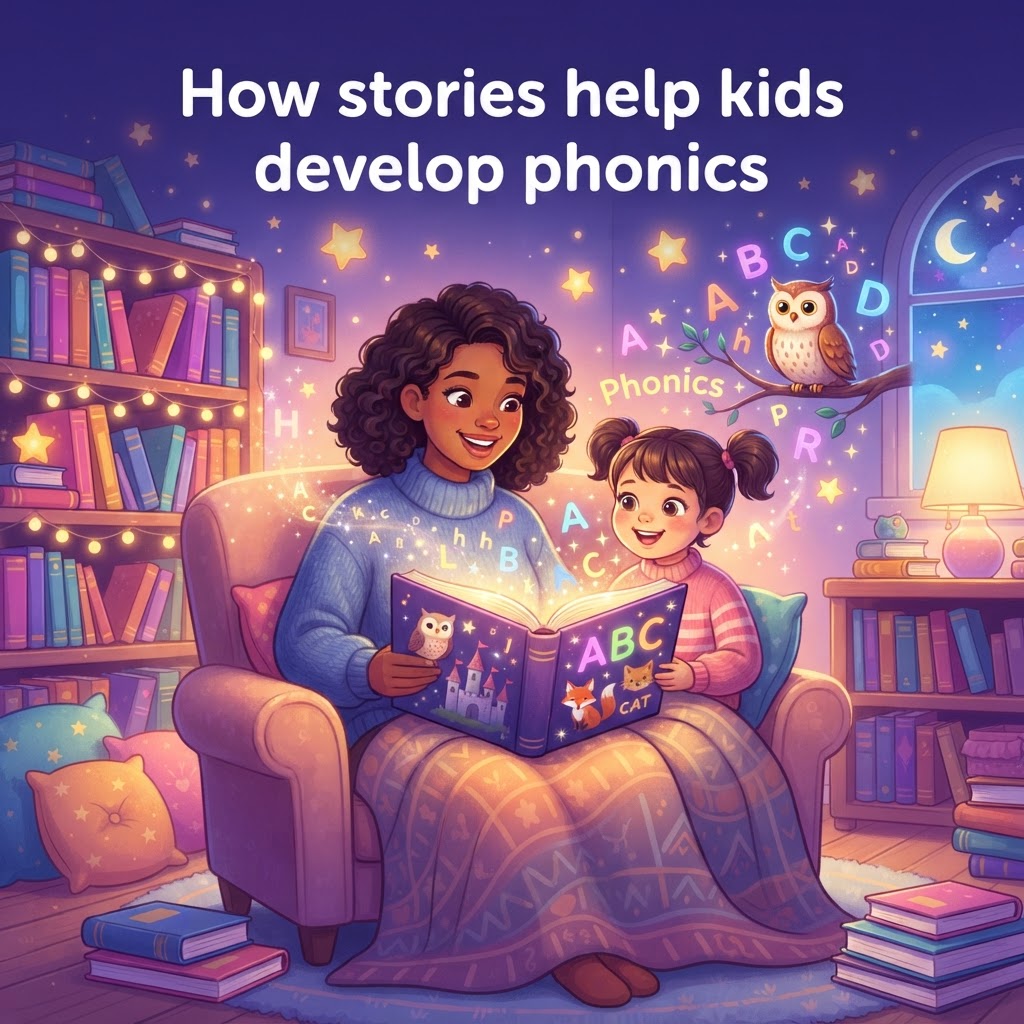
Stories can be a powerful tool for early reading. They do not replace explicit phonics instruction, but they make phonics meaningful, memorable, and fun. When children hear repeated sounds, rhymes, and predictable phrases in stories, they start noticing how language works — and that is a big part of phonics development.
For parents, this is good news. You do not need to turn every bedtime story into a lesson. With the right kinds of books and a few simple habits, phonics and storytelling can work together naturally. Research shows that children learn best when sound awareness, print awareness, and rich language experiences grow side by side.
What is the connection between stories and phonics development?
The connection is simple: stories help children hear patterns in spoken language, and phonics helps them map those sounds to print. Together, they support early reading in a natural, child-friendly way.
Phonics is the understanding that letters represent sounds. Before children can decode words on a page, they need to notice that words are made of smaller sound parts. Stories help with that by exposing children to rhyme, repetition, alliteration, and familiar word patterns.
For example, when a child hears “big brown bear” or “cat sat on the mat,” they are not just enjoying the story. They are also hearing repeated beginning sounds and rhyming endings. These sound patterns build phonological awareness, which is a key foundation for phonics.
This is why phonics development stories matter. They place sound play inside a meaningful context, so children pay attention longer and remember more.
How do stories strengthen the brain skills behind phonics?
Stories strengthen phonics by building the mental skills that reading depends on. They train children to hear sounds, hold them in memory, and connect them to words they know.
Here are the main cognitive mechanisms at work:
- Phonological awareness: Stories with rhyme and repetition help children notice syllables, rhyme families, and individual sounds.
- Auditory memory: Repeated phrases help children remember sound sequences, which supports blending and decoding later.
- Attention to pattern: Predictable language teaches children to expect sound and word patterns.
- Print awareness: When adults point to words while reading, children start connecting spoken sounds to printed forms.
- Motivation and emotional engagement: Kids learn more when they care about the content. Stories keep them engaged far longer than isolated drills.
This matters because phonics is not only about memorizing letter sounds. Children also need to process those sounds quickly and accurately. Story time gives them repeated, low-pressure practice.
As Reading Rockets explains, strong early reading grows from both sound awareness and print knowledge. Stories support both.
What does research say about phonics and storytelling?
Research shows that stories are helpful for phonics, but they work best alongside direct teaching of letter-sound relationships. In other words, stories build the foundation and reinforce the skill.
A few key findings stand out:
- The National Reading Panel (2000) found that systematic phonics instruction improves word reading and spelling, especially in kindergarten and first grade.
- Bus, van IJzendoorn, and Pellegrini (1995) found in a major meta-analysis that shared book reading supports language growth, which is essential for later reading success.
- Sénéchal and LeFevre (2002) found that storybook reading strongly supports vocabulary and oral language, while parent teaching of print and letters more directly predicts early word reading. The takeaway: children benefit most when both are present.
- Whitehurst and colleagues showed that dialogic reading — where adults ask questions and invite children to join in — improves language skills that support reading.
- Castles, Rastle, and Nation (2018) argued that skilled reading depends on both explicit code-based learning and rich language experience.
This fits what literacy experts say today. NICHD emphasizes that reading development depends on phonemic awareness, phonics, fluency, vocabulary, and comprehension working together. And Harvard Graduate School of Education notes that phonics is most effective when children also have strong oral language experiences.
So yes, stories for phonics are useful — not as a substitute for instruction, but as a powerful support.
Which story features are best for stories for phonics?
The best stories for phonics are the ones that make sound patterns easy to hear and easy to revisit. Look for stories with repetition, rhyme, strong rhythm, and clear sound play.
Helpful features include:
- Rhyming words like cat/hat or star/car
- Alliteration like silly snake or bouncing bunny
- Repeated refrains that children can join in with
- Simple sentence patterns that make words predictable
- High-frequency sound patterns such as short a, short o, or common consonants
- Clear print and short lines so adults can track words with a finger
Personal relevance can help too. Children pay more attention when the main character has their name, interests, or favorite animals. That is one reason personalized stories can be so effective: they combine emotional engagement with repeated exposure to target sounds.
If you want a fuller picture of how story time supports decoding, fluency, and confidence, see our guide to stories that support early reading. Stories also support vocabulary growth through stories, which strengthens reading overall.
What are five practical ways parents can use stories to build phonics?
Parents can build phonics during story time with a few simple, repeatable habits. The goal is not to quiz your child, but to help them notice sounds in a playful way.
1. Choose one sound to notice
Before reading, pick one target sound such as m, s, or short a. Tell your child, “Let’s listen for words that start with /m/.”
This gives the story a light phonics focus without interrupting the fun.
2. Pause for rhyme and prediction
When a line sets up a rhyme, stop and let your child guess. “The frog sat on a...” often invites “log.”
This helps children hear sound endings and anticipate word patterns.
3. Stretch and repeat key words
If a word is useful for phonics, say it slowly once: “Ssss-sun” or “m-a-t, mat.” Then say it normally and move on.
A quick sound spotlight is often enough. It keeps the story flowing while still building awareness.
4. Track print with your finger
For preschoolers and early readers, point to words as you read simple lines. This connects spoken language to print and shows that words on the page match the words they hear.
That visual link is important for phonics and storytelling to work together.
5. Reread the same story across several days
Repetition is one of the best tools in early literacy. On the second or third reading, children notice more sounds because they already know the meaning.
If you want more sound-focused ideas, our article on building phonics through stories offers extra examples and activity tips.
How can you use InstaTales to support phonics and storytelling?
InstaTales can make phonics practice more engaging by letting you create stories around your child’s interests and target sounds. A personalized story is often more effective because children are more likely to listen, join in, and ask to hear it again.
You can create your own personalized bedtime story with a simple prompt like:
- “Write a bedtime story for a 4-year-old with lots of words that start with S.”
- “Create a rhyming story about Mia and a cat in a hat.”
- “Make a short story with repeated short-a words like map, jam, and bat.”
- “Write a calm, repetitive story that repeats: ‘Ben can hop.’”
A few tips make this especially useful:
- Ask for repetition and predictable phrases
- Request a specific letter sound or rhyme family
- Keep stories short for younger children
- Re-read favorite stories several times during the week
- Save strong stories in your story library so you can return to them for extra practice
This approach works well because it blends explicit sound goals with the warmth of story time. It also helps you tailor phonics development stories to your child’s exact stage, whether they are just enjoying rhyme or starting to sound out simple words.
When should stories be paired with direct phonics instruction?
Stories should be paired with direct phonics instruction as soon as children begin learning letters and sounds. The strongest approach is both/and: explicit teaching for accuracy, stories for meaning and repetition.
If a child is learning that b says /b/, story time can reinforce that learning with words like ball, bug, and bed. But children still need direct practice in hearing, identifying, and blending sounds.
A helpful rule is this:
- Use direct instruction to teach the pattern
- Use stories to reinforce the pattern in context
- Use rereading to strengthen memory and confidence
That balance helps children see reading as both a skill and a source of joy.
Frequently Asked Questions
Can stories replace phonics instruction?
No. Stories are a strong support for phonics, but most children still need direct teaching of letter-sound relationships and blending. Stories make those skills more meaningful and easier to remember.
What age should I start using stories for phonics?
You can start in toddlerhood. For very young children, focus on rhyme, rhythm, repetition, and playful sound listening rather than formal decoding.
What kinds of stories are best for phonics development?
Stories with rhyme, repeated phrases, simple patterns, and clear sound play work best. Personalized stories can be especially effective because children pay closer attention to content that feels familiar.
How often should I reread a story for phonics practice?
Several times across a week is ideal. Repeated reading helps children notice sound patterns more easily because they already understand the story.
Is phonics and storytelling helpful for struggling readers?
Yes, especially when stories reduce pressure and increase motivation. For struggling readers, short, predictable, sound-focused stories paired with explicit teaching can be very effective.
Can teachers use personalized stories for classroom phonics?
Yes. Personalized or sound-targeted stories can support small-group instruction, listening centers, and home-school reading practice. The key is to align the story with the phonics pattern students are currently learning.
Ready to Create a Personalized Bedtime Story?
Use our free AI bedtime story generator to create a personalized illustrated story for your child in 30 seconds — no credit card needed.
Popular story types:
Maya Rodriguez
Lead Content Editor & Early Literacy Specialist
Maya is a former early childhood educator and literacy specialist with over a decade of experience helping children develop a love of reading. She leads content at InstaTales, where she writes about the science of storytelling, child development, and how families can use personalized AI stories to build literacy and emotional resilience.
instatales.ai