Writing Development Stories: How Kids Learn to Write
Want to help your child develop writing? Discover how stories naturally build this skill — and how to maximize the benefit.
✦ Key Takeaways
- •Stories matter because writing begins in the mind long before it appears on the page.
- •Stories help children build the cognitive systems that writing depends on.
- •Research strongly supports the link between stories and writing.
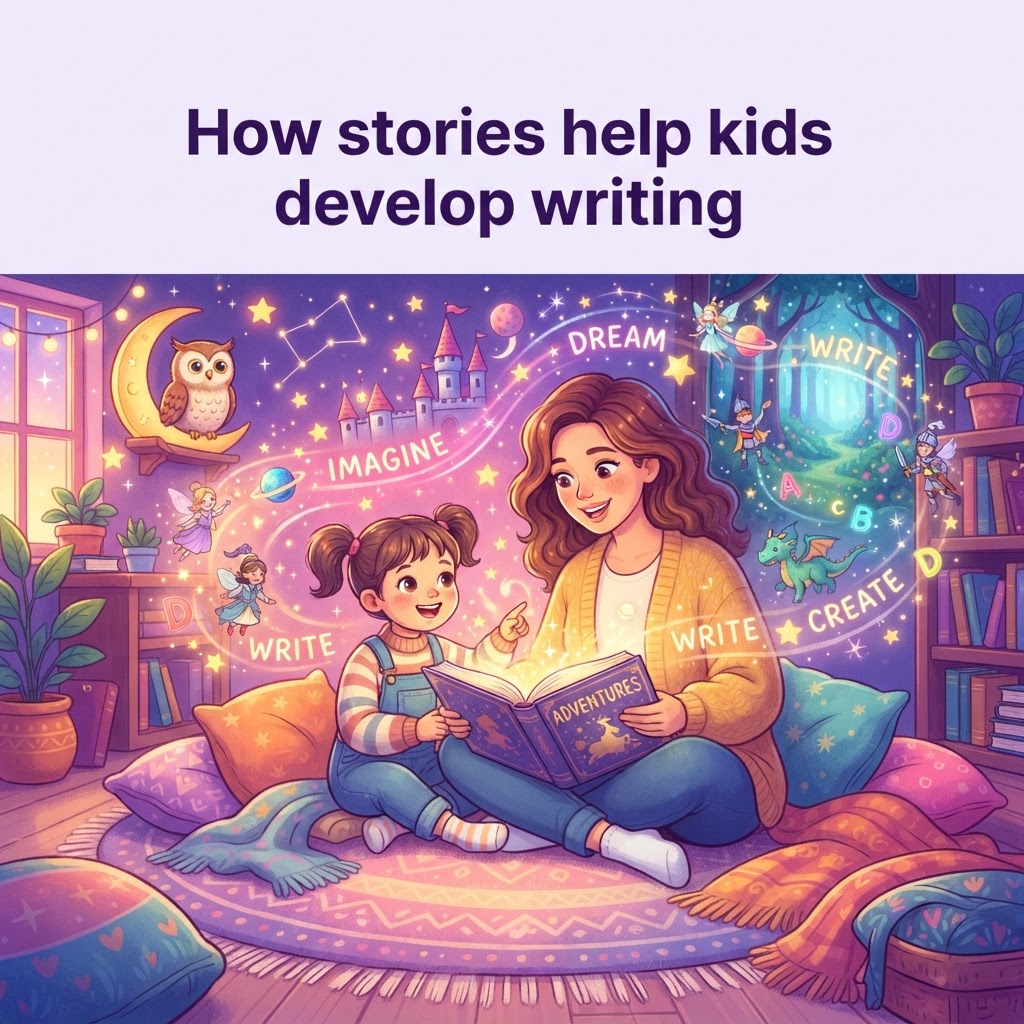
Stories are one of the most natural tools for writing development. When children hear, retell, and create stories, they absorb vocabulary, sentence patterns, story structure, and the confidence to put ideas on paper. That is why writing development stories, stories for writing, and everyday writing and storytelling experiences matter so much at home and at school.
The good news is that you do not need formal lessons to start. A steady diet of rich stories, paired with simple follow-up talk and drawing, can build the mental foundations children need to become writers.
Why do stories matter for writing development?
Stories matter because writing begins in the mind long before it appears on the page. Children first learn to organize ideas orally, and stories give them a clear model for how language works.
When kids listen to stories, they hear:
- New vocabulary in meaningful context
- Sentence structure they can imitate later
- Story grammar such as character, problem, sequence, and ending
- Cause-and-effect thinking that helps ideas flow logically
- Voice and style, including humor, suspense, and description
This is one reason reading and writing grow together. If you want a fuller picture of that connection, our guide on how stories build reading skills explains why both areas develop side by side.
In practice, children who know how stories sound are better prepared to write their own. They may start by dictating one sentence, drawing a scene, or retelling a favorite bedtime adventure. Those small steps are real writing growth.
How do stories change the brain work behind writing?
Stories help children build the cognitive systems that writing depends on. In simple terms, storytelling strengthens the “idea engine” behind writing, not just the handwriting or spelling.
Researchers often describe writing as a combination of text generation and transcription. Text generation is thinking of what to say. Transcription is getting it onto the page through spelling, handwriting, or typing. Studies by Virginia Berninger and colleagues have shown that young writers need both systems to work together.
Stories support the text-generation side in several important ways:
- Oral language grows. Children learn how to explain events, describe feelings, and connect ideas.
- Working memory gets support. Story structure gives children a mental map, so they do not have to invent everything from scratch.
- Vocabulary becomes usable. Words heard in stories are easier to retrieve later in speech and writing.
- Syntax improves. Repeated exposure to rich sentences helps children internalize grammar patterns.
- Perspective-taking develops. Stories encourage children to think about what characters know, want, and feel, which leads to more detailed writing.
This is why a child may write better after hearing many stories, even before spelling is perfect. The ideas become stronger, clearer, and easier to express.
For family-friendly literacy guidance, the University of Florida Literacy Institute offers strong, research-based resources on early reading and writing development.
What does research say about writing and storytelling?
Research strongly supports the link between stories and writing. Children develop stronger written language when storytelling, oral language, and literacy experiences are part of daily life.
A few findings stand out:
- The National Early Literacy Panel (2008) found that oral language skills are important predictors of later literacy success, including the foundations needed for written expression.
- Sénéchal and LeFevre (2002) showed that home literacy experiences, especially shared reading, support children’s language growth. That language growth later feeds both reading and writing.
- Nicolopoulou and colleagues (2015) found that storytelling and story-acting in early childhood classrooms improved narrative skills and supported later literacy-related development.
- Olinghouse and Leaird (2009) reported that oral vocabulary and grammar were linked to the quality of young children’s written compositions.
- Isbell et al. (2004) found that storytelling experiences improved young children’s comprehension and oral language, both of which are key building blocks for writing.
The broad message is clear: children learn to write better when they first learn to think in stories.
This is also consistent with guidance from the National Center on Improving Literacy, which emphasizes oral language, read-alouds, and meaningful literacy practice. For educators looking for evidence-based intervention summaries, the What Works Clearinghouse is also a useful source.
Which practical strategies help children turn stories into writing?
The best strategies are simple, consistent, and playful. You do not need long worksheets to turn stories for writing into real skill growth.
Here are five practical ways to do it.
1. Ask for a retell before asking for writing
Retelling is often the bridge between listening and writing. After a story, ask your child, “What happened first?” “What was the problem?” and “How did it end?”
This helps children rehearse structure out loud before they face the harder job of writing it down.
2. Use drawing and dictation
Young children often have ideas that are bigger than their handwriting skills. Let them draw a scene, then dictate a sentence or two for you to write.
This protects creativity while building authorship. It is one of the most effective early writing and storytelling practices for ages 1-6.
3. Reuse familiar story patterns
Children write more easily when they can borrow a structure they already know. Try frames like:
- “One day…”
- “But then…”
- “So…”
- “In the end…”
A familiar pattern reduces cognitive load and frees up energy for vocabulary and ideas. If you want more examples, our article on building writing through stories shares easy ways to scaffold this at home.
4. Talk about interesting words and sentences
Pause once or twice during a story to notice a vivid phrase. You might say, “I like how this sentence tells us exactly how the dragon moved.”
Children become better writers when they notice craft in action. Keep this light and brief. The goal is to build awareness, not interrupt the joy of the story.
5. Turn story time into low-pressure authorship
Invite your child to change one part of a story: the setting, the helper, the ending, or the problem. This kind of revision is an early writing skill.
For older children, this can grow into paragraph writing. For younger children, it may just be oral storytelling with one new twist. Both count.
How can parents and teachers use InstaTales to support writing?
InstaTales can support writing best when it is used as a springboard, not just as passive entertainment. Personalized stories give children a strong reason to talk, retell, and create.
A simple routine works well:
- Create your own personalized bedtime story based on your child’s interests, name, or a skill you want to practice.
- Read it aloud and ask two or three open questions about the character, problem, and ending.
- Invite your child to change one detail and tell a new version.
- Have them draw or write a follow-up scene.
- Save favorites in your story library so you can reread and revisit vocabulary, structure, and ideas over time.
This works especially well because motivation matters. Children are more willing to write when the story feels personal. A child who sees themselves as the explorer, veterinarian, or mermaid is often eager to add “one more chapter.”
For classroom use, teachers can adapt the same method with shared prompts, partner retells, and response writing. InstaTales for teachers can help turn personalized storytelling into literacy centers, small-group work, or quick writing warm-ups.
A few best practices make AI story tools more effective:
- Keep stories age-appropriate and short enough for discussion.
- Use the story as a prompt for conversation, drawing, and writing.
- Reread strong stories to deepen language learning.
- Focus on creativity first; edit later.
- Stay involved so the child is co-creating, not just consuming.
If you teach different age groups, you can also build on story-based writing with more targeted support later in elementary school. Our article collection in the InstaTales blog includes age-specific ideas and progression.
How can you tell if stories are actually improving writing?
You can usually see progress before you see polished spelling. The earliest signs of growth are stronger ideas, clearer sequencing, and more detailed language.
Look for these markers:
- Your child includes a beginning, middle, and end
- They use more descriptive words
- They explain why something happened
- They write or dictate longer responses
- They add feelings, dialogue, or character actions
- They show more willingness to revisit and expand a story
These are meaningful signs of writing development. Many families worry too much about neatness and too little about composition. In early writing, ideas come first.
Frequently Asked Questions
At what age do stories start helping writing?
Stories support writing from the earliest years, even before a child can form letters. Babies and toddlers build oral language through listening, and that language later becomes the base for writing.
Do children need to read independently before stories help writing?
No. Listening to stories, talking about them, and retelling them all strengthen the skills behind writing. Independent reading helps later, but it is not the starting point.
What if my child hates writing but loves stories?
That is actually a useful starting place. Begin with oral storytelling, drawing, and dictation so your child can create without the pressure of spelling or handwriting.
How often should we use stories for writing practice?
Short, frequent practice works best. Even 10 minutes a few times a week can build strong habits when you pair stories with retelling, drawing, or one simple writing response.
Are personalized AI stories good for writing development?
Yes, if an adult uses them actively. Personalized stories can increase motivation and idea generation, especially when children discuss, change, and extend the story afterward.
Should I correct every writing mistake right away?
Usually not. In the early stages, it is better to protect momentum and confidence. Focus first on ideas and structure, then gradually support spelling, punctuation, and sentence editing.
Explore More Stories
Ready for more? - free AI bedtime story generator
Get a new bedtime story every week
Free, personalized, and delivered to your inbox. No spam, ever.
Ready to Create a Personalized Bedtime Story?
Use our free AI bedtime story generator to create a personalized illustrated story for your child in 30 seconds — no credit card needed.
Popular story types:
Maya Rodriguez
Lead Content Editor & Early Literacy Specialist
Maya is a former early childhood educator and literacy specialist with over a decade of experience helping children develop a love of reading. She leads content at InstaTales, where she writes about the science of storytelling, child development, and how families can use personalized AI stories to build literacy and emotional resilience.
instatales.ai