How Teachers Use AI Story Generators in the Classroom: 5 Real Use Cases
Real teachers share how they use AI story generators to boost engagement, differentiate instruction, and save time. 5 practical classroom use cases with examples.
✦ Key Takeaways
- •Yes — and it may be one of the most effective tools for this specific challenge.
- •AI-generated stories work exceptionally well as mentor texts and writing springboards.
- •Absolutely — and this is where AI story generators become genuine curriculum partners rather than just engagement tools.
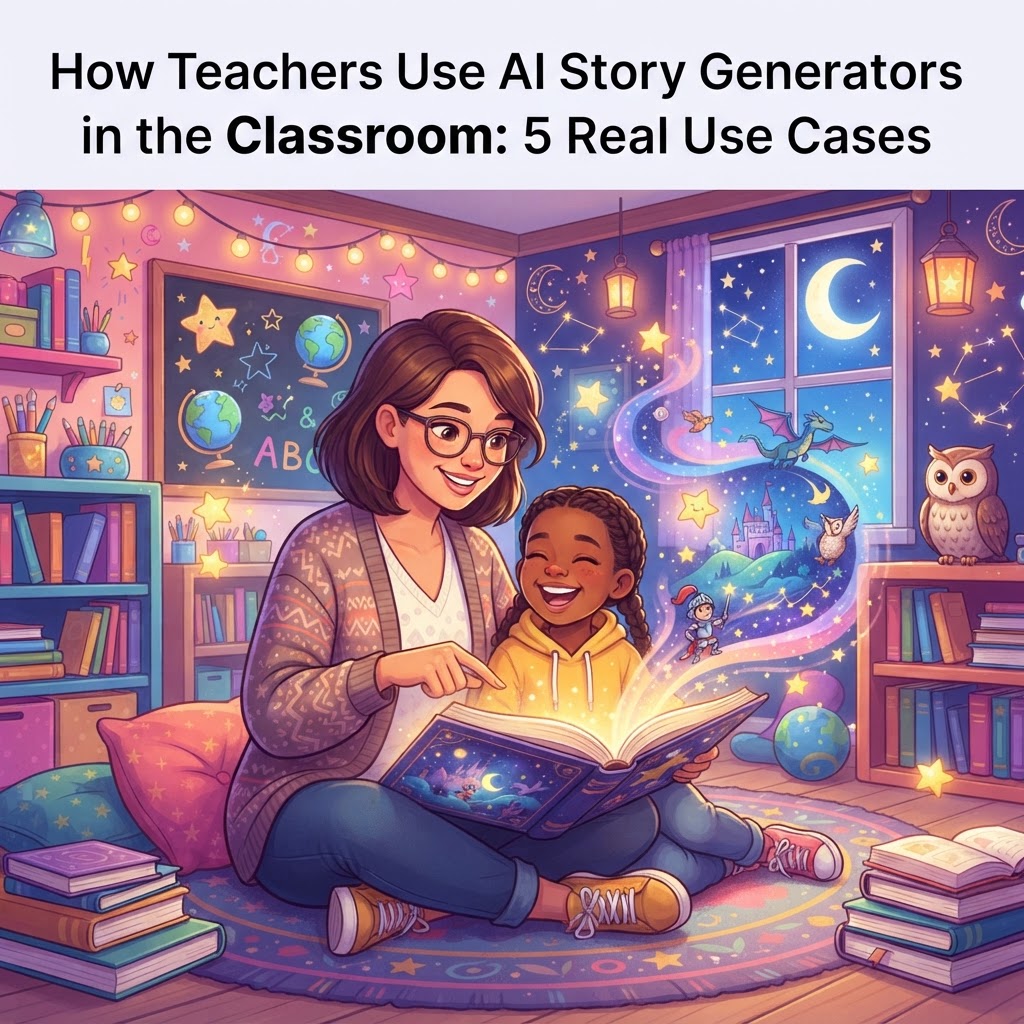
Teachers are always looking for tools that actually work — ones that save time, boost engagement, and meet students where they are. AI story generators have quietly become one of the most practical additions to the elementary classroom, not because they replace teacher creativity, but because they amplify it. From helping a reluctant reader finally crack open a "book" to giving ESL students a story in their native language on day one, the use cases are surprisingly concrete. Here are five real ways teachers are using AI in the classroom right now.
Can an AI Story Generator Actually Help Reluctant Readers?
Yes — and it may be one of the most effective tools for this specific challenge. When a child sees their own name, their pet, or their favourite hobby in a story, the psychological barrier to reading drops significantly.
Research from the International Literacy Association consistently shows that student choice and personal relevance are among the strongest predictors of reading motivation. AI story generators let teachers customise stories around individual interests in seconds — something that used to require hours of planning or expensive levelled book sets.
Real use case: A second-grade teacher in Ohio noticed that one student, Marcus, refused to engage with any classroom reading material. She used an AI story generator to create a short adventure story starring a boy named Marcus who loved Minecraft. Within two weeks, Marcus was requesting new chapters and had begun writing his own story sequel.
"I'd tried everything for six months. The personalised story was the turning point. He went from refusing to read to asking me for 'the next part' every morning." — 2nd Grade Teacher, Ohio
For teachers working with reluctant readers, tools like InstaTales allow story customisation by character name, interest, and reading level — making personalisation genuinely scalable across a whole class.
How Do Teachers Use AI Stories as Writing Prompt Generators?
AI-generated stories work exceptionally well as mentor texts and writing springboards. A teacher can generate a short story with an open ending, then ask students to write what happens next — a technique aligned with Common Core writing standards for narrative development.
This approach works because students are responding to something engaging rather than staring at a blank page. The story does the heavy lifting of context-setting; the child contributes imagination and voice.
Real use case: A third-grade teacher in Texas generates a new AI story every Monday morning themed around the week's vocabulary words. Students read the story together, identify the target words in context, then write a paragraph continuing the story using at least three of those words.
"My writing scores have genuinely improved. Students are less intimidated when they have a story to launch from. And honestly, generating the story takes me about 90 seconds." — 3rd Grade Teacher, Texas
Key benefits teachers report:
- Eliminates "I don't know what to write" paralysis
- Vocabulary words appear in natural, memorable context
- Stories can be pitched at different complexity levels for differentiated groups
Do Themed AI Stories Support Science and Social Studies Units?
Absolutely — and this is where AI story generators become genuine curriculum partners rather than just engagement tools. When teachers are deep in a dinosaur unit or exploring the solar system, a thematically matched story reinforces content learning through narrative, which research from Carnegie Mellon University links to stronger long-term retention than direct instruction alone.
Stories activate a different kind of processing. A child who hears about a palaeontologist named Sofia discovering a triceratops fossil is encoding science vocabulary, sequencing events, and building schema — all at once.
Real use case: A first-grade teacher in California runs a two-week space unit every spring. She generates a serialised AI story following a crew of child astronauts visiting each planet. Each chapter aligns with the day's lesson — one day Mercury, the next Venus. Students can't wait to find out what happens on Mars.
"The story became the backbone of the whole unit. Kids were using words like 'orbit' and 'atmosphere' in casual conversation by week two. That's never happened before." — 1st Grade Teacher, California
InstaTales supports themed story generation around popular curriculum topics, making it easy to align narrative content with learning objectives without building lessons from scratch.
Can AI Stories Be Used to Teach Social-Emotional Learning?
Yes — stories have always been the most natural vehicle for SEL. Characters navigating friendship conflicts, managing big emotions, or learning to ask for help model behaviour in a way that feels safe and non-threatening to children.
A 2023 report highlighted by Education Week on AI and reading comprehension noted that personalised, emotionally resonant content increases both reading engagement and empathy development — two outcomes SEL programmes actively target.
Real use case: A school counsellor in Michigan collaborates with classroom teachers to generate AI stories featuring characters who experience anxiety before a test, conflict with a friend, or a difficult change at home. After reading, students discuss how the character felt and what they could have done differently.
"Having a character go through it first makes the conversation so much easier. Kids who won't talk about their own feelings will absolutely talk about why the story character was upset." — Elementary School Counsellor, Michigan
Effective SEL story themes teachers regularly request:
- Managing frustration and anger
- Inclusion and kindness to new classmates
- Coping with change (new school, new sibling)
- Perseverance after making mistakes
How Does an AI Story Generator Support ESL and ELL Students?
For English Language Learners, a personalised story in their native language — or a bilingual version — can be the bridge that makes everything else click. Starting a child's reading journey in a language they understand builds confidence before the harder work of English acquisition begins.
AI story generators can produce content at adjustable complexity levels, which matters enormously for ELL students who may have grade-level comprehension in their first language but beginner proficiency in English.
Real use case: A dual-language kindergarten teacher in Florida generates the same story in both English and Spanish. ELL students read the Spanish version first, discuss it in their home language, then read the English version with the context already established. Comprehension scores for this group increased measurably within one semester.
"Having the same story in both languages was a game-changer. The kids didn't feel behind — they felt ahead, because they already knew the story." — Kindergarten Teacher, Florida
This approach aligns with sheltered instruction best practices and supports the comprehensible input principles outlined in second-language acquisition research.
Frequently Asked Questions
Is AI in the classroom appropriate for young children?
AI tools used in the classroom are mediated by teachers, not used independently by young students. When a teacher selects and reviews AI-generated content before sharing it, the experience is no different from any other curated reading material. The teacher remains in full professional control.
How do teachers manage AI story tools for a whole class?
Many AI story platforms, including InstaTales, offer class codes and assignment features that let teachers generate and distribute stories to the whole group at once. Teachers can create differentiated versions for different reading groups without additional preparation time.
Do AI-generated stories meet curriculum standards?
AI stories are not a curriculum replacement — they're a supplemental engagement and differentiation tool. When teachers align story themes and vocabulary to their existing units, AI stories can directly support standards-based learning goals in literacy, science, and social studies.
Can AI stories replace levelled readers in the classroom?
Not entirely, but they complement them well. AI stories can be generated at specific reading levels, making them useful for differentiated reading groups. However, they work best alongside structured literacy programmes rather than as a standalone reading curriculum.
Are there privacy concerns with using AI tools for students?
Teachers should always review a platform's privacy policy before using any digital tool with students. Reputable platforms comply with COPPA (Children's Online Privacy Protection Act) and do not store personally identifiable information. Always check with your school's technology coordinator before introducing a new tool.
How much time does it actually save teachers?
Teachers who regularly use AI story generators report saving between one and three hours per week on reading material preparation, differentiation planning, and writing prompt creation. That time is redirected toward instruction, feedback, and student support.
If you're curious about bringing personalised AI stories into your classroom, InstaTales offers teacher-friendly features designed specifically for elementary educators — including class assignments, reading level adjustments, and themed story generation. It's worth exploring what a five-minute story creation session could do for your most disengaged reader.
Ready to Create a Personalized Bedtime Story?
Use our free AI bedtime story generator to create a personalized illustrated story for your child in 30 seconds — no credit card needed.
Popular story types:
Maya Rodriguez
Lead Content Editor & Early Literacy Specialist
Maya is a former early childhood educator and literacy specialist with over a decade of experience helping children develop a love of reading. She leads content at InstaTales, where she writes about the science of storytelling, child development, and how families can use personalized AI stories to build literacy and emotional resilience.
instatales.ai