Help Kids Write Stories: A Parent’s Guide
Want to nurture your child's creativity? Here's how to help them write their own stories — from first idea to finished tale.
✦ Key Takeaways
- •Storytelling is one of the most natural ways children learn language, imagination, and sequence.
- •The best way to help depends on your child’s developmental stage.
- •A simple structure is the fastest way to reduce blank-page anxiety.
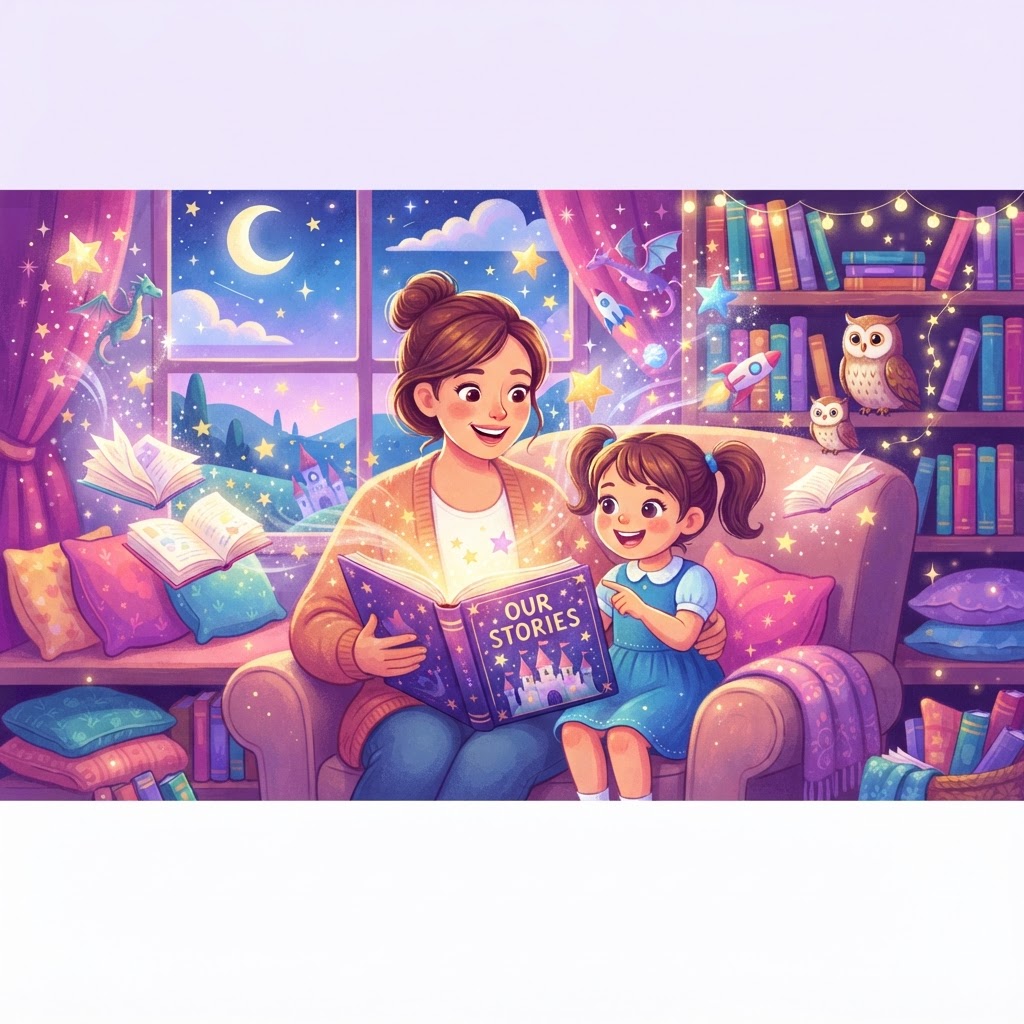
If you want to help kids write stories, start by making storytelling feel playful, not like homework. Children learn to write stories best when adults treat their ideas with real interest, offer just enough support, and give them simple structures they can use again and again.
The good news is that child creative writing does not begin with perfect spelling or long paragraphs. It begins with talking, pretending, drawing, dictating, and retelling. Whether your child is 2 or 10, storytelling for kids grows through conversation, repetition, and encouragement.
Why is storytelling such a powerful way to build writing skills?
Storytelling is one of the most natural ways children learn language, imagination, and sequence. When children tell stories, they practice vocabulary, memory, emotions, and cause-and-effect thinking all at once.
Research and classroom practice both support this. Early childhood experts at the National Association for the Education of Young Children emphasize that oral language, play, and dictation are foundational to literacy. Child development research also shows that back-and-forth conversation helps build language and thinking skills; the Harvard Center on the Developing Child describes these responsive interactions as essential for learning.
In practice, story writing helps children:
- organize their thoughts
- understand beginnings, middles, and endings
- express feelings safely
- build vocabulary
- strengthen reading and writing confidence
If your child already loves books, you can build on that by using expressive read-alouds and noticing how stories work. This guide on reading aloud with expression can help you turn story time into a writing lesson without making it feel like one.
How can you help kids write stories at each age and stage?
The best way to help depends on your child’s developmental stage. Young children need oral storytelling and play, while older children can handle more structure and independence.
What works for toddlers and young preschoolers?
For toddlers, story writing looks like talking and pretending. Ask simple prompts such as “What happened to the bunny?” or “Where is the truck going?” and write down their exact words.
At this age, focus on:
- naming characters
- describing actions
- using repetition
- connecting stories to daily life
A toddler’s story may be only two lines long: “Doggy runs. Doggy finds moon.” That counts. Dictation is a well-known early literacy practice because it shows children that their spoken words can become written language.
What works for older preschoolers and kindergarteners?
Preschoolers do well with shared storytelling. Let them draw first, then tell you what is happening, and write their words underneath the picture.
You can also try:
- story baskets with toys or puppets
- “once upon a time” sentence starters
- picture sequencing cards
- retelling favorite books with silly changes
If your child loves art, turning pictures into plots is especially effective. You can use story ideas from drawings to move naturally from image-making into writing.
What works for early elementary children?
Children in grades K-2 are ready for a basic story frame. They still need lots of support, but they can begin to generate characters, settings, and problems on their own.
Helpful supports include:
- sentence stems
- mini story planners
- word banks
- invented spelling without too much correction
At this stage, confidence matters more than correctness. According to literacy experts at Reading Rockets, writing develops best when children have meaningful reasons to communicate and adults respond to their ideas, not just errors.
What works for older elementary children?
Children in grades 3-5 can usually plan, draft, revise, and share stories with more independence. They benefit from learning how authors build tension, describe characters, and revise endings.
You can support them by asking coaching questions like:
- “What does your character want?”
- “What problem gets in the way?”
- “How will the ending change them?”
This is where scaffolding, a teaching approach linked to Lev Vygotsky’s work, is so useful: give help at the start, then step back as your child grows more capable.
What simple story structure helps children get started?
A simple structure is the fastest way to reduce blank-page anxiety. Most children can write more easily when they know a story needs a character, a setting, a problem, and a solution.
Try this four-part framework:
- Character: Who is the story about?
- Setting: Where and when does it happen?
- Problem: What goes wrong or what does the character want?
- Solution: How is the problem solved?
You can turn that into a child-friendly formula:
Somebody + wanted + but + so + then
For example:
- Somebody: Mia the dragon
- Wanted: to win the moonlight race
- But: her wings were too small
- So: she built a wind kite
- Then: she discovered cleverness can beat speed
This framework works because it teaches narrative logic without overwhelming children. If your child needs an even easier starting point, use story templates to give them a ready-made shape they can personalize.
How can parents support child creative writing without taking over?
The best support is gentle, specific, and child-led. Your job is to coach, not co-author.
A helpful rhythm is:
- Listen first: Let your child talk through ideas.
- Ask one question at a time: Too many questions can shut creativity down.
- Praise craft, not just outcome: Say “I love how you made the ending surprising.”
- Save correction for later: Fixing every spelling mistake can break momentum.
- Celebrate sharing: Read stories aloud at bedtime or to family members.
One of the strongest approaches from creative writing pedagogy is the process model: plan, draft, revise, share. Children do not need to master all four stages at once, but they should see that stories can grow over time.
It also helps to create a regular routine. Even 10 minutes after dinner or before bed can work. If you want a consistent family rhythm, this guide to a bedtime story routine can make storytelling feel easy and repeatable.
How can AI support storytelling for kids without replacing your child’s voice?
AI can be a helpful writing partner when it expands your child’s ideas instead of doing all the creative work. The goal is to keep your child in charge of the characters, choices, and meaning.
Here are smart ways to use AI:
- brainstorm names, settings, or plot twists
- turn a child’s spoken idea into a readable draft
- offer age-appropriate sentence starters
- generate alternative endings for revision practice
- create personalized stories that model structure
For example, your child might say, “I want a story about a shy robot who loses his laugh.” You can use that idea to create your own personalized bedtime story, then ask your child what should change. That moves them from passive consumer to active author.
To use AI well:
- stay with your child during use
- protect personal information
- treat AI output as a draft, not the final answer
- invite your child to revise details, dialogue, and ending
- save favorite versions so children can compare their growth later in your story library
For classrooms, AI works best as a scaffold for brainstorming, differentiation, and publishing, not a replacement for original thinking.
What prompts help kids write stories when they feel stuck?
Good prompts lower pressure and spark imagination. The best prompts are specific enough to start a story but open enough for a child to make it their own.
Try these 10 writing prompts:
- A tiny giraffe wakes up and finds a giant hat on the floor.
- Your teddy bear can talk, but only after midnight.
- A child opens the fridge and discovers a snowy world inside.
- A dragon is afraid of fire and wants to learn how to bake instead.
- A lost rainboot keeps hopping from house to house.
- A classroom plant starts giving advice during math time.
- A pirate finds treasure, but it is not gold.
- A squirrel wants to build the world’s coziest treehouse.
- On the first day of summer, the sun forgets to rise.
- A child hears a knock on the window from a friendly moonbird.
If your child freezes when asked to “write,” invite them to tell the story first. Oral rehearsal is a proven support in child creative writing because it helps children organize ideas before they worry about handwriting or spelling.
How can you make story writing feel fun enough to last?
Story writing lasts when it feels meaningful, social, and doable. Children keep writing when their stories are heard, saved, revisited, and enjoyed.
Simple ways to build momentum:
- make a family story notebook
- read your child’s stories aloud at bedtime
- let siblings illustrate each other’s tales
- revisit favorite characters in sequels
- pair story time with drawing or pretend play
You can also connect writing to reading challenges, seasonal themes, or classroom projects. If you want more family literacy ideas, you’ll find extra inspiration on the InstaTales blog.
Frequently Asked Questions
At what age can children start writing stories?
Children can start storytelling long before they can write sentences. Toddlers can dictate stories aloud, and preschoolers can tell stories through drawings, play, and simple narration.
What if my child says they do not know what to write?
Start with talk, not writing. Give a simple prompt, use a favorite toy or picture, and ask your child to tell you what happens first.
Should I correct spelling and grammar right away?
Usually, no. During early drafting, focus on ideas and flow first, then help with editing later so creativity is not interrupted.
Is AI good for child creative writing?
Yes, if it is used as a support tool rather than a replacement. AI can help with brainstorming, structure, and personalization, but children should still make the key story decisions.
How long should a story-writing session be?
Short sessions often work best. For many children, 10-20 minutes is enough to keep the activity fun and productive.
What if my child prefers drawing to writing?
That is completely fine and developmentally appropriate. Drawing is often the bridge into storytelling for kids, and many strong stories begin as pictures before they become words.
Ready to Create a Personalized Bedtime Story?
Use our free AI bedtime story generator to create a personalized illustrated story for your child in 30 seconds — no credit card needed.
Popular story types:
Maya Rodriguez
Lead Content Editor & Early Literacy Specialist
Maya is a former early childhood educator and literacy specialist with over a decade of experience helping children develop a love of reading. She leads content at InstaTales, where she writes about the science of storytelling, child development, and how families can use personalized AI stories to build literacy and emotional resilience.
instatales.ai