Educational Bedtime Stories That Never Feel Like Lessons
Bedtime stories can be both fun and educational. Here's how to sneak learning into your child's favorite stories without them noticing.
✦ Key Takeaways
- •Educational bedtime stories work because stories help children connect emotion, language, and memory.
- •The best way to teach through stories is to choose one small learning goal and hide it inside a fun plot.
- •Children can learn language, science, morals, and social skills from the same story when the ideas are woven naturally into the action.
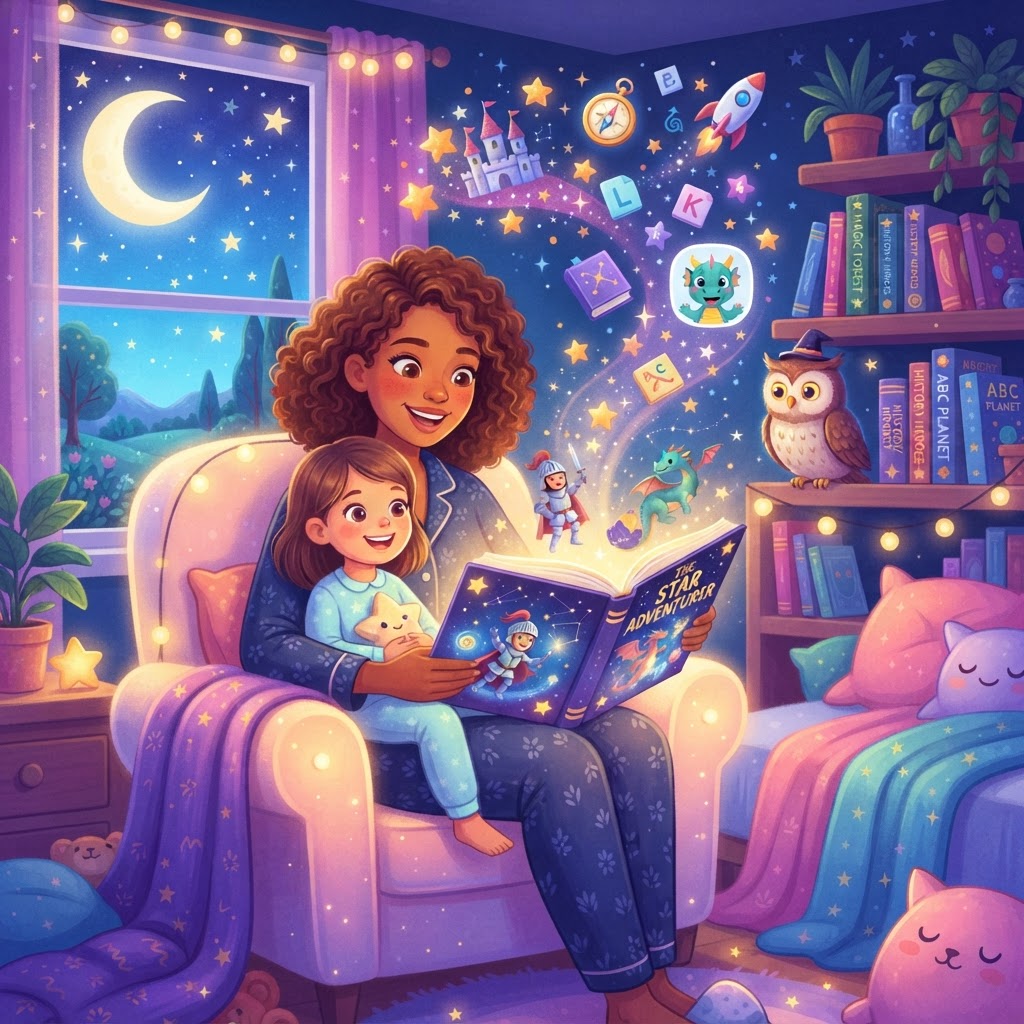
Bedtime is one of the best times for learning through stories because children are calm, close to you, and ready to imagine. The trick is simple: make the story come first and the lesson ride quietly in the background. When children laugh, predict, repeat, and care about the characters, they learn new words, ideas, and social skills without feeling like they are being taught.
Good educational bedtime stories do not sound like mini lectures. They feel warm, playful, and personal. Whether you tell stories from memory, use picture books, or create your own personalized bedtime story, you can turn bedtime into a powerful learning moment while still protecting the magic.
Why do educational bedtime stories work so well?
Educational bedtime stories work because stories help children connect emotion, language, and memory. Kids remember ideas better when those ideas are wrapped inside a character, a problem, and a satisfying ending.
Shared reading supports far more than literacy. The American Academy of Pediatrics recommends reading aloud from infancy because it builds language, strengthens relationships, and supports healthy development. The Harvard Center on the Developing Child also explains that warm, responsive interactions are key to early brain development.
In practice, this means bedtime stories can support:
- Vocabulary growth
- Listening and attention
- Background knowledge
- Emotional understanding
- Moral reasoning
- Social problem-solving
That is why educational storytelling works best when it feels relational, not instructional.
How can you teach through stories without making bedtime feel like school?
The best way to teach through stories is to choose one small learning goal and hide it inside a fun plot. If you try to teach too much at once, children notice the agenda and lose interest.
A simple formula helps:
- Start with a child’s favorite topic: dinosaurs, mermaids, trucks, pets, space
- Add one learning layer: one new word, one science idea, one social skill
- Keep the conflict child-sized: lost mitten, nervous first day, sharing a toy
- End with comfort, not a quiz
For example, instead of saying, “Tonight we are learning about weather,” tell a story about a bunny who wants to fly a kite before the wind changes. The child still learns about breeze, clouds, and storms, but the story feels alive.
It also helps to keep stories predictable at bedtime. Familiar structure makes children feel safe and ready to engage. If you want that calm rhythm, a consistent bedtime story routine makes educational stories much easier to enjoy.
What can children learn from bedtime stories?
Children can learn language, science, morals, and social skills from the same story when the ideas are woven naturally into the action. You do not need separate “teaching stories” for each subject.
Vocabulary
Stories are a gentle way to introduce rich words in context. A child is more likely to understand enormous, fragile, or curious when those words describe a dragon egg, a snowflake castle, or a mouse detective.
Try to:
- Use 1-3 new words in one story
- Repeat each word naturally
- Give context clues instead of stopping to define everything
Science facts
Science works beautifully in story form because children already love asking “why?” A story about a seed, a shadow, or a rainbow can carry real facts while keeping wonder at the center.
You might include:
- Plant growth
- Animal habitats
- Day and night
- Weather changes
- Simple machines
Moral lessons
Moral learning sticks better when children see a character make a choice and live with the result. A lecture about honesty is easy to ignore. A story about a fox who hides a broken lantern and then must fix the problem is more memorable.
Social skills
Bedtime stories are also ideal for teaching turn-taking, empathy, apology, patience, and flexibility. This matters because social understanding grows through repeated examples, not one big talk.
If you want story ideas that fit your child’s stage, this guide to story types by age can help you match the lesson to their development.
How do you weave vocabulary into a story naturally?
The easiest way to teach vocabulary is to repeat a new word during meaningful moments in the story. Children learn words faster when they hear them in context and connect them to emotion or action.
Here is a simple method educators use in learning through stories:
-
Pick one “golden word.”
Choose a useful, vivid word such as soar, tiny, patient, or investigate. -
Use it three times in different ways.
“The owl was patient.” “He waited with patient eyes.” “Being patient helped him hear the cricket.” -
Invite a low-pressure response.
Ask, “Have you ever had to be patient like the owl?” That is conversation, not a test.
Research on repeated read-alouds, including guidance from Reading Rockets, shows that repetition and discussion support comprehension and vocabulary growth. In other words, if your child wants the same story five nights in a row, that is not a problem. It is often where the learning happens.
How can you add science facts, moral lessons, and social skills without sounding preachy?
To avoid sounding preachy, let the character discover the lesson instead of having the narrator explain it. Children engage better when they infer the message through the plot.
Use these strategies:
-
Show cause and effect.
If a character forgets to water a plant, the drooping leaves create the teaching moment. -
Let characters make mistakes.
Perfection is boring. Learning is more believable when a character gets something wrong first. -
Keep facts short and accurate.
One true line is enough: “Owls are awake at night because they are nocturnal.” -
Use dialogue for social learning.
“Can I have a turn when you’re done?” teaches more naturally than “We should share.” -
End with emotional resolution.
Comfort matters at bedtime. Even when a lesson is included, the ending should feel safe.
This is also where personalized stories shine. A child who resists sharing may listen more openly if the lesson appears in a story about their favorite pirate, puppy, or astronaut. Using ready-made story templates can help you build that balance quickly, then save the winners in your story library for re-reading.
What are five educational story prompts you can use tonight?
The best educational story prompts combine a child’s interests with one clear learning goal. Here are five prompts that make educational storytelling feel playful, not heavy.
-
Vocabulary prompt:
“Tell a bedtime story about a shy fox who learns the words brave, whisper, and explore while searching for a glowing berry in the forest.” -
Science prompt:
“Create a gentle story about a little raindrop named Pip who travels through clouds, rain, puddles, and sunshine to explain the water cycle.” -
Moral lesson prompt:
“Write a cozy story about a bear who breaks his sister’s toy boat and must decide whether to hide it or tell the truth.” -
Social skills prompt:
“Tell a story about two dinosaur friends who both want the same swing and learn how to take turns and use kind words.” -
Emotional learning prompt:
“Create a calming bedtime story about a young astronaut who feels nervous before sleeping on a space station and learns three ways to feel safe and calm.”
To make these prompts work even better, personalize the main character, setting, or challenge around your child’s current interests. You can also adapt old favorites, legends, or family memories. For inspiration, the InstaTales blog has more ideas for parents who want stories with both heart and purpose.
How can parents use AI to support educational storytelling well?
AI can be a helpful tool for educational bedtime stories when parents stay in charge of the tone, lesson, and age level. It works best as a creative assistant, not a replacement for connection.
A thoughtful approach looks like this:
- Choose one goal for the story
- Keep prompts age-appropriate and simple
- Read the story aloud yourself when possible
- Adjust any facts, tone, or wording before bedtime
- Reuse favorite stories for repetition and comfort
AI is especially useful when you want to match a story to a child’s exact interests or current challenge. If your child is obsessed with trains but needs help with frustration, you can create that blend in minutes. It also helps busy parents keep a steady reading habit, which is often more important than making every story perfect.
Frequently Asked Questions
What makes a bedtime story educational?
A bedtime story is educational when it builds a child’s language, knowledge, or social understanding while still feeling enjoyable. The key is that the story leads, and the lesson stays gentle and woven into the plot.
How many learning goals should one story include?
Usually, one main goal is best. You can add a light secondary idea, but too many lessons can make the story feel forced and less relaxing.
Are educational bedtime stories good for toddlers?
Yes, but keep them very simple. Toddlers learn best from repetition, clear emotions, familiar routines, and one small idea like a new word, an animal fact, or a sharing moment.
How can I tell if my child is learning from stories?
Look for small signs: your child repeats a new word, asks a related question, retells part of the plot, or uses a social skill from the story in real life. Learning often shows up later, not during the reading itself.
Can AI-generated stories be educational?
Yes, if the prompt is thoughtful and the adult checks the final story for accuracy, tone, and age fit. AI can make personalization easier, but the human connection during reading is still what gives the story its real power.
Ready to Create a Personalized Bedtime Story?
Use our free AI bedtime story generator to create a personalized illustrated story for your child in 30 seconds — no credit card needed.
Popular story types:
Maya Rodriguez
Lead Content Editor & Early Literacy Specialist
Maya is a former early childhood educator and literacy specialist with over a decade of experience helping children develop a love of reading. She leads content at InstaTales, where she writes about the science of storytelling, child development, and how families can use personalized AI stories to build literacy and emotional resilience.
instatales.ai