How Personalized Stories Boost Children's Reading Comprehension
Research shows personalized stories improve children's reading comprehension and engagement. Here's why seeing themselves in stories helps kids learn — and how to use it.
✦ Key Takeaways
- •Self-referential encoding is the cognitive process by which the brain stores information more deeply when it connects to the self.
- •Yes — and the evidence is specific.
- •Attention is the gateway to all learning — and it's famously hard to sustain in young children.
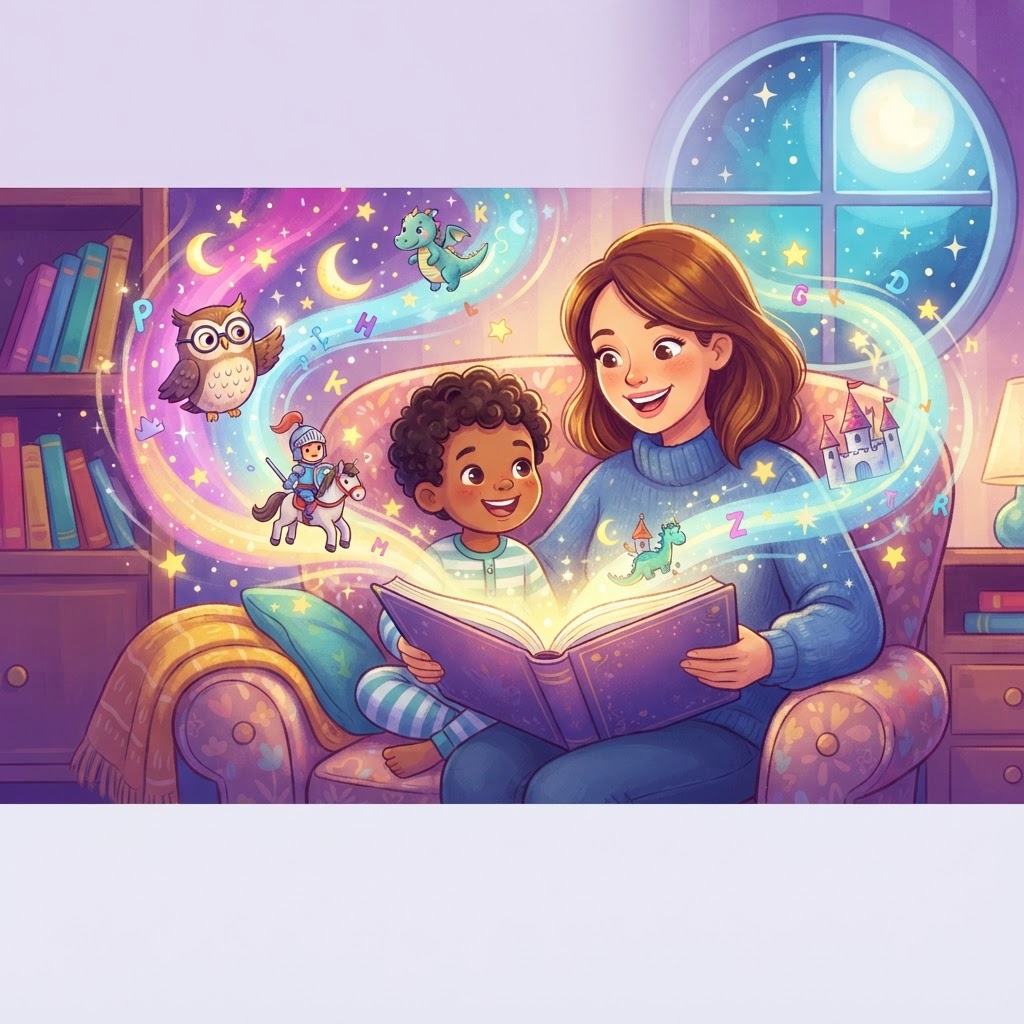
Every parent has watched it happen: you mention your child's name in a story and their eyes light up. They lean in. They listen. That moment isn't just adorable — it's backed by decades of cognitive science. When children see themselves in a story, something powerful happens in their brains that goes far beyond simple enjoyment. Research increasingly shows that personalized children's books can meaningfully improve reading comprehension, vocabulary retention, and long-term literacy motivation. Here's what the science says — and how you can use it at home.
What Is Self-Referential Encoding, and Why Does It Matter for Kids?
Self-referential encoding is the cognitive process by which the brain stores information more deeply when it connects to the self. Put simply: when something feels personally relevant, we remember it better. This effect was first documented in adults during the 1970s by psychologists Rogers, Kuiper, and Kirker, and later research confirmed that the same mechanism operates powerfully in children.
When a child hears a story where the main character shares their name, their interests, or their family situation, their brain processes that narrative differently. The prefrontal cortex and medial regions associated with self-identity become more active, creating stronger, more retrievable memory traces. For early literacy, this means comprehension isn't just improved in the moment — the story sticks.
The University of Michigan's research on self-referential processing and related memory formation helps explain why personalised learning experiences consistently outperform generic ones across age groups. When the story is about me, I pay closer attention, understand more deeply, and remember longer.
Does Research Support Personalized Stories for Reading Comprehension?
Yes — and the evidence is specific. A study published in the Early Childhood Research Quarterly examined how character similarity affected young children's engagement and comprehension during shared reading. The findings were clear: children who identified with the story's protagonist showed significantly higher levels of engagement, asked more questions about the text, and demonstrated better recall of story events compared to children who read stories with dissimilar characters.
This matters enormously for personalized stories and reading comprehension. Comprehension isn't a passive process — it requires children to actively build meaning by connecting new information to what they already know. When a child sees a character who shares their name, their love of dinosaurs, or their fear of the dark, they have an immediate mental bridge. That bridge makes comprehension easier, faster, and more durable.
Beyond the Early Childhood Research Quarterly, the broader literacy research community has consistently found that motivation is one of the strongest predictors of reading success. And nothing boosts reading motivation quite like feeling seen.
How Does Personalization Improve Children's Attention During Story Time?
Attention is the gateway to all learning — and it's famously hard to sustain in young children. Custom storybooks that incorporate a child's name, appearance, favourite animals, or real-life friends give the brain a compelling reason to stay engaged.
Cognitive load theory helps explain this. When children encounter unfamiliar characters in generic stories, some mental effort goes toward building a basic model of who that character is. Personalized stories skip that step entirely. The child already knows the character. That freed-up cognitive bandwidth can go directly toward comprehension — following plot, understanding cause and effect, and absorbing new vocabulary.
Parents and educators often report that children who are normally wiggly and distracted during story time will sit still and focused through a personalized story. That's not a coincidence. It's self-referential encoding in action.
Can Personalized Learning Stories Build Emotional Connection to Reading?
Absolutely — and emotional connection is one of the most underrated factors in early literacy development. When children feel emotionally invested in a story, they're more likely to ask to hear it again, more likely to discuss it afterward, and more likely to make connections to their own lives. All of these behaviours reinforce comprehension.
Personalized learning stories create what researchers call narrative transportation — the feeling of being genuinely inside the story world. Children who experience narrative transportation consistently show better story recall and deeper thematic understanding. They don't just remember what happened; they understand why it happened and how it made the characters feel.
This emotional layer also builds a positive association with books and reading itself. A child who thinks "reading is something that happens to me and for me" is far more likely to become a lifelong reader than one who sees books as external, generic objects.
At InstaTales, every story is built around the individual child — their name, their interests, their world — which is precisely why so many parents report their children asking for the same personalized story night after night.
What Are 5 Practical Ways to Maximize Comprehension with Personalized Stories?
Getting the most out of personalized children's books doesn't require a teaching degree. These five strategies are simple, effective, and easy to weave into your existing bedtime routine.
-
Ask prediction questions before you read. "What do you think [child's name] is going to find in the forest?" Prediction activates prior knowledge and primes the brain for comprehension.
-
Pause at key moments and ask "why" questions. "Why do you think the character felt scared?" Questions that require inference — not just recall — build deeper understanding.
-
Let your child retell the story in their own words. Retelling is one of the most evidence-backed comprehension strategies available. It forces active processing rather than passive listening.
-
Connect the story to real life. "That happened to you when we visited Grandma, didn't it?" Personal connections reinforce the self-referential encoding that makes personalized stories so effective.
-
Read the same story more than once. Repetition isn't boring for young children — it's how they consolidate meaning. Each re-read typically reveals a new layer of comprehension.
The National Reading Panel's guidelines on reading comprehension instruction emphasise that active, meaning-focused engagement — exactly what these strategies encourage — is essential for lasting literacy gains.
Frequently Asked Questions
What age group benefits most from personalized stories?
Children between ages 3 and 8 tend to show the strongest response to personalized stories, as this is the critical window for early literacy development and identity formation. That said, research suggests even toddlers as young as 18 months show increased attention when their name appears in a story. Children up to age 10 can benefit, particularly when personalization extends to interests and experiences, not just names.
How does self-referential encoding differ from standard memorisation?
Standard memorisation often relies on repetition to create surface-level recall, while self-referential encoding creates deep, meaning-based memory traces connected to the child's sense of identity. Information encoded this way is typically easier to retrieve and more resistant to forgetting. It's the difference between remembering a fact and truly understanding something as part of your own experience.
Are personalized children's books better than traditional storybooks?
Personalized and traditional books serve complementary roles in a child's reading diet. Traditional classics build cultural literacy and expose children to diverse perspectives, while personalized stories excel at building engagement, comprehension confidence, and reading motivation. The best approach combines both — and using personalized stories to spark a love of reading can make a child more receptive to all books over time.
Can personalized stories help children who struggle with reading?
Yes — and this is one of the most promising applications of personalization in early education. Children who find reading difficult often disengage because they don't see themselves reflected in the material, compounding their struggles. Personalized stories reduce this barrier by making the content immediately relevant and motivating. Several educators report using personalized books as a re-engagement tool for reluctant readers with meaningful success.
How does InstaTales personalize stories for my child?
InstaTales uses AI to generate unique bedtime stories tailored to each child's name, age, favourite themes, and interests. Parents input a few simple details, and the platform creates an original, age-appropriate story in seconds. Each story is crafted to be warm, imaginative, and genuinely engaging — not just a template with a name swapped in.
Is there a risk of children only wanting to read about themselves?
This is a fair question, but research and practice suggest it isn't a significant concern. Personalized stories typically serve as a gateway — they build the confidence, motivation, and comprehension skills that help children engage with all kinds of books. Think of them as a bridge, not a destination. Most children who fall in love with personalized stories naturally become more enthusiastic readers overall.
The science is clear: when children see themselves in stories, they engage more deeply, comprehend more fully, and remember more lastingly. Self-referential encoding isn't a teaching trick — it's a fundamental feature of how human brains learn. By choosing personalized learning stories and pairing them with active comprehension strategies, you're giving your child one of the most powerful early literacy tools available.
Ready to see the difference for yourself? Create your child's first personalized bedtime story with InstaTales — it takes less than a minute, and the look on their face when they hear their own name in the adventure? That's priceless.
Ready to Create a Personalized Bedtime Story?
Use our free AI bedtime story generator to create a personalized illustrated story for your child in 30 seconds — no credit card needed.
Popular story types:
Maya Rodriguez
Lead Content Editor & Early Literacy Specialist
Maya is a former early childhood educator and literacy specialist with over a decade of experience helping children develop a love of reading. She leads content at InstaTales, where she writes about the science of storytelling, child development, and how families can use personalized AI stories to build literacy and emotional resilience.
instatales.ai