Personalized vs Generic Stories: What Research Says
Are personalized stories really better than generic books? We look at the research on personalization and reading engagement.
✦ Key Takeaways
- •Personalized stories are books that include details connected to a specific child, such as their name, appearance, interests, family members, or daily experiences.
- •Personalization tends to boost engagement because children naturally pay more attention to information that feels personally relevant.
- •Sometimes yes: personalized stories can support comprehension, especially for younger children or when the story connects to familiar experiences.
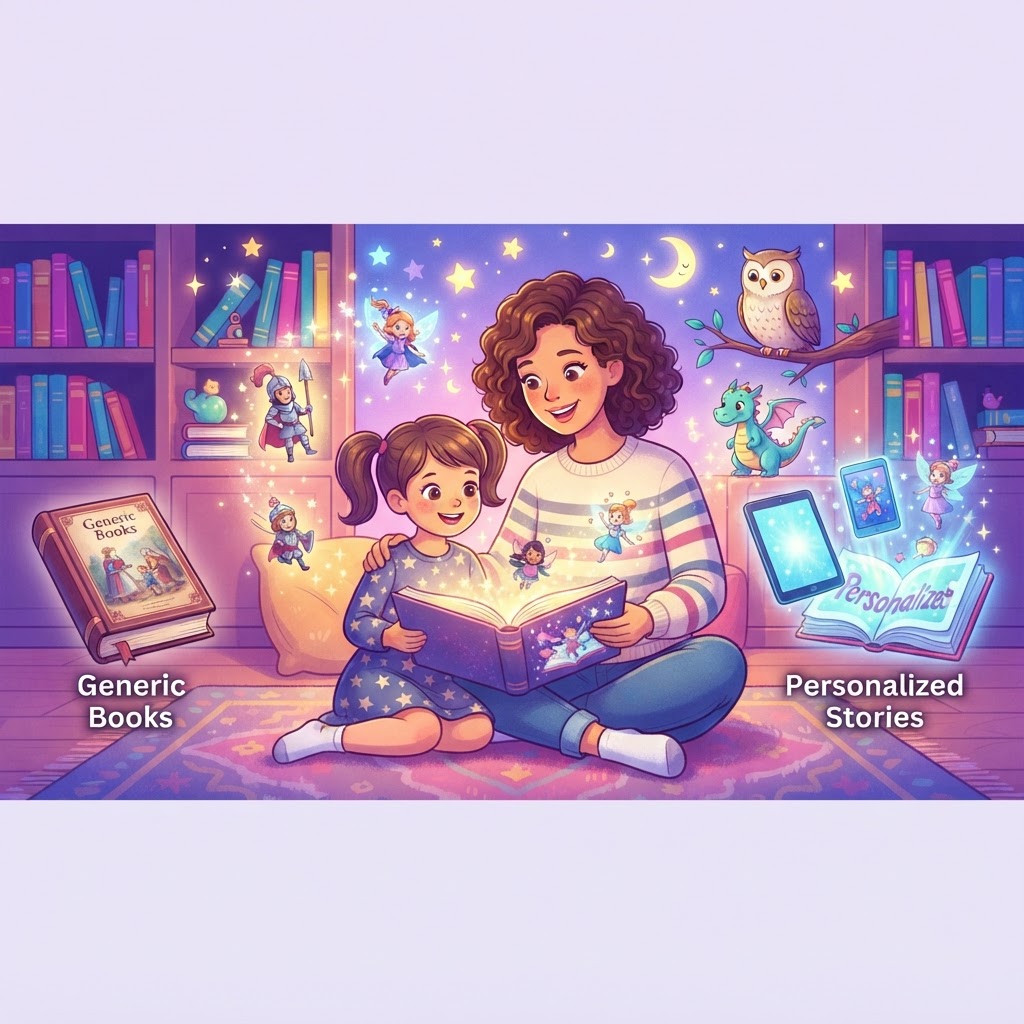
Parents often ask whether personalized stories are actually better than traditional books, or whether they just feel novel. The short answer from personalized books research is this: personalization can improve attention, motivation, and sometimes comprehension, but it is not a magic upgrade in every area. In the debate over personalized vs generic stories, the strongest evidence points to better engagement when children see themselves in the story, while broader outcomes like moral learning depend much more on conversation, repetition, and book quality.
That matters because many families are now choosing between custom storybooks vs regular books at bedtime. A child may light up when their name, favorite toy, or home routine appears in a story. But a beautifully written generic picture book can still do just as much heavy lifting for language, empathy, and family connection.
What do researchers mean by “personalized” stories?
Personalized stories are books that include details connected to a specific child, such as their name, appearance, interests, family members, or daily experiences. Researchers usually separate this from simple customization, because true personalization links story content to what the child already knows about themselves.
This matters because the research is not really comparing “fun books” to “boring books.” It is comparing stories with self-relevant cues to stories without them. In many studies, children see their own name, photo, or familiar settings embedded in the narrative.
A useful concept here is self-referential encoding. In classic memory research, people remember information better when they connect it to themselves. The well-known work of Rogers, Kuiper, and Kirker helped establish this “self-reference effect,” and later developmental research found similar patterns in children: self-linked information often gets more attention and is easier to recall.
For parents, that means a personalized story may help a child mentally say, “This is about me,” which can make the story feel more meaningful from the start.
Why does personalization often boost reading engagement?
Personalization tends to boost engagement because children naturally pay more attention to information that feels personally relevant. When a story includes a child’s name or familiar world, it lowers the barrier to entry and increases emotional involvement.
Researchers such as Natalia Kucirkova, who has studied children’s personalized books extensively, have found that children often show:
- more interest in the story
- longer attention during reading
- more talk about the book
- stronger motivation to revisit it
This fits with broader child development guidance from the American Academy of Pediatrics, which emphasizes that the value of reading is not just the text itself, but the responsive interaction around it. If personalization helps a child lean in, point, comment, and ask questions, it can create richer shared reading moments.
In practice, this is where personalized stories shine most:
- reluctant readers who need a stronger hook
- toddlers and preschoolers who thrive on familiar routines
- children working through big feelings, transitions, or fears
- bedtime reading when attention is already running low
If you want to create your own personalized bedtime story, this is the best lens to use: personalization is most helpful when it gets your child emotionally and verbally involved in the reading experience.
Does personalized books research show better comprehension?
Sometimes yes: personalized stories can support comprehension, especially for younger children or when the story connects to familiar experiences. The effect is usually modest, but it can be real.
Why? Comprehension improves when children can attach new language and events to something they already understand. A story about “you packing your red boots for a rainy-day adventure” may be easier to follow than a story about an unfamiliar child in an unfamiliar setting. Personalization gives children more mental anchors.
Several studies in the personalized reading space suggest children may:
- recall story events more accurately
- retell the story with more detail
- use more language during discussion
- show better understanding of cause and effect in the plot
That said, the evidence is not uniform. Not every personalized book leads to stronger comprehension, and not every child responds the same way. Quality still matters. A weak story with a child’s name inserted into it is not automatically better than a well-written generic book with rich language and clear structure.
This is also where adult reading style matters a lot. Techniques such as asking open-ended questions, pausing for predictions, and inviting children to connect the story to their own life often matter as much as personalization itself. Reading Rockets highlights these dialogic reading practices because conversation is one of the main drivers of deeper understanding.
A simple rule for parents: personalization can open the door to comprehension, but interaction helps children walk through it.
Where do generic books work just as well—or even better?
Generic books often work just as well for vocabulary growth, exposure to complex ideas, and moral learning. In some cases, they may even be better because they introduce children to worlds beyond themselves.
This is the most important nuance in the personalized vs generic stories conversation. Research suggests personalization is strongest for engagement and sometimes comprehension, but the advantage narrows when the goal is learning a moral lesson. A child does not usually become more honest, patient, or kind simply because the main character shares their name.
For moral learning, children need:
- clear cause-and-effect in the story
- repeated exposure to the theme
- adult discussion after reading
- opportunities to practice the value in real life
In other words, a story about responsibility teaches best when you talk about choices, feelings, and consequences, not just when you personalize the character. That is why many excellent generic books remain powerful tools for social-emotional learning. If you are focusing on values, our guides to stories about responsibility and stories about inclusion can help you turn any book into a meaningful conversation.
Generic books also offer something personalized stories cannot always match: distance. Sometimes children understand a difficult topic better when it happens to another character first. That small bit of emotional space can help them reflect more calmly and think more deeply.
How should parents choose between custom storybooks vs regular books?
The best choice is usually not either-or; it is a thoughtful mix. Use personalized books for motivation and connection, and use regular books for breadth, language richness, and exposure to new ideas.
A practical way to decide is to match the book type to your goal.
Choose personalized stories when you want to:
- hook a child who resists reading
- support a bedtime routine
- prepare for a new sibling, school start, or travel
- help a child process a specific fear or experience
- encourage re-reading of the same story
Choose generic books when you want to:
- build vocabulary and background knowledge
- explore diverse characters and settings
- teach literary rhythm, strong storytelling, and humor
- discuss big values without making the child feel singled out
If you use AI-generated stories, keep the same standards you would use with any children’s book. Look for age-appropriate language, a clear plot, emotional safety, and a satisfying resolution. Saving favorites in your story library can also help because rereading is where many learning gains actually show up.
For educators, the same principle applies in classrooms. Personalization can increase participation, but it works best alongside high-quality instruction and discussion, not instead of them. Teachers using InstaTales for teachers can think of personalized stories as a scaffold for literacy, not a replacement for a strong reading curriculum. For broader evidence-based literacy guidance, the U.S. Department of Education’s What Works Clearinghouse is a useful starting point.
What is the smartest way to use personalized stories at home?
Use personalized stories as a bridge, not the whole bookshelf. They work best when they help children enter reading with confidence and joy, then expand outward into other books.
A balanced home reading routine might look like this:
- one personalized bedtime story during the week
- several traditional picture books with rich language
- re-reading favorites for fluency and comfort
- short follow-up conversations about feelings, choices, and new words
This approach gives children the best of both worlds. They get the motivational spark of seeing themselves in a story, plus the developmental benefits of meeting characters who are different from them.
If you want more ideas, the InstaTales blog has practical guides for turning story time into a stronger literacy routine. The research does not say personalized books are always better. It says they are especially useful for engagement, sometimes helpful for comprehension, and most effective when paired with responsive adults and a varied reading diet.
Frequently Asked Questions
Are personalized stories better than generic books?
Not across the board. Personalized stories often improve engagement and interest, but generic books can be just as strong for language growth, imagination, and moral learning.
What does the research say about personalized books?
Personalized books research suggests that self-relevant details can increase attention, recall, and discussion. The strongest benefits appear in engagement, with mixed but promising findings for comprehension.
Do children learn morals better from personalized stories?
Usually not just because the story is personalized. Moral learning depends more on discussion, repetition, and helping children connect the lesson to real-life choices.
Are custom storybooks vs regular books a good choice for reluctant readers?
Yes, custom storybooks can be especially helpful for reluctant readers because they make reading feel immediately relevant. Seeing their own name and experiences in a story can lower resistance and increase curiosity.
Can personalized stories replace traditional bedtime books?
No. Personalized stories are best used alongside traditional books, not instead of them. Children benefit from both self-focused stories and books that introduce new people, places, and ideas.
Ready to Create a Personalized Bedtime Story?
Use our free AI bedtime story generator to create a personalized illustrated story for your child in 30 seconds — no credit card needed.
Popular story types:
Maya Rodriguez
Lead Content Editor & Early Literacy Specialist
Maya is a former early childhood educator and literacy specialist with over a decade of experience helping children develop a love of reading. She leads content at InstaTales, where she writes about the science of storytelling, child development, and how families can use personalized AI stories to build literacy and emotional resilience.
instatales.ai