The Science of Bedtime Stories: 6 Research-Backed Benefits for Child Development
Reading bedtime stories does more than soothe kids to sleep. Here are 6 research-backed benefits of bedtime stories for child development — with studies.
✦ Key Takeaways
- •Yes — and brain imaging studies prove it.
- •Bedtime stories expose children to a far wider range of words than everyday conversation does.
- •Stories are one of the most effective tools for building emotional intelligence in young children.
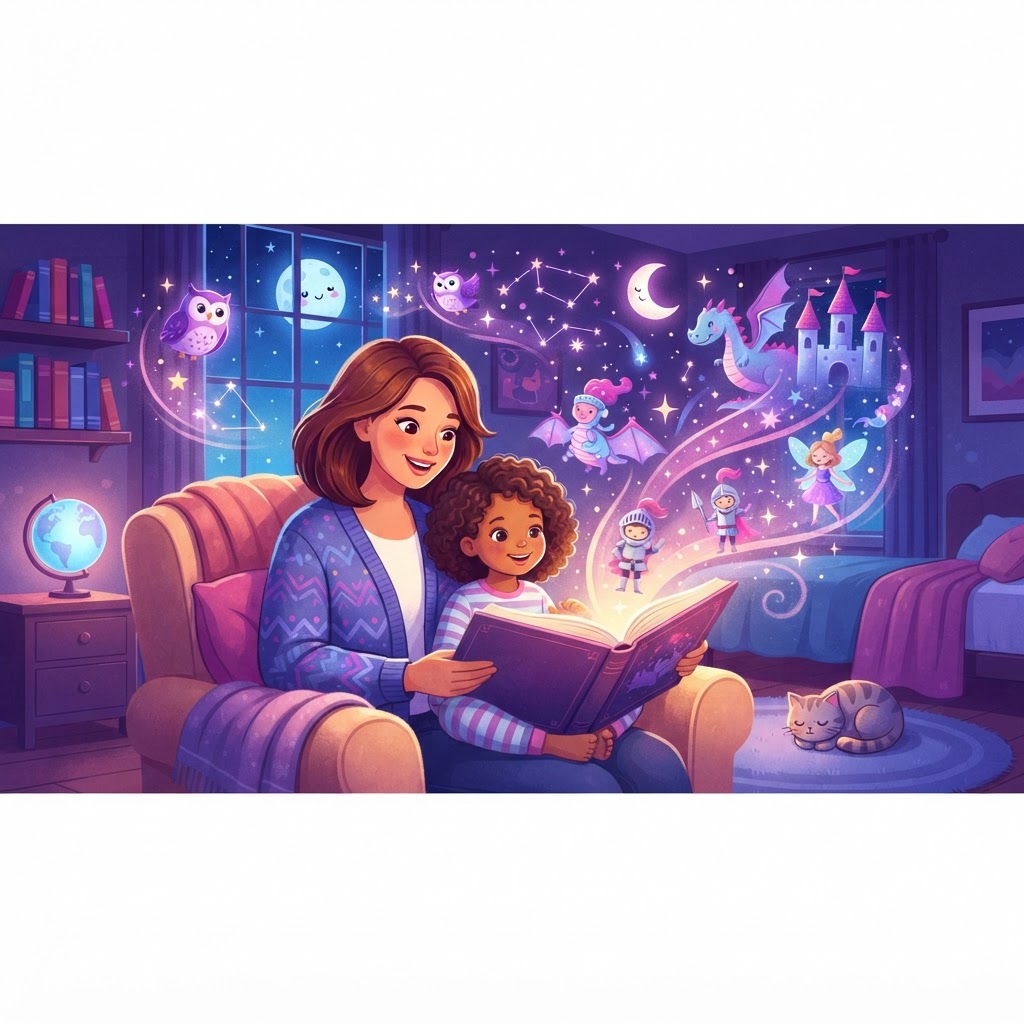
Every parent who has sat with a sleepy child and read Goodnight Moon for the twentieth time knows something instinctively: this moment matters. But the science now confirms just how much. Research from leading institutions — including the American Academy of Pediatrics and Harvard Medical School — shows that bedtime stories aren't just a calming ritual. They are one of the most powerful tools available for shaping a child's developing brain. Here are six research-backed benefits of bedtime stories that every parent should know.
Does Reading Aloud Actually Change a Child's Brain?
Yes — and brain imaging studies prove it. A landmark 2015 study published in Pediatrics used functional MRI scans to observe brain activity in children aged 3–5 while they listened to stories. Children who were read to more frequently at home showed significantly greater activation in the left-hemisphere brain regions associated with narrative comprehension, mental imagery, and language processing.
What's remarkable is that these differences showed up even at rest. The brains of children with rich story-reading histories were structurally primed to process language more efficiently. This is one of the clearest pieces of evidence that bedtime reading benefits go far beyond the moment — they leave a lasting neurological imprint.
How Do Bedtime Stories Build a Child's Vocabulary?
Bedtime stories expose children to a far wider range of words than everyday conversation does. Research from Harvard's Center on the Developing Child highlights that the early years are a critical window for language acquisition, with vocabulary size at age five being a strong predictor of reading comprehension and academic success.
Picture books and children's stories are uniquely rich in what linguists call "rare words" — vocabulary that rarely appears in everyday speech but is critical for reading fluency later on. Studies suggest that:
- Children's books contain 50% more rare words than prime-time television or casual adult conversation
- Regular story-reading can add thousands of words to a child's vocabulary by the time they enter school
- Children who are read to daily score measurably higher on language assessments by age four
The science of reading to children is clear: oral exposure to rich, narrative language builds the internal word bank that fuels later literacy.
Can Stories Help Children Develop Empathy?
Stories are one of the most effective tools for building emotional intelligence in young children. When a child hears a story, they are invited to inhabit another perspective — to wonder why a character is sad, scared, or brave. This imaginative work is the foundation of empathy.
A study from York University found that children who were read fiction regularly demonstrated stronger "theory of mind" — the ability to understand that other people have different feelings, thoughts, and experiences. This isn't a soft benefit. Theory of mind is linked to positive social outcomes, better conflict resolution, and reduced aggressive behaviour in school settings.
For younger children especially, bedtime stories that mirror real emotional experiences — starting school, welcoming a new sibling, feeling afraid of the dark — provide a safe container for processing feelings they may not yet have words for.
Do Bedtime Stories Strengthen the Parent-Child Bond?
Shared reading is one of the richest forms of serve-and-return interaction available to parents. The serve-and-return model — where a child reaches out with curiosity and a caregiver responds with warmth and engagement — is foundational to secure attachment. Bedtime story time is saturated with these moments: pointing at pictures, asking "what do you think happens next?", laughing together, cuddling close.
The American Academy of Pediatrics (AAP) formally recommends reading aloud to children from birth, citing not only cognitive benefits but the relational warmth it creates. In families where co-reading is a consistent ritual, children show stronger attachment security, lower cortisol levels at bedtime, and greater trust in caregivers as a source of comfort and information.
Personalized stories amplify this dynamic further. When a child hears their own name, their pet's name, or their real-life fears and joys woven into a story, the moment becomes even more meaningful — and more memorable. This is one reason why parents using InstaTales often describe the experience as feeling more connected, not less, even though the story is AI-generated.
Why Do Bedtime Stories Help Children Sleep Better?
A consistent bedtime story signals the brain that it's time to wind down — and this signal becomes more powerful over time. Sleep researchers describe this as stimulus control: when a specific behaviour is consistently paired with sleep, the brain begins to associate that behaviour with the onset of rest.
Beyond the conditioned response, the content of stories matters too. Calm, predictable narratives with gentle pacing lower heart rate and reduce the cognitive arousal that keeps children awake. A fixed bedtime reading routine has been shown to:
- Reduce bedtime resistance in children aged 2–8
- Shorten sleep onset time (the time it takes to fall asleep)
- Improve overall sleep duration, which is critical for memory consolidation and immune function
For parents using AI story tools like InstaTales, the ability to generate a calm, age-appropriate, tailored story at any moment makes it easier to maintain that consistent routine — even on travelling nights, difficult evenings, or when the family bookshelf has been exhausted.
How Do Early Stories Lay the Foundation for Reading and Literacy?
Children who are regularly read to arrive at school with the pre-literacy skills that make learning to read dramatically easier. These include phonological awareness (the ability to hear and manipulate the sounds in words), print concepts (understanding that text moves left to right), and narrative comprehension (following the arc of a story).
According to the National Institute for Literacy, children who have been read to regularly are significantly more likely to learn to read on schedule and with fewer difficulties. The bedtime story isn't just entertainment — it's a daily literacy lesson delivered in the most optimal learning state possible: relaxed, emotionally connected, and fully attentive.
Self-referential encoding — a well-documented psychological phenomenon — explains why personalized stories are especially effective here. When a child's own name, experiences, and world appear in a story, the brain processes and retains that information more deeply. InstaTales uses this principle deliberately, creating stories where your child is the hero, which strengthens both engagement and the neural encoding of language patterns.
Frequently Asked Questions
At what age should I start reading bedtime stories to my child?
The American Academy of Pediatrics recommends reading aloud to children from birth. Even newborns benefit from hearing language, rhythm, and the sound of a familiar voice. The earlier you start, the longer the window of neural development you're supporting.
How long should a bedtime story be for a toddler?
For children aged 1–3, 5 to 10 minutes is typically ideal. Toddlers have shorter attention spans and benefit more from repetition and engagement than length. As children grow, story time can naturally extend to 15–20 minutes for children aged 4 and up.
Is it beneficial to read the same bedtime story repeatedly?
Yes — repetition is neurologically valuable for young children. Repeated exposure to the same story deepens vocabulary retention, strengthens narrative comprehension, and gives children the satisfaction of mastery and prediction. If your child asks for the same story again, that's a good sign.
Can AI-generated stories provide the same benefits as traditional books?
Research on self-referential encoding suggests that personalized stories may actually enhance certain benefits, particularly engagement and language retention. The key factor is the quality of the shared reading experience — a parent reading an AI-generated story aloud with warmth and interaction delivers the same neurological and emotional benefits as a traditional picture book.
How many nights per week should we read bedtime stories?
The evidence consistently points to nightly reading as the gold standard. Even 15 minutes per night compounds significantly over time — a child read to nightly from birth to age five accumulates roughly 900 hours of language-rich experience before starting school.
Do bedtime stories help children with anxiety?
Yes, significantly. Consistent bedtime rituals, including story time, have been shown to reduce cortisol levels and bedtime anxiety in young children. Stories that gently address a child's specific fears — with a reassuring resolution — can help children process anxiety in a safe, low-stakes environment.
The evidence is genuinely compelling. From brain activation to empathy, from better sleep to literacy foundations, the humble bedtime story is one of the highest-return investments a parent can make in a child's development. If you're looking for a way to make story time more consistent, more personalised, and more magical — even on the nights when you've run out of inspiration — try InstaTales free and create your child's first personalised bedtime story tonight.
Get a new bedtime story every week
Free, personalized, and delivered to your inbox. No spam, ever.
Ready to Create a Personalized Bedtime Story?
Use our free AI bedtime story generator to create a personalized illustrated story for your child in 30 seconds — no credit card needed.
Popular story types:
Maya Rodriguez
Lead Content Editor & Early Literacy Specialist
Maya is a former early childhood educator and literacy specialist with over a decade of experience helping children develop a love of reading. She leads content at InstaTales, where she writes about the science of storytelling, child development, and how families can use personalized AI stories to build literacy and emotional resilience.
instatales.ai