7 Story-Based Drawing Activities for Kids
Combine storytelling with drawing activities — fun, educational activities that extend the story experience and build skills.
✦ Key Takeaways
- •Story-based drawing activities help children remember, retell, and personalize what they read.
- •A story map is one of the easiest drawing activities for kids because it turns plot into pictures.
- •Character drawing helps children notice details, traits, and emotions.
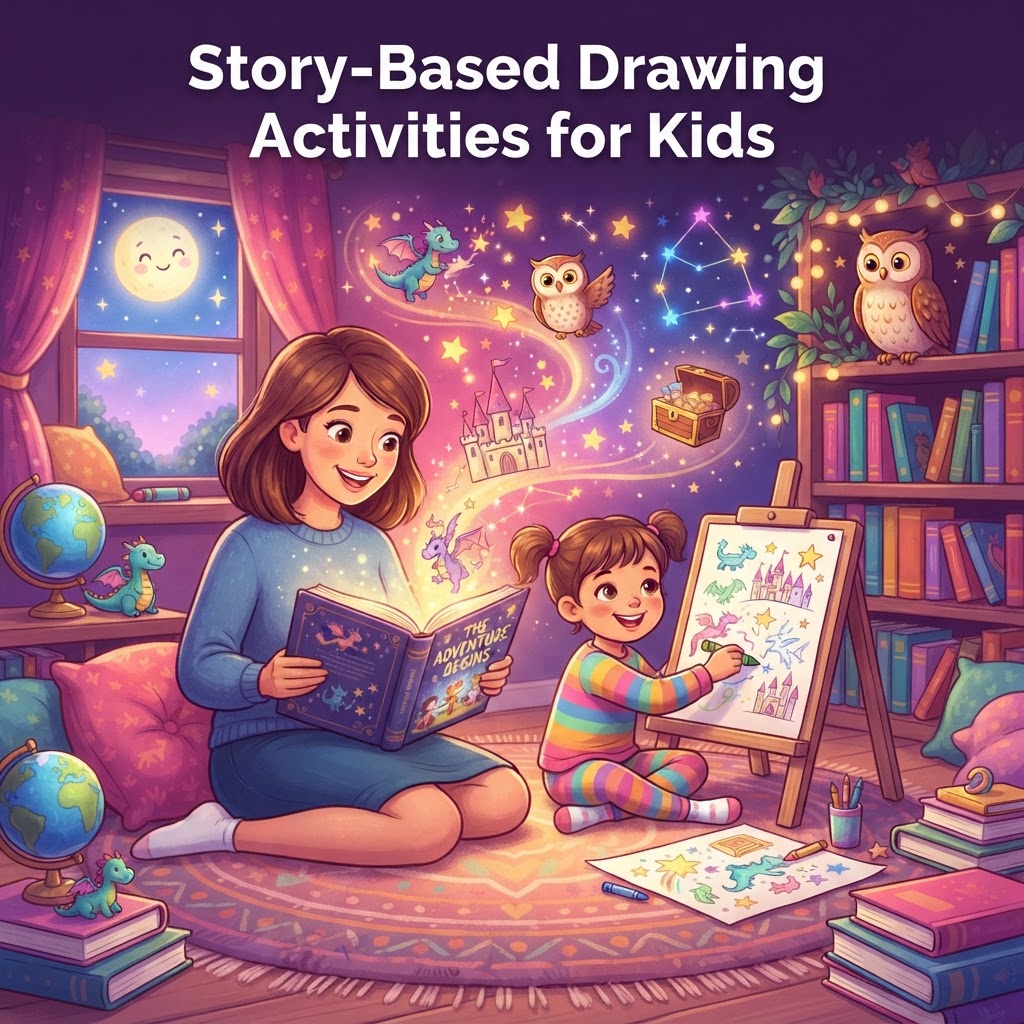
Stories give children something meaningful to draw, and drawing helps them understand the story more deeply. That is why drawing activities for kids work especially well when they start with a character, setting, or problem a child already cares about.
With InstaTales, you can create your own personalized bedtime story in minutes, then turn that story into hands-on art at home or in the classroom. These story-based drawing-activities are simple, low-prep, and designed to build language, memory, fine motor skills, and creative thinking without making art feel like a test.
Why do story-based drawing activities help children learn?
Story-based drawing activities help children remember, retell, and personalize what they read. When a child draws a scene or character, they are practicing comprehension, sequencing, and visual expression at the same time.
This matters for development. The CDC highlights early language, thinking, and fine motor growth as key parts of childhood learning. The Harvard Center on the Developing Child also notes that rich back-and-forth experiences strengthen brain development. Adding drawing to storytime creates exactly that kind of active, responsive learning.
Art should stay open-ended, too. NAEYC recommends process-focused art experiences, which means the value is in the thinking and creating, not in making every picture look “right.” That is why the best drawing activities children do after reading are flexible, playful, and conversation-rich.
How can children make a story map after reading?
A story map is one of the easiest drawing activities for kids because it turns plot into pictures. Children draw the beginning, middle, and end of a story, which strengthens sequencing and recall.
Story prompt
“Can you draw what happened first, next, and last in your InstaTales story?”
Materials needed
- Paper folded into 3 sections
- Crayons, markers, or colored pencils
- Optional: stickers or labels
Instructions
- Read or re-read an InstaTales story from your story library.
- Ask your child to choose 3 key moments.
- Draw one picture in each section: beginning, middle, and end.
- Invite them to tell the story back using their pictures.
- For older children, add a short sentence under each drawing.
Why it works: This activity supports narrative skills and helps children organize events in order. For ages 1-3, keep it to one favorite scene instead of three.
How can kids draw the main character in detail?
Character drawing helps children notice details, traits, and emotions. It also encourages them to connect appearance with personality, which is a strong comprehension skill.
Story prompt
“What does the hero of your InstaTales story look like, and what makes them special?”
Materials needed
- Plain paper
- Markers or pencils
- Optional: yarn, googly eyes, scraps of paper for collage
Instructions
- Choose one main character from the story.
- Ask questions before drawing: What are they wearing? How do they move? What do they love?
- Draw the character large on the page.
- Add 3-5 details from the story, such as a cape, a backpack, or a pet dragon.
- Write or dictate one sentence: “This character is brave/kind/funny because…”
If you need a fast starting point, use one of the InstaTales story templates to generate a story with a strong, easy-to-visualize hero. In class, teachers can turn this into a bulletin board of “story heroes.”
How can children draw the setting to build imagination?
Drawing the setting helps children picture where a story happens and notice descriptive language. It is a simple way to build visualization, which supports reading comprehension.
Story prompt
“Where did the story happen, and what could you see there?”
Materials needed
- Large paper
- Crayons, watercolor, or colored pencils
- Optional: cotton balls, tissue paper, or natural items for texture
Instructions
- Revisit the part of the story that describes the place.
- Ask your child to name what belongs in that setting: trees, stars, castles, waves, snow, or robots.
- Draw the background first, then add details from the story.
- Encourage sensory thinking with prompts like, “Was it bright, cold, quiet, or busy?”
- Add the character into the setting at the end.
This is one of the best story-based drawing-activities for extending vocabulary. Parents can compare two settings from two different stories, while teachers can use it to support descriptive writing after art.
How can kids draw feelings from the story?
Emotion drawing helps children identify feelings in themselves and in story characters. That makes it a strong social-emotional learning activity as well as an art task.
Story prompt
“How did the character feel at different parts of the story?”
Materials needed
- Paper
- Markers or crayons
- Optional: a printed circle divided into 4 parts
Instructions
- Pick 3 or 4 moments from the story.
- Draw the character’s face in each moment with a different emotion: happy, worried, proud, calm, excited.
- Talk about what happened in the story to cause each feeling.
- Ask, “What clues in the picture show that feeling?”
- Older kids can label each emotion and explain why it changed.
If you are using InstaTales for teachers, this works well as a read-aloud follow-up, partner discussion, or morning meeting activity. It is especially useful after stories about friendship, new experiences, or problem-solving.
How can children invent and draw a new ending?
Drawing a new ending builds creativity and flexible thinking. Children move beyond recall and start making original story choices, which is a higher-level literacy skill.
Story prompt
“What if the story ended in a different way?”
Materials needed
- Paper
- Drawing tools
- Optional: a second sheet for “original ending” and “new ending”
Instructions
- Talk through the original ending first.
- Ask your child to imagine one change: a new helper, a surprise twist, or a different choice.
- Draw the new final scene.
- Compare the original ending and the new one.
- Invite the child to narrate their version aloud.
This is a great way to reuse favorite stories without them feeling repetitive. Families can save the original story in your story library and return later to create “version two” artwork after a second reading.
How can kids make a comic strip from a story?
A comic strip turns a story into short visual scenes, which helps children break big events into manageable parts. It is ideal for children who like structure and quick drawing tasks.
Story prompt
“Can you turn your story into 4 little picture boxes?”
Materials needed
- Paper divided into 4-6 boxes
- Pencils, markers, crayons
- Optional: speech bubbles
Instructions
- Choose 4 important moments from the story.
- Draw one event in each box.
- Add simple speech bubbles or sound words like “Wow!” or “Roar!”
- Number the boxes in order.
- Read the comic back together.
For younger children, an adult can draw the boxes and write the words they dictate. For older children, this becomes one of the most effective drawing activities for kids because it combines storytelling, art, and early writing in one page.
How can a group create a collaborative story mural?
A group mural helps children work together while staying connected to one shared story. It is one of the best drawing-activities activities children can do in a classroom, library, or sibling group.
Story prompt
“What big picture can we make together from the story?”
Materials needed
- Large roll paper or poster board
- Crayons, markers, paint sticks
- Optional: labels with children’s names beside their part
Instructions
- Read one InstaTales story aloud to the whole group.
- Assign parts: one child draws the sky, another the house, another the main character, another the animals.
- Encourage children to discuss where each part should go.
- Add details together after the main mural is done.
- Display the finished mural and invite children to retell the story using it.
This activity works beautifully for class projects, reading corners, or homeschool co-ops. If you want more literacy extensions, you can also browse the InstaTales blog for related storytime ideas.
Frequently Asked Questions
What age are story-based drawing activities best for?
These activities work well for ages 1-10 with simple adjustments. Younger children can make one big picture, while older children can add labels, captions, and multiple scenes.
How do I use InstaTales stories for drawing time?
Start by reading the story once for enjoyment, then read it again with a drawing goal in mind. Pick one clear focus, such as the character, setting, or ending, so the activity stays manageable.
What if my child says they “can’t draw”?
Keep the focus on ideas, not perfect pictures. Simple shapes, stick figures, and dictated descriptions still build comprehension and confidence.
Are these drawing activities useful in classrooms?
Yes. They support literacy, speaking, listening, social-emotional learning, and fine motor practice in one lesson. Teachers can use them after read-alouds, during centers, or as quiet early-finisher work.
How long should a story-based drawing activity take?
Most can be done in 10-20 minutes. If a child is deeply engaged, you can extend the activity into a longer art or writing project.
Should I correct the picture if it does not match the story exactly?
Usually, no. Ask curious questions instead, because a child may be adding imagination, making a connection, or remembering a detail in their own way.
Explore More Stories
Ready for more? - free AI bedtime story generator
Get a new bedtime story every week
Free, personalized, and delivered to your inbox. No spam, ever.
Ready to Create a Personalized Bedtime Story?
Use our free AI bedtime story generator to create a personalized illustrated story for your child in 30 seconds — no credit card needed.
Popular story types:
Maya Rodriguez
Lead Content Editor & Early Literacy Specialist
Maya is a former early childhood educator and literacy specialist with over a decade of experience helping children develop a love of reading. She leads content at InstaTales, where she writes about the science of storytelling, child development, and how families can use personalized AI stories to build literacy and emotional resilience.
instatales.ai