Geography Activities for Kids Through Stories
Combine storytelling with geography activities — fun, educational activities that extend the story experience and build skills.
✦ Key Takeaways
- •Story-based geography activities help children understand abstract ideas by attaching them to characters, settings, and action.
- •A story map is one of the easiest geography activities for kids because it turns plot into place.
- •Building landforms helps children see that geography is physical, not just printed on a page.
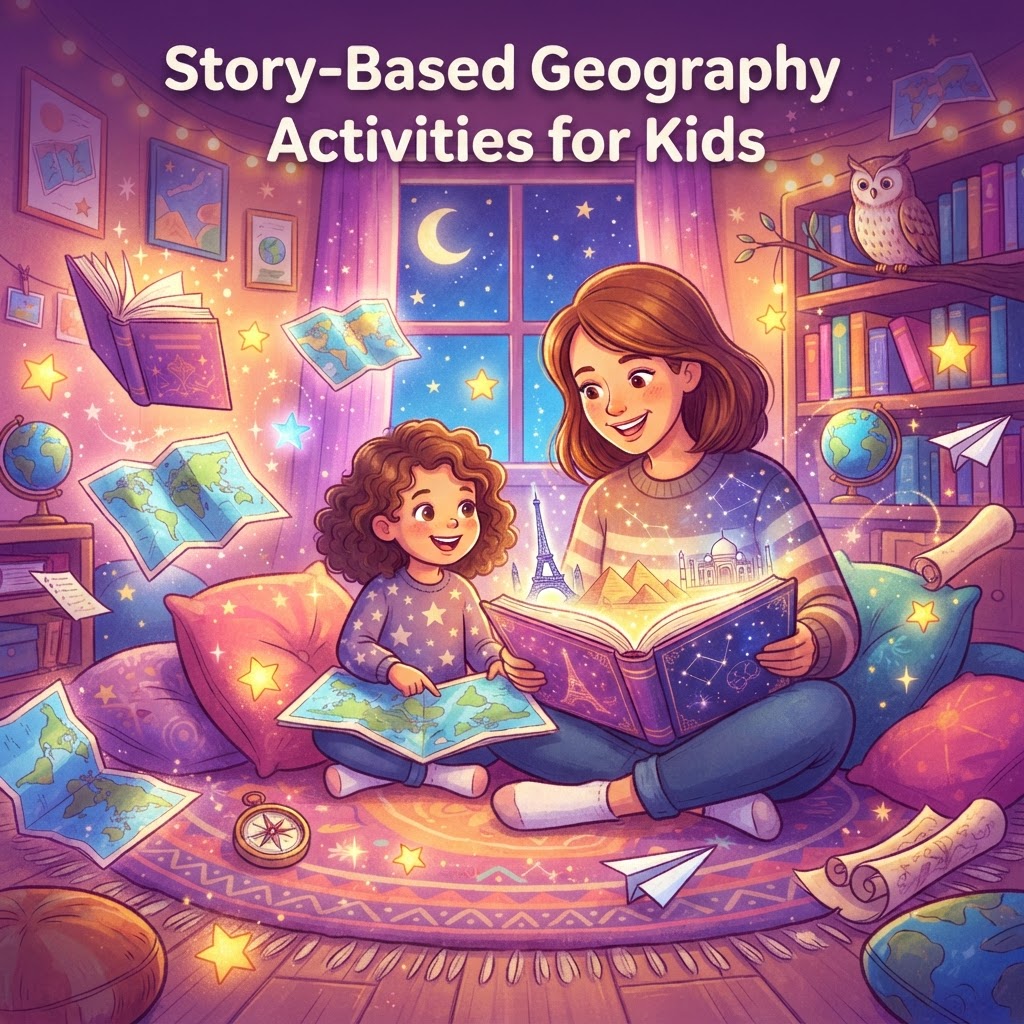
A child who just heard a story set in a rainforest, mountain village, or busy city is already thinking about place, distance, and how people live in different environments. That is why story-based geography activities work so well: stories give children an emotional connection first, then hands-on learning makes the geography stick.
With InstaTales, parents and teachers can create your own personalized bedtime story using a setting that fits the skill you want to teach, such as deserts, oceans, farms, or famous landmarks. You can also save strong setting-rich stories in your story library and revisit them for centers, homeschool lessons, or class projects with InstaTales for teachers. Below, you will find practical geography activities for kids that turn one good story into a full learning experience.
Why do story-based geography activities work so well for kids?
Story-based geography activities help children understand abstract ideas by attaching them to characters, settings, and action. Instead of memorizing map terms, children imagine where a character traveled, what the weather felt like, and why homes or clothing might differ from place to place.
This approach matches what child development experts recommend. The Harvard Center on the Developing Child highlights the value of active, back-and-forth learning experiences for building memory, language, and flexible thinking. Geography also grows best through concrete experiences, and the National Geographic Society has long emphasized map skills, spatial language, and place-based learning in elementary years.
For young learners, keep the goal simple: help them notice where, how far, which direction, and what is different about each setting. That is the heart of effective geography activities for children.
How can a story map help kids follow a character’s journey?
A story map is one of the easiest geography activities for kids because it turns plot into place. When children track where a character goes, they practice sequencing, direction words, and early map-reading skills.
Story prompt
Create an InstaTales story about a child traveling to three places, such as a forest, a river, and a mountain cabin. Ask the story to include movement words like “north,” “across,” “near,” and “far.”
Materials
- Large paper or poster board
- Markers or crayons
- Stickers or cut-out pictures
- Optional toy figure
Instructions
- Read the story once for enjoyment.
- On a second reading, pause each time the character changes location.
- Help your child draw a simple map of the journey.
- Add symbols for key places: a tree for the forest, a blue line for the river, a triangle for the mountain.
- Use arrows to show the route.
For older children, add a map key and compass rose. This is also a great follow-up to family conversation time; if you want more ways to talk through stories, explore these story discussion ideas for families.
What can children learn by building the landforms from a story?
Building landforms helps children see that geography is physical, not just printed on a page. When kids shape mountains, islands, valleys, and rivers from a story setting, they understand how land affects travel, homes, and daily life.
Story prompt
Use an InstaTales story set in a place with clear landforms, such as a dragon living beside a volcano, an explorer crossing a canyon, or a penguin family near icy cliffs.
Materials
- Modeling clay, playdough, or a sensory tray
- Blue paper or foil for water
- Small flags or labels
- Toy animals or figures
Instructions
- Ask your child to name the landforms they heard in the story.
- Build the setting together in a tray or on cardboard.
- Label each feature: mountain, lake, island, hill, river.
- Move the character through the landform model and ask, “Which route is easiest?” or “Why did the character stop here?”
This activity works especially well for ages 4 to 8 because it combines touch, movement, and vocabulary. If your child loves hands-on extension work, pair it with these story-based sensory activities.
How can a weather journal turn a story setting into a geography lesson?
A weather journal teaches children that geography includes climate and seasonal patterns, not just maps. By comparing the weather in a story setting to their own local weather, children start noticing how location shapes daily life.
Story prompt
Generate an InstaTales story set somewhere with strong weather, such as a windy coast, tropical island, snowy village, or desert camp. Ask for details about clothing, sky conditions, and what the character does outdoors.
Materials
- Notebook or printable chart
- Pencils
- Weather icons or stickers
- Access to a local forecast
Instructions
- After reading, ask: “What was the weather like in the story?”
- Draw or write the story weather in one column.
- Compare it with today’s real weather where you live.
- Discuss how the character’s clothes, food, or transport might change because of the weather.
For a classroom extension, students can compare several settings over a week. Resources from NOAA Education can support simple weather learning for children.
How do postcard activities help kids explore world cultures and places?
Postcard writing helps children connect geography with real people, daily life, and cultural awareness. It moves learning beyond “where is it?” to “what might it feel like to live there?”
Story prompt
Create an InstaTales story about a child visiting a new country, region, or community, such as a market in Morocco, a village in Peru, or a fishing town in Japan. Keep the focus on respectful, age-appropriate daily details.
Materials
- Index cards or cardstock
- Crayons or markers
- World map or globe
- Stickers
Instructions
- Ask your child to pretend they are the story character.
- On the front of a postcard, draw the setting from the story.
- On the back, write 2 to 4 sentences: “I visited… I saw… The weather is… People here…”
- Find the location on a globe or world map.
This is one of the most flexible story-based geography activities for mixed ages. Younger children can dictate their message, while older children can add facts they learned from the story or lesson.
How can a treasure hunt teach map symbols and directions?
A treasure hunt makes direction words and map symbols feel purposeful. Children remember geography vocabulary better when they use it to solve a problem inside a story.
Story prompt
Ask InstaTales for an adventure story in which the main character must find a hidden object using clues. Include landmarks such as a bridge, cave, tree, pond, or tower.
Materials
- Simple hand-drawn map
- Small “treasure”
- Sticky notes for clues
- Compass rose drawn on paper
Instructions
- Create a map of one room, the playground, or the classroom.
- Mark 4 to 6 landmarks using symbols.
- Hide the treasure.
- Read the story, then let your child follow map clues such as “Go east past the chair” or “Turn south at the bookshelf.”
- Invite your child to design the next treasure hunt map.
This is excellent for active learners. For even more whole-body extensions, try these story-based movement games.
What does a day-and-night globe activity teach about the world?
A day-and-night activity introduces children to the idea that places around the world experience time differently. It is a simple way to build early global awareness from one memorable story.
Story prompt
Create an InstaTales story about two friends in different parts of the world who are doing different things at the same time, such as one eating breakfast while the other gets ready for bed.
Materials
- Globe or ball
- Flashlight
- Paper and crayons
Instructions
- Shine the flashlight on one side of the globe to represent the sun.
- Show how one part is bright while another is dark.
- Connect it back to the story: “When Maya sees sunrise, Leo sees nighttime.”
- Ask your child to draw what each character is doing.
Keep the explanation simple for younger children. The goal is not mastering time zones; it is understanding that the world is shared by many places at once.
How can parents and teachers make these geography activities easier to use again and again?
The easiest way to repeat geography learning is to build a small routine around story setting, mapping, and discussion. Repetition helps children retain vocabulary, and familiar structures make planning faster for adults.
Try this simple routine:
- Choose one setting-rich InstaTales story each week.
- Ask three questions: Where are we? What is the land or weather like? How does that affect the character?
- Pick one extension activity from this list.
- Save the strongest stories and responses for future reuse.
Teachers can organize these into center rotations, while families can use them as part of bedtime or weekend learning. For more printable and creative extensions, browse the InstaTales blog.
Frequently Asked Questions
What age are these geography activities best for?
Most of these activities work well for ages 3 to 10 with small adjustments. Younger children need more drawing, play, and dictation, while older children can add labels, comparisons, and short written responses.
Do I need to teach maps before doing story-based geography activities?
No. Start with simple location words like near, far, left, right, river, mountain, and road. The story gives children enough context to begin understanding maps naturally.
How can I use InstaTales stories for classroom geography lessons?
Choose a weekly theme such as weather, landforms, or communities, then generate a story that highlights that concept. One story can anchor read-aloud time, a map center, writing practice, and a hands-on project.
What if my child is more interested in fantasy than real places?
That is completely fine. Fantasy stories still teach geography if they include journeys, landmarks, weather, and landforms. You can always connect the imaginary setting to real-world concepts after reading.
Can these activities support literacy as well as geography?
Yes. Children practice listening comprehension, sequencing, vocabulary, oral language, and descriptive writing while learning about place. That is one reason story-based geography activities are so effective for early learners.
Ready to Create a Personalized Bedtime Story?
Use our free AI bedtime story generator to create a personalized illustrated story for your child in 30 seconds — no credit card needed.
Popular story types:
Maya Rodriguez
Lead Content Editor & Early Literacy Specialist
Maya is a former early childhood educator and literacy specialist with over a decade of experience helping children develop a love of reading. She leads content at InstaTales, where she writes about the science of storytelling, child development, and how families can use personalized AI stories to build literacy and emotional resilience.
instatales.ai