Storytelling and Vocabulary: What Research Shows
Stories are one of the richest sources of vocabulary for children. Here's what the research says about storytelling and word learning.
✦ Key Takeaways
- •Storytelling is powerful because stories contain more varied and sophisticated language than daily conversation.
- •Stories help children learn words because they provide context.
- •The most effective storytelling for vocabulary is interactive, expressive, and repeated.
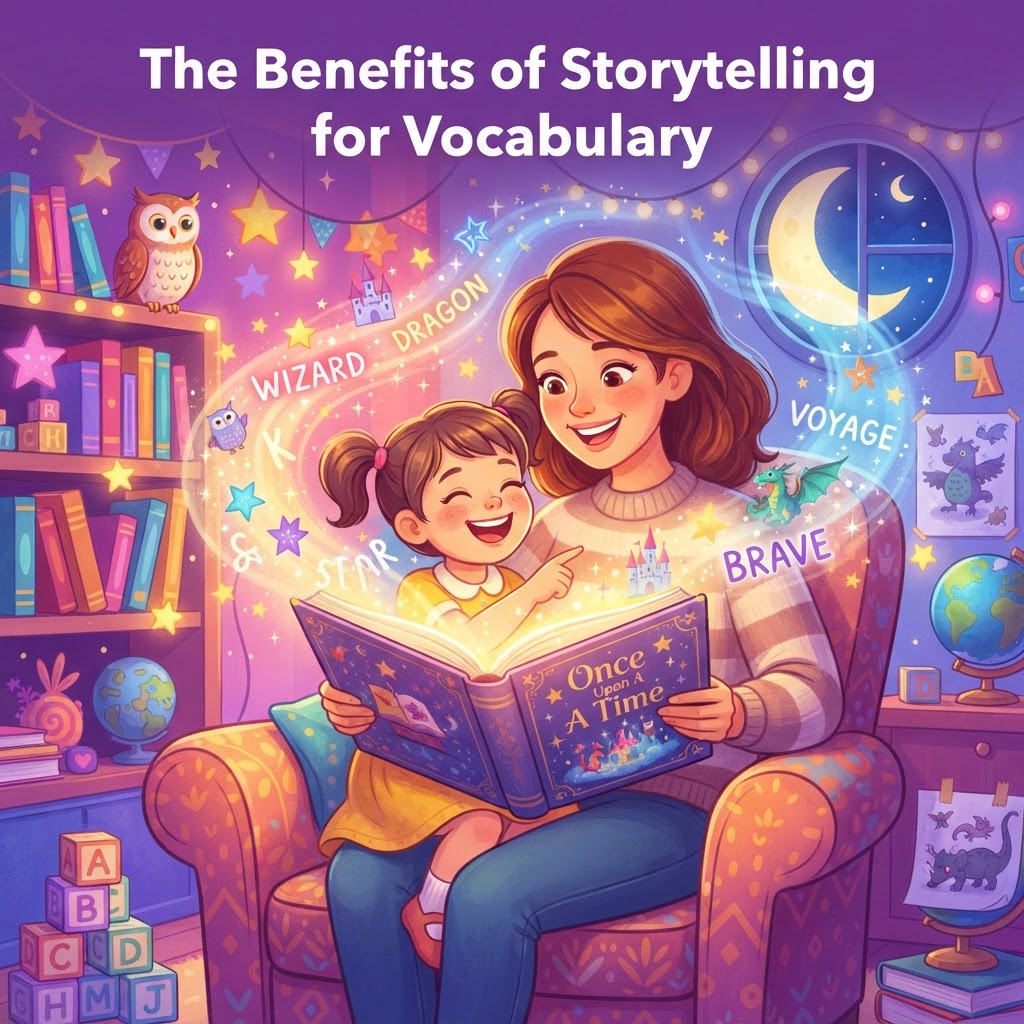
Stories do far more than entertain children. They are one of the best tools we have for building language, because they expose kids to words, ideas, and sentence patterns that do not always show up in everyday talk. If you have ever noticed your child using a new word from a favorite book, you have seen storytelling and vocabulary growth in action.
Research in early literacy consistently shows that stories and word learning go hand in hand. When adults read aloud, tell stories, and talk about what is happening, children hear richer language, connect words to meaning, and get the repetition they need to remember new terms. For parents and teachers focused on vocabulary development children need for reading success, storytelling is not extra. It is foundational.
Why is storytelling such a powerful source of new words?
Storytelling is powerful because stories contain more varied and sophisticated language than daily conversation. In simple terms, books and oral stories often give children access to words they might not hear at the dinner table or on the playground.
Researchers such as Hayes and Ahrens found that written language tends to include more “rare words” than ordinary speech. That matters because children build vocabulary one exposure at a time. The more rich language they hear, the more opportunities they have to learn.
Stories also introduce what educators call decontextualized language. That means language about places, feelings, problems, and events beyond the here and now. A child may hear words like “enormous,” “fragile,” “curious,” or “disappeared” in a story long before those words come up naturally in daily life.
This is one reason the American Academy of Pediatrics encourages shared reading from infancy onward. Story time is not only about enjoying books. It is a key part of language development.
How do stories help children learn the meaning of new words?
Stories help children learn words because they provide context. A new word is much easier to understand when it appears in a meaningful situation, supported by pictures, tone of voice, and action.
Imagine a child hears the word “soared” in a story about a bird flying high above the trees. Even if the word is unfamiliar, the child can use the picture, the plot, and your expression to infer that it means flying upward through the air. This is one of the biggest advantages of stories and word learning: children do not need a dictionary definition first.
Research supports this. Studies by Sénéchal and colleagues found that children can learn vocabulary from storybook reading, especially when adults give simple explanations or revisit the word. Repeated read-alouds give children multiple chances to connect a word with its meaning.
Context works especially well when adults:
- Point to the picture or action
- Briefly explain the word in child-friendly language
- Use the word again later in the story
- Connect it to the child’s own life
That kind of back-and-forth also reflects the “serve and return” interactions highlighted by the Harvard Center on the Developing Child. Children learn language best when adults respond, expand, and engage with them.
What kinds of storytelling best support vocabulary development in children?
The most effective storytelling for vocabulary is interactive, expressive, and repeated. Children learn more when stories are not just delivered to them, but shared with them.
Read-alouds are especially strong for vocabulary development children need because adults can pause, explain, and invite participation. But oral storytelling matters too. Telling family stories, making up bedtime adventures, and retelling familiar tales all build language.
One research-backed approach is dialogic reading, developed by Grover Whitehurst and studied widely in early literacy research. In dialogic reading, the adult turns story time into a conversation by asking prompts, expanding the child’s responses, and encouraging the child to retell parts of the story. Reading Rockets explains dialogic reading well.
Helpful storytelling formats include:
- Shared read-alouds: Great for rich book language and discussion
- Oral storytelling: Builds listening, sequencing, and expressive vocabulary
- Personalized stories: Increase engagement because the child cares about the characters and events
- Story retelling: Helps children use new words actively, not just recognize them
Personalized stories can be especially useful for reluctant listeners. When a child hears a story starring their favorite animal, hobby, or even their own name, they often stay engaged longer. If you want to create your own personalized bedtime story, a tailored plot can make new vocabulary feel more meaningful and memorable.
How can parents and teachers maximize vocabulary growth during story time?
Parents and teachers can maximize vocabulary growth by choosing rich stories, slowing down, and talking about a few useful words. You do not need to teach every unfamiliar word. A small number of well-supported words is often better.
Here are practical strategies that work:
- Pick 2-4 target words in a story, such as “enormous,” “search,” or “patient.”
- Give a quick, simple definition: “Patient means waiting calmly.”
- Ask open questions: “Why do you think the bear was patient?”
- Repeat the word naturally several times during and after the story.
- Act it out or connect it to play so the word becomes real.
- Use the word later in the day: “You were patient while we waited.”
For teachers, this matters across the curriculum. A story about gardening can build science words. A story about feelings can build social-emotional language. That is why literacy-rich classrooms often combine read-alouds, discussion, and play-based follow-up. Educators looking for flexible classroom ideas can explore InstaTales for teachers.
At home, it also helps to keep story time calm and consistent. Many families find that bedtime stories support language while also helping with routine, connection, and rest. If you want to explore those related benefits, our guides on how stories support bonding with children and how storytelling can improve children’s focus and attention are good next reads.
Does re-reading the same story really help with word learning?
Yes, re-reading the same story is one of the best ways to strengthen vocabulary. The first reading helps children follow the plot. The second and third readings free up mental space to notice and remember the language.
Research on repeated storybook reading shows that children often learn more new words when they hear the same story multiple times. This makes sense. Word learning is rarely instant. Children need repeated, meaningful exposure before a word sticks.
Re-reading also lets you go deeper each time. On the first night, you may simply enjoy the story. On the second, you can pause for one or two key words. On the third, you can ask your child to explain or use those words.
This is why it helps to save favorite stories and return to them often. Keeping books or digital stories organized in your story library makes it easier to revisit the same language across days or weeks.
How much storytelling do children need for strong vocabulary growth?
Children benefit most from storytelling when it happens often and consistently. Daily story time, even for 10 to 15 minutes, can make a real difference over time.
There is no magic number of stories per day. What matters more is regular exposure to rich language and active conversation. A short, engaged read-aloud is usually more effective than a long, distracted one.
A good weekly rhythm might include:
- One bedtime story most nights
- Re-reading favorite stories several times
- Talking briefly about a few new words
- Telling oral stories in the car, at meals, or during play
- Letting children retell stories in their own words
Consistency matters because vocabulary grows slowly, through thousands of small moments. The good news is that storytelling fits naturally into family life. It does not require flashcards or formal lessons. It just requires time, attention, and language-rich interaction.
If you want more ideas for building literacy routines, you can browse the InstaTales blog for more research-based articles and practical tips.
What should parents remember most about storytelling and vocabulary?
The most important thing to remember is this: stories build vocabulary best when children are engaged, supported, and given repeated exposure to rich words. Story time is not only about finishing the book. It is about helping language come alive.
Whether you are reading a picture book, telling a made-up dragon adventure, or sharing a personalized bedtime tale, you are doing valuable literacy work. Over time, those small story moments help children understand more words, use more words, and approach reading with greater confidence.
Frequently Asked Questions
At what age does storytelling start helping vocabulary?
Storytelling helps vocabulary from the very beginning. Even babies benefit from hearing varied words, rhythm, and responsive talk during books and oral stories.
Is reading aloud better than everyday conversation for word learning?
Both matter, but stories often include richer and less common vocabulary than daily talk. That makes read-alouds a powerful way to expand the range of words children hear.
How many new words should I teach in one story?
Usually 2 to 4 target words is enough for one reading. Focusing on a few useful words helps children understand and remember them better.
Do children learn words from stories without direct teaching?
Yes, children can learn some words from context alone. But they learn more when adults briefly explain a word, repeat it, and connect it to the child’s experience.
Does personalized storytelling help vocabulary?
Yes, personalized stories can boost attention and motivation, which supports word learning. When children care about the story, they are more likely to listen closely and remember new language.
What if my child wants the same story every night?
That is usually a good sign for vocabulary growth. Repetition strengthens comprehension, memory, and confidence with the words in the story.
Explore More Stories
Ready for more? - free AI bedtime story generator
Get a new bedtime story every week
Free, personalized, and delivered to your inbox. No spam, ever.
Ready to Create a Personalized Bedtime Story?
Use our free AI bedtime story generator to create a personalized illustrated story for your child in 30 seconds — no credit card needed.
Popular story types:
Maya Rodriguez
Lead Content Editor & Early Literacy Specialist
Maya is a former early childhood educator and literacy specialist with over a decade of experience helping children develop a love of reading. She leads content at InstaTales, where she writes about the science of storytelling, child development, and how families can use personalized AI stories to build literacy and emotional resilience.
instatales.ai