How Storytelling Builds Strong Writing Skills
Reading stories makes kids better writers. Here's how storytelling supports writing development in children.
✦ Key Takeaways
- •Storytelling helps children become better writers by giving them a mental model for how writing works.
- •Stories teach narrative structure so effectively because they naturally show children how a narrative is built.
- •Storytelling grows vocabulary and sentence style by exposing children to language that is richer than everyday conversation.
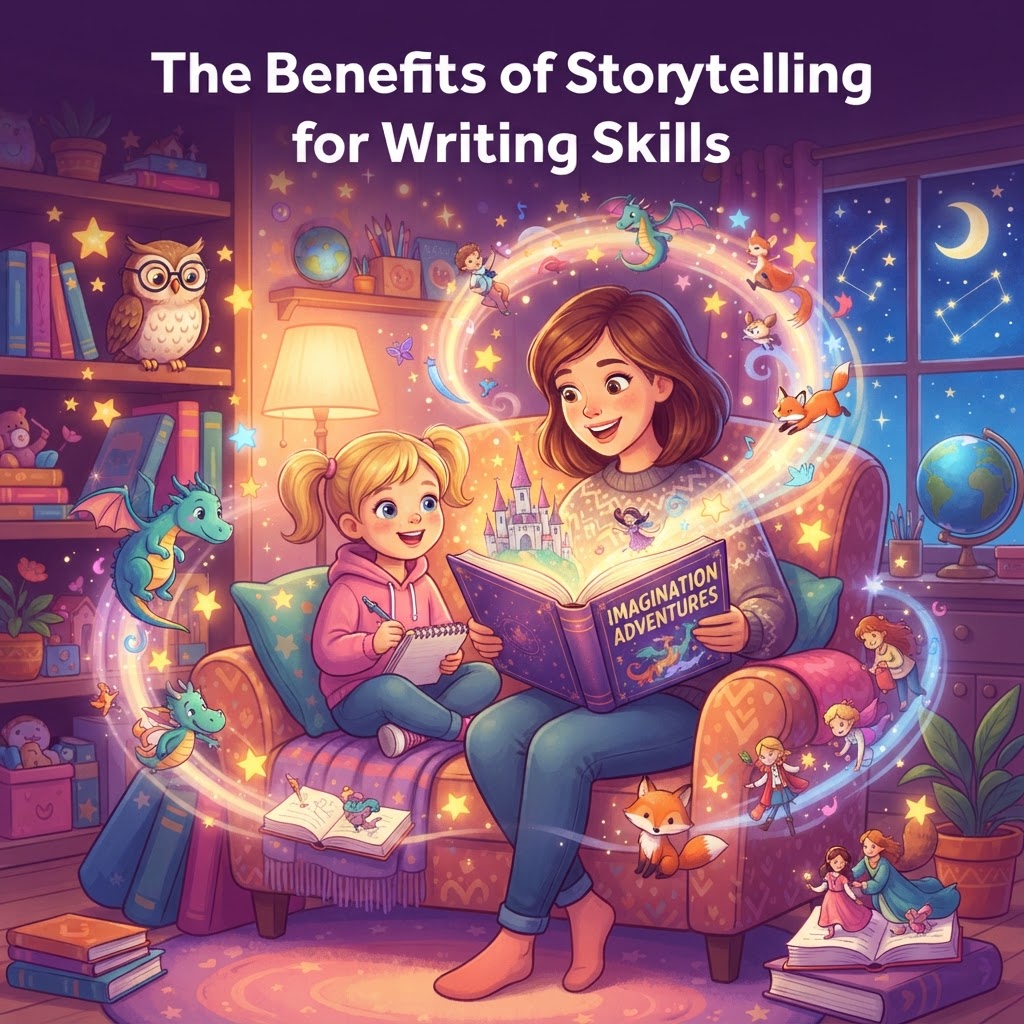
Storytelling and writing grow together. Long before children can write a full sentence, they learn how stories sound, how events connect, and how characters feel. That early exposure matters because writing is not only about spelling and handwriting. It is also about organizing ideas, choosing words, and making meaning.
For young children, stories are often the first writing lessons they receive. When kids hear, retell, and invent stories, they practice the same thinking skills that later support paragraphs, narratives, and school assignments. Research on stories and writing development shows that oral language, vocabulary, and narrative knowledge all play an important role in literacy growth.
How does storytelling help children become better writers?
Storytelling helps children become better writers by giving them a mental model for how writing works. When children hear and tell stories, they practice sequencing, describing, explaining, and imagining—core skills that later show up on the page.
This is why storytelling and writing are so closely linked in early childhood. A child who can explain what happened first, next, and last is already rehearsing the structure of written language. A child who invents dialogue for a character is experimenting with voice and tone.
Storytelling also reduces the pressure that can come with writing. Many children have ideas before they have the motor skills or spelling knowledge to write them down. Oral storytelling lets them build confidence first. Then writing becomes the next step, not a separate skill.
At home and in the classroom, this looks simple:
- listening to read-alouds
- retelling favorite stories
- making up stories from pictures
- dictating stories for an adult to write down
- acting out stories through play
These experiences help children see that writing is communication, not just correctness.
Why do stories teach narrative structure so effectively?
Stories teach narrative structure so effectively because they naturally show children how a narrative is built. A well-told story models a beginning, a problem, rising action, and an ending in a way children can remember and reuse.
Researchers often call this understanding story grammar. Children learn that stories usually include:
- a setting
- characters
- a problem or goal
- key events in sequence
- a resolution
This matters for narrative writing children produce in school. When children already understand how stories are organized, they have an easier time planning their own writing. They are less likely to jump randomly from idea to idea because they have an internal map.
The National Early Literacy Panel report highlights the importance of oral language and related early literacy skills for later literacy success. Narrative ability is part of that wider foundation. Children who can follow and retell stories are strengthening the same comprehension and organization skills needed for writing.
Story structure also supports attention and memory. Repeated exposure to clear story patterns helps children anticipate what comes next and hold details in mind. That is one reason storytelling can also build focus during reading and learning routines.
How does storytelling grow vocabulary and sentence style?
Storytelling grows vocabulary and sentence style by exposing children to language that is richer than everyday conversation. Stories often include precise verbs, descriptive adjectives, time words, dialogue, and varied sentence patterns.
In daily talk, adults may say, “He went fast.” In stories, children might hear, “He raced down the path,” or “She tiptoed quietly through the forest.” Those differences matter. Strong writing depends on strong word choice.
Storytelling helps children absorb:
- vocabulary: words for feelings, actions, places, and sensory details
- syntax: longer and more complex sentence patterns
- transitions: words like suddenly, later, meanwhile, and finally
- voice: humor, suspense, warmth, or wonder
- dialogue: how characters sound different from narration
The American Academy of Pediatrics has long emphasized shared reading as part of healthy child development. One reason is language growth. Read-alouds expose children to words and sentence structures they may not hear as often in everyday speech.
Re-reading is especially powerful. When children hear a story several times, they begin to notice phrases, patterns, and style. That repeated exposure supports both comprehension and expression. If you like creating custom stories around a child’s interests, you can create your own personalized bedtime story and save favorites in your story library for easy re-reading.
What does research say about stories and writing development?
Research says that storytelling supports writing development because writing grows out of oral language, vocabulary, and knowledge of text structure. In simple terms, children write better when they have many chances to hear, discuss, retell, and invent stories.
Several research-based organizations point in the same direction. The Institute of Education Sciences recommends teaching students to plan, organize, draft, and revise their writing. Storytelling supports those same habits early by helping children organize ideas before they write them.
Child development research also shows that conversation matters. It is not enough to only read a story aloud. When adults ask questions like “Why did the character do that?” or “What do you think happens next?” children practice reasoning, language, and perspective-taking. Those skills strengthen both comprehension and writing.
A practical summary of the evidence would look like this:
- Oral language supports literacy: Children need strong speaking and listening skills to become strong writers.
- Narrative knowledge helps composition: Understanding how stories work makes it easier to write one.
- Vocabulary exposure improves written expression: Children write better when they have more words to choose from.
- Interactive reading works best: Discussion, retelling, and play deepen learning more than passive listening alone.
Stories also help children understand emotions, motivation, and cause-and-effect. That is why storytelling can strengthen empathy while also improving writing. A child who understands what a character feels is more likely to create believable characters in their own work.
How can parents and teachers use storytelling to support writing skills?
Parents and teachers can support writing skills through storytelling by moving children through a simple sequence: hear stories, tell stories, then write or dictate stories. This approach is effective because it matches how writing develops in real life.
You do not need a formal lesson every time. Small, repeatable routines work well.
Try this simple storytelling-to-writing routine
- Read a short story aloud.
- Ask three questions: Who was in the story? What happened first? How did it end?
- Invite a retell: Let the child tell it back in their own words.
- Change one detail: What if the dragon was scared? What if the trip happened at night?
- Write it down: For younger children, an adult can act as a scribe. Older children can write a few sentences themselves.
Use age-appropriate expectations
- Ages 1-3: focus on naming characters, repeating phrases, and sequencing simple events
- Ages 4-6: encourage retelling, invented stories, and drawing-plus-dictation
- Ages 7-10: work on openings, dialogue, details, and clear endings
For teachers, storytelling is also a strong bridge into literacy instruction. Oral rehearsal before writing can help children generate ideas and reduce blank-page anxiety. If you want ready-made classroom story prompts, InstaTales for teachers can support creative writing, discussion, and narrative practice.
The key is consistency. Short daily storytelling moments often do more for stories and writing development than occasional long lessons. A bedtime story, a car ride retell, or a picture prompt after school can all build the foundation for better writing.
In the end, children become better writers when they are surrounded by meaningful language. Stories give them that language in a form they can enjoy, remember, and use for themselves.
Frequently Asked Questions
How does storytelling improve writing in children?
Storytelling improves writing by helping children organize ideas, use stronger vocabulary, and understand narrative structure. Before children can write well, they need lots of experience hearing and telling meaningful stories.
Is reading aloud enough to support writing development?
Reading aloud helps a lot, but discussion makes it even more effective. Asking children to retell, predict, and change parts of a story builds the language and thinking skills that support writing.
What is the connection between narrative skills and writing?
Narrative skills help children understand how stories are organized. That makes it easier for them to plan their own beginning, middle, and end when writing.
At what age should children start storytelling for writing skills?
Children can start long before formal writing begins. Toddlers benefit from simple retells and repeated phrases, while preschoolers and older children can move into invented stories and dictation.
Can storytelling help reluctant writers?
Yes. Storytelling removes some of the pressure of spelling, handwriting, and getting everything “right” at once. It lets children develop ideas orally first, which often makes writing feel easier and more enjoyable.
How can I make storytelling part of a daily routine?
Keep it simple and repeatable. Read one short story, ask a few questions, invite a retell, and let your child add a new twist or ending.
Ready to Create a Personalized Bedtime Story?
Use our free AI bedtime story generator to create a personalized illustrated story for your child in 30 seconds — no credit card needed.
Popular story types:
Maya Rodriguez
Lead Content Editor & Early Literacy Specialist
Maya is a former early childhood educator and literacy specialist with over a decade of experience helping children develop a love of reading. She leads content at InstaTales, where she writes about the science of storytelling, child development, and how families can use personalized AI stories to build literacy and emotional resilience.
instatales.ai