The Solar System for Kids: Stories They’ll Love
Feed your child's curiosity with these the solar system stories that combine imagination with real science and discovery.
✦ Key Takeaways
- •Yes—storytelling helps children remember science because stories organize facts into meaningful patterns.
- •The best solar system stories combine one clear science idea with one strong adventure.
- •The easiest way to get a strong result is to ask for both story elements and science facts in the same prompt.
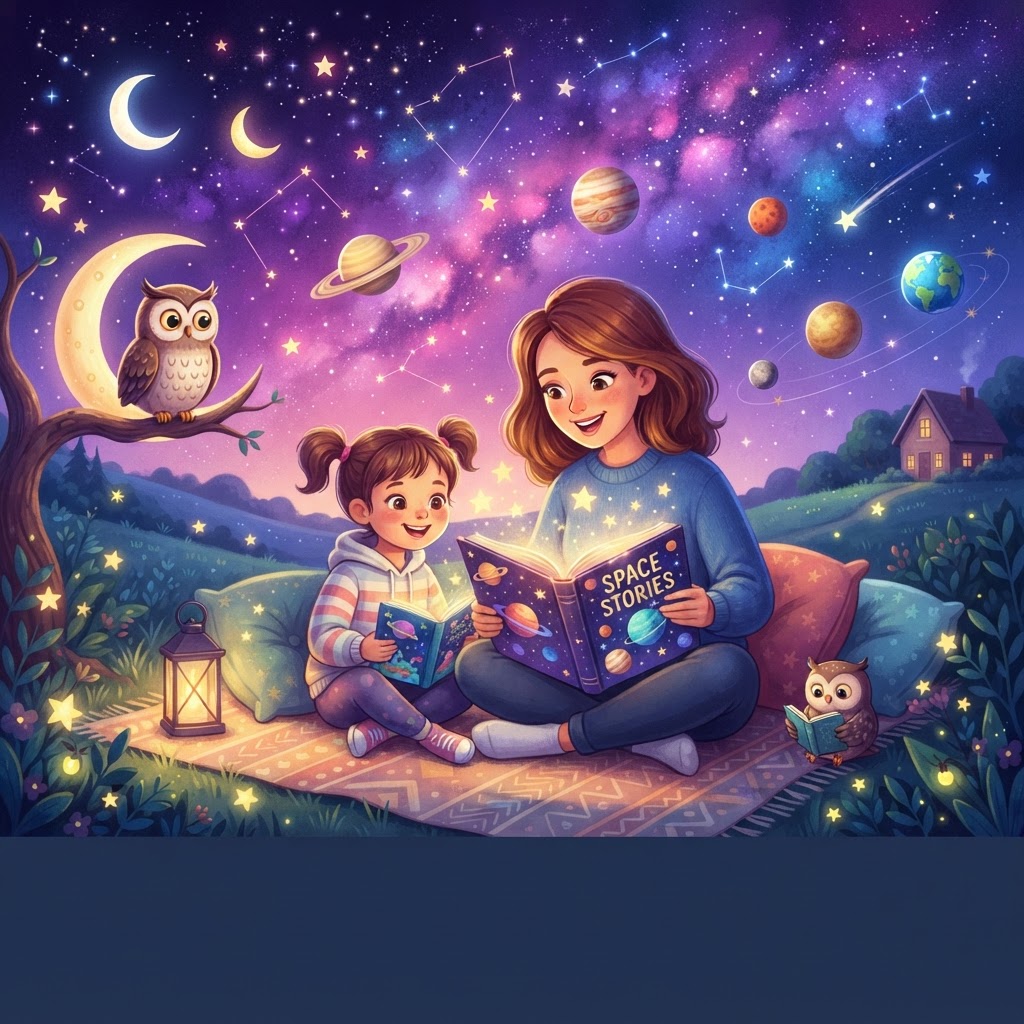
When you turn planets into characters, the solar system for kids becomes easier to understand and much more fun to remember. That is why the solar system stories work so well for young learners: they mix imagination, emotion, and real science in a way that sticks.
For curious children, space is full of natural wonder. There are rings made of ice, storms bigger than Earth, and rovers exploring dusty red landscapes. In this guide, you will find story-based ways to teach space, five ready-to-use story ideas grounded in real facts, and simple tips for using InstaTales to create science-rich bedtime adventures at home or in the classroom.
Why do the solar system stories help kids remember science?
Yes—storytelling helps children remember science because stories organize facts into meaningful patterns. When kids hear information inside a plot, with characters, goals, and problems to solve, their brains have more “hooks” for recall.
This matters for early childhood learning. The American Academy of Pediatrics has long emphasized that shared reading supports language, attention, and relationship-building, all of which help children learn new concepts over time. Research in child development also shows that conversation, repetition, and emotionally engaging experiences strengthen memory and understanding. You can explore more about early literacy and learning through the American Academy of Pediatrics.
In practice, stories make space facts less abstract. Instead of saying, “Mars is the fourth planet from the Sun,” a child hears about a brave rover crossing the fourth stop on a cosmic road trip. The fact stays the same, but the meaning becomes richer.
Stories also support:
- Vocabulary growth: orbit, planet, moon, crater, galaxy
- Cause-and-effect thinking: “Venus is hot because its atmosphere traps heat”
- Prediction skills: “What do you think the astronaut will find next?”
- Emotional engagement: children care more when a character is curious, worried, or excited
If you have curious kids, the solar system is a perfect topic because it naturally invites questions. Why does Saturn have rings? Why is Jupiter so big? Could we walk on the Moon? Storytelling gives children a safe, playful way to explore those big ideas.
What are five solar system story ideas curious kids will want to hear?
The best solar system stories combine one clear science idea with one strong adventure. Below are five story concepts that spark imagination while staying true to real astronomy.
-
1. The Mercury Morning Mission
A tiny astronaut must deliver a sunrise message on Mercury before the planet gets too hot. Real fact: Mercury is the closest planet to the Sun, and because it has almost no atmosphere, temperatures change dramatically between day and night. -
2. The Cloud Castle of Venus
A young explorer floats above Venus in a special science balloon and discovers why the planet glows so brightly in the sky. Real fact: Venus is the hottest planet in our solar system, not because it is closest to the Sun, but because its thick carbon dioxide atmosphere traps heat. -
3. The Red Rescue on Mars
A robot and a child scientist team up to find a missing sample near a giant volcano. Real fact: Mars is known as the Red Planet because of iron oxide in its dust, and it is home to Olympus Mons, the largest volcano in the solar system. -
4. Jupiter and the Giant Storm School
A child visits a cloud-top school where every lesson happens inside a swirling storm. Real fact: Jupiter is the largest planet, and its Great Red Spot is a massive storm that has lasted for many years. Jupiter also has many moons, including Ganymede, which is the largest moon in the solar system. -
5. Saturn’s Ring Orchestra
A space musician travels around Saturn collecting icy ring sounds for a concert of the planets. Real fact: Saturn’s rings are made mostly of ice and rock, and Saturn is so low in density that, in theory, it would float in a giant enough body of water.
These ideas work because they keep one main fact at the center of the story. Children do not need every detail at once. One memorable truth per story is enough to build a strong foundation.
If you want more inspiration, you can explore more science-based story ideas for bedtime reading and classroom discussion.
How can you prompt InstaTales for science-rich solar system adventures?
The easiest way to get a strong result is to ask for both story elements and science facts in the same prompt. A clear prompt tells the AI the child’s age, the tone, the learning goal, and which facts must be included.
When you create your own personalized bedtime story, try this simple prompt formula:
- Child’s age
- Favorite character or theme
- One planet or space topic
- 2-3 real facts to include
- Tone: cozy, funny, exciting, gentle
- Length: short bedtime story, 5-minute read, etc.
- Optional learning feature: questions, repetition, or a mini glossary
Sample prompt for ages 3-5
“Write a gentle bedtime story for a 4-year-old about a bunny visiting the Moon. Include the facts that the Moon orbits Earth, it has craters, and astronauts have walked on it. Use simple words, repetition, and a calm ending.”
Sample prompt for ages 6-8
“Write an adventurous story for a 7-year-old about two friends exploring Mars with a rover. Include real facts about Mars being the fourth planet from the Sun, its red dust, and Olympus Mons. Add three dialogue lines and one question for the child to answer.”
Sample prompt for ages 9-10
“Write a science-rich story for a 10-year-old about a mission through the outer planets. Include accurate facts about Jupiter’s Great Red Spot, Saturn’s icy rings, and Neptune’s strong winds. Keep the science correct and explain any hard words naturally in the story.”
A few prompt tips make a big difference:
- Ask for fact accuracy directly
- Limit the story to one or two big science ideas
- Request age-appropriate vocabulary
- Ask for a wonder question at the end, such as “Which planet would you visit?”
- Invite repetition for younger children: “round and round,” “farther and farther”
If your child likes familiar structure, start with story templates and adjust the planet, character, or level of detail. When you find a story that works well, save it to your story library so your child can revisit favorite space adventures again and again.
How can parents and teachers keep the solar system for kids accurate and age-appropriate?
You can keep space stories both exciting and trustworthy by checking a few key facts and matching the language to the child’s age. Accuracy matters, but it does not require turning bedtime into a lecture.
For science facts, use child-friendly trusted sources such as NASA Space Place, which explains astronomy clearly for children. For teaching practice, the National Science Teaching Association offers guidance grounded in inquiry, observation, and age-appropriate science learning.
Here is a practical age guide:
- Ages 1-3: focus on wonder words—Moon, stars, Sun, round planet
- Ages 4-5: add simple facts—Earth goes around the Sun, Saturn has rings
- Ages 6-8: introduce comparisons—Jupiter is biggest, Mars is dusty and cold
- Ages 9-10: include systems, atmosphere, gravity, moons, and space missions
You do not need to correct every fantasy element. A talking comet is fine in fiction. What matters is that the core science stays sound. For example, it is fine for Saturn to sing in a story, but its rings should still be described as icy and beautiful rather than “made of fire.”
Teachers can also use story-based space learning in literacy blocks, STEM time, or creative writing lessons. If you are planning group activities or cross-curricular work, InstaTales for teachers can help you turn science topics into reading, discussion, and writing practice.
How can you extend the solar system adventures children love into real learning?
Yes—simple follow-up activities turn the solar system adventures children enjoy into deeper understanding. A short story becomes far more powerful when children retell it, draw it, or connect it to the real sky.
Try one of these easy extensions after reading:
- Ask, “What was one true fact in the story?”
- Let your child draw the planet and label one feature
- Act out the story with pillows as planets
- Compare two planets: “Which one is hotter? Which one has rings?”
- Start a Moon journal and notice changes over a week
- Re-read favorite stories to reinforce vocabulary and sequence
Retelling is especially valuable. When children explain a story back to you, they practice comprehension, memory, and scientific language all at once. That is one reason story-based science works so well for curious kids.
If your child enjoys collecting favorite stories, keep a themed set in your story library. You can build one shelf for planets, one for astronauts, and one for science bedtime favorites. For even more ideas, browse the InstaTales blog for reading tips, themed prompts, and family learning activities.
Frequently Asked Questions
What is the best way to teach the solar system for kids?
The best way is to mix simple facts with strong stories and visuals. Children remember more when they hear one clear science idea inside a fun narrative they can picture and retell.
At what age can children start learning about space?
Children can start learning basic space ideas as toddlers. Very young children enjoy words like Sun, Moon, and stars, while older children can understand planets, orbits, and space missions in more detail.
How accurate should solar system stories be?
The core science should be accurate, even if the story uses imagination. A planet can be a character, but facts like its temperature, size, rings, or position should stay true.
How many facts should I include in one bedtime story?
For most children, one to three facts is ideal. That keeps the story light and memorable without turning it into an overload of information.
Can teachers use AI-generated solar system stories in class?
Yes, as long as they review the content for accuracy and match it to student age and goals. AI stories can support reading comprehension, science vocabulary, discussion, and creative writing.
What should I put in an InstaTales prompt for a science story?
Include the child’s age, the planet or topic, the tone, and 2-3 facts that must appear. You can also ask for a short length, simple vocabulary, or a question at the end to encourage discussion.
Get a new bedtime story every week
Free, personalized, and delivered to your inbox. No spam, ever.
Ready to Create a Personalized Bedtime Story?
Use our free AI bedtime story generator to create a personalized illustrated story for your child in 30 seconds — no credit card needed.
Popular story types:
Maya Rodriguez
Lead Content Editor & Early Literacy Specialist
Maya is a former early childhood educator and literacy specialist with over a decade of experience helping children develop a love of reading. She leads content at InstaTales, where she writes about the science of storytelling, child development, and how families can use personalized AI stories to build literacy and emotional resilience.
instatales.ai