How to Turn Your Child's Drawing Into a Story
Your child's drawings are full of stories waiting to be told. Here's how to turn any drawing into a personalized story — a creative activity that builds imagination and literacy.
✦ Key Takeaways
- •Combining visual art with narrative is one of the most effective ways to support early literacy and creative development.
- •Children's drawings are naturally rich with storytelling material.
- •You don't need any special materials or training.
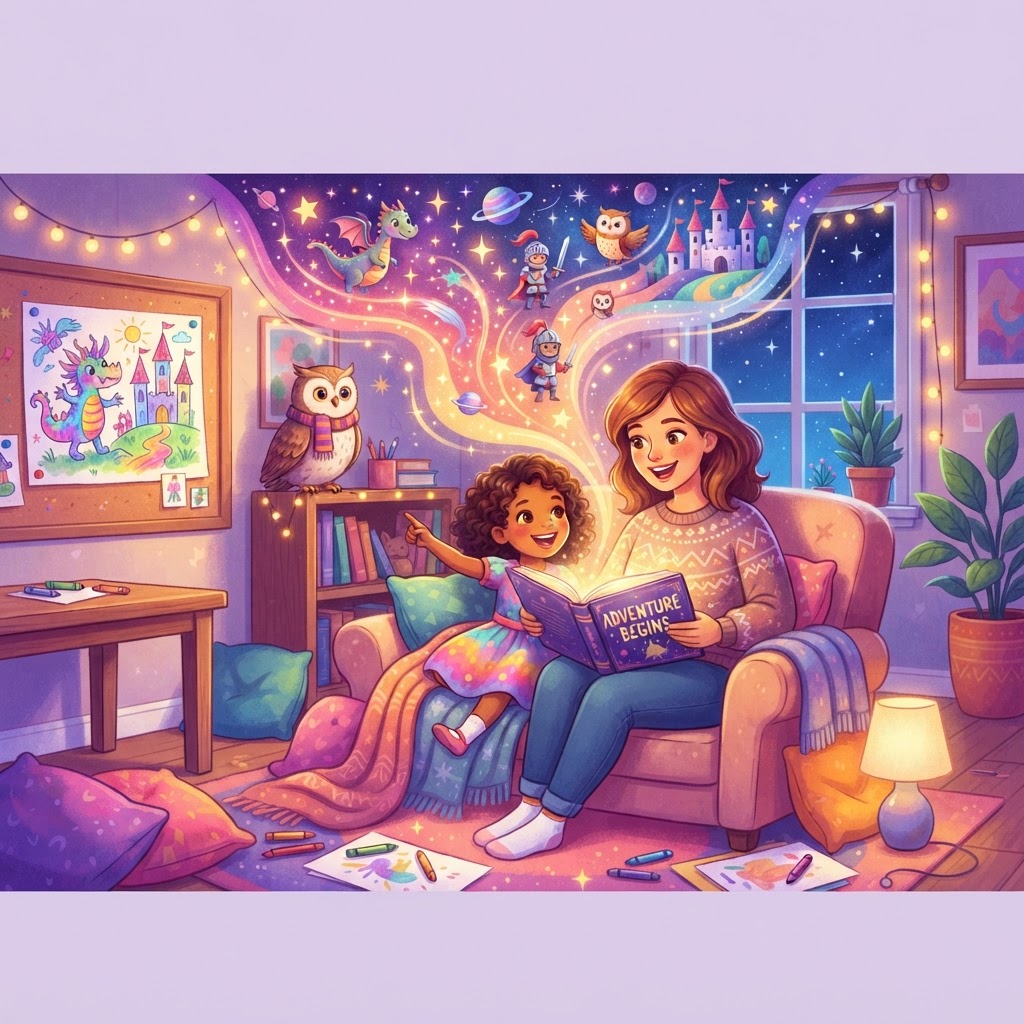
Every child's drawing tells a story. That lopsided house with the bright yellow sun, the purple dragon floating above a castle, the stick-figure family holding hands in a garden — these aren't just pictures. They're windows into your child's inner world, full of characters, settings, and adventures waiting to be told out loud.
Turning your child's drawing into a personalized story is one of the most powerful creative activities you can do together. It honours their artwork, stretches their imagination, and builds early literacy skills — all before bedtime. Here's exactly how to do it.
Why Does Connecting Drawing and Storytelling Help Children Learn?
Combining visual art with narrative is one of the most effective ways to support early literacy and creative development. When children see their drawings become stories, they experience a direct link between what they imagine, what they create, and how language describes the world.
Research from the National Literacy Trust consistently shows that children who engage in creative, multimodal activities — drawing alongside storytelling — develop stronger vocabulary, better narrative comprehension, and greater enthusiasm for reading. When a child watches their purple dragon become a character with a name, a problem to solve, and a happy ending, they're learning story structure without even realising it.
This connection also builds confidence. A child who might feel shy about "making up" a story verbally finds it much easier when they have their own drawing as a starting point. The picture is their prompt — and it's already perfect.
What Makes a Child's Drawing the Perfect Story Prompt?
Children's drawings are naturally rich with storytelling material. Unlike a blank page, a drawing already contains:
- Characters — people, animals, creatures, or objects
- A setting — indoors, outdoors, underwater, in space
- Mood and colour — clues about tone and feeling
- Action or tension — something happening, or something about to happen
Even the simplest drawing has a "why." Why is that sun so big? Why is the dog floating? Why does the house have three chimneys? These questions are the seeds of a story.
According to child development guidance from the American Academy of Pediatrics, imaginative play — including storytelling — is essential for cognitive development in children aged 2–10. Drawing-based storytelling sits right at the intersection of play and learning.
How Can You Turn Any Drawing Into a Story Step by Step?
You don't need any special materials or training. Follow these six simple steps any time your child brings you their latest masterpiece.
Step 1: Look at the Drawing Together
Sit beside your child and really look at their drawing. Don't rush to interpret it — ask them to show you what they've made. Let them lead.
Step 2: Ask Curious Questions
Use open-ended questions to draw out the story hiding in the picture:
- "Who is this character? What's their name?"
- "Where are they right now?"
- "What just happened before this moment?"
- "What are they going to do next?"
- "Is there anything scary or exciting about to happen?"
Even very young children (ages 2–4) will surprise you with rich, detailed answers when prompted gently.
Step 3: Identify the Key Story Elements
Jot down what you learn. You're looking for:
- Character(s) — name, personality, special powers or traits
- Setting — time and place
- Problem or adventure — what does the character want or need?
- Feeling — happy, brave, curious, a little scared?
Step 4: Build a Story Prompt
Now shape these elements into a short description — one or two sentences — that captures the drawing's world. This is also exactly how you'd describe the drawing to a tool like InstaTales to generate a personalised story.
A good prompt sounds like: "A brave girl called Mia lives in a floating cloud castle. She's trying to rescue her pet rainbow fox from a friendly giant who lives in the mountains."
Step 5: Generate or Tell the Story
Read the story aloud together — whether you make it up yourself, or use a personalised story generator like InstaTales to bring it to life in seconds.
Step 6: Read the Story With the Drawing Visible
This is the magic step. Hold the drawing up beside the story. Point to characters as they appear. Ask your child, "Is that what you imagined?" This builds reading comprehension, narrative connection, and pride in their own creativity.
What Are Some Examples of Drawing-to-Story Transformations?
Here are five real examples of how a simple drawing can become a rich story prompt:
-
A yellow dog on a red boat → "Captain Biscuit the golden dog has sailed to an island where all the fish have gone missing. Can he solve the mystery before the storm arrives?"
-
A girl with wings standing next to a big tree → "Elara has just discovered her wings work — but only at night. Now she must fly through the moonlit forest to bring her grandmother a glowing star flower."
-
A robot and a cat sitting together → "Robot R9 has never had a friend before. When a small orange cat wanders into his workshop, he must learn what friendship really means."
-
A castle with a rainbow over it → "The Rainbow Castle only appears once a year. Prince Leo has exactly one day to find the hidden door before it disappears again for another twelve months."
-
Stick figures holding hands in a garden → "The Sunflower Family tends the most magical garden in the whole valley. But today, something tiny and very unusual has grown overnight…"
Each of these can be typed directly into InstaTales as a story prompt. The result is a fully personalised bedtime story that mirrors your child's artwork.
How Do You Describe a Drawing to Generate the Best AI Story?
Getting a great personalised story from an AI generator comes down to how you describe the drawing. Here's a simple formula:
[Character name + who they are] + [setting] + [one problem or adventure] + [optional: mood or feeling]
Be specific about names and details your child chose. If the dragon is called "Sprinkle" and lives in a volcano made of cheese — write exactly that. The more your prompt reflects your child's actual drawing, the more the story will feel like theirs.
Research from Harvard's Center on the Developing Child highlights that when children see their ideas reflected and validated by adults, it strengthens both self-expression and language development. A story that mirrors their drawing does exactly that.
Frequently Asked Questions
What age is drawing-to-story best suited for?
This activity works beautifully for children aged 2–10. Younger children (2–4) benefit from you asking the questions and building the prompt together, while older children (5–10) can write or dictate their own prompts. The key is following the child's lead at every age.
Do I need to be a good storyteller to do this activity?
Not at all. Your child's drawing does most of the creative work for you. If you're not confident making up stories on the spot, tools like InstaTales can generate a personalised story from your description in seconds — so you can focus on the experience, not the performance.
How long should the story prompt description be?
One to three sentences is ideal. Focus on the main character, where they are, and what they want or need. You don't need to describe every detail in the drawing — just enough to capture the world your child created.
Can we do this activity regularly, or is it a one-off?
It's a wonderful regular activity — especially on weekends or as part of a bedtime routine. Children who see their drawings become stories consistently tend to draw with storytelling in mind, which deepens both creative skills over time.
What if my child's drawing doesn't have an obvious story?
That's actually a great opportunity. Abstract drawings, shapes, and scribbles can become the setting, a magic spell, a dream world, or a map. Ask your child, "If this was a place, what would it be called?" Even the most abstract image can spark a story with the right question.
Is it better to make up the story together or use a story generator?
Both approaches have real value. Making up the story together is wonderful for verbal creativity and bonding. Using a generator like InstaTales gives you a complete, beautifully structured story your child can hear read aloud — and you can always add your own twists afterward. Many families do both.
Your child's drawings are already full of stories. All they need is someone willing to ask the right questions — and a little help bringing the words to life. Next time your child hands you a picture, try sitting down with it together and following these steps. You might be surprised at the world they've been quietly imagining.
Ready to turn your child's next drawing into a bedtime story? Try InstaTales and generate a personalised story from your description in seconds.
Get a new bedtime story every week
Free, personalized, and delivered to your inbox. No spam, ever.
Ready to Create a Personalized Bedtime Story?
Use our free AI bedtime story generator to create a personalized illustrated story for your child in 30 seconds — no credit card needed.
Popular story types:
Maya Rodriguez
Lead Content Editor & Early Literacy Specialist
Maya is a former early childhood educator and literacy specialist with over a decade of experience helping children develop a love of reading. She leads content at InstaTales, where she writes about the science of storytelling, child development, and how families can use personalized AI stories to build literacy and emotional resilience.
instatales.ai