Fourth Grade Science Stories That Build Understanding
Make science engaging for fourth grade students with stories. Practical strategies, story ideas, and classroom activities for teachers.
✦ Key Takeaways
- •Fourth grade science stories help students learn because narrative organizes information into a meaningful sequence.
- •The best science stories for fourth grade are accurate, purposeful, and closely tied to observable phenomena.
- •The most effective fourth grade science activities use stories as the launch point for investigation, not the end point.
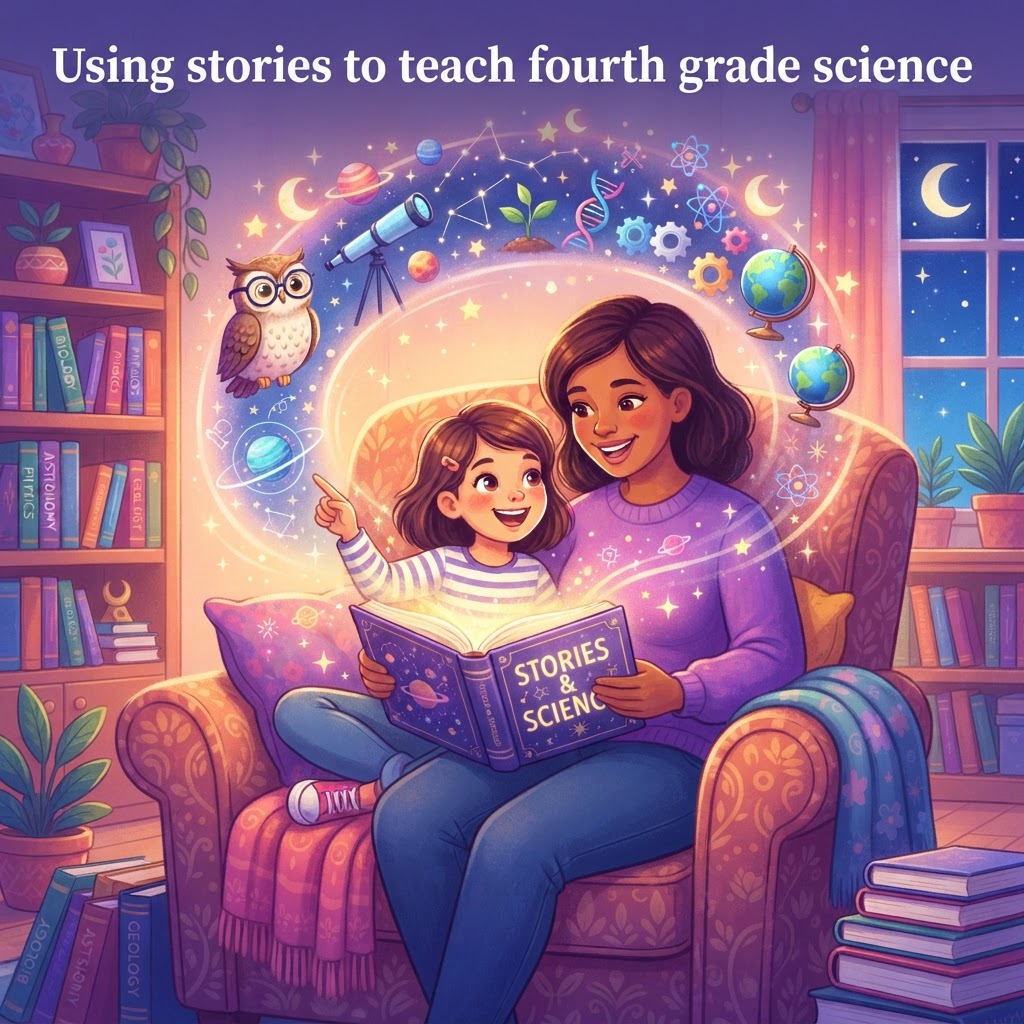
Fourth graders are ready for real scientific thinking, but they still learn best when ideas feel concrete, vivid, and connected. That is why fourth grade science stories can be such a powerful teaching tool. A well-chosen narrative gives students a reason to care about erosion, energy, ecosystems, or animal structures before they are asked to explain the science behind it.
For teachers, teaching science with stories is not about replacing experiments or standards-based instruction. It is about giving students a memorable context for observation, vocabulary, discussion, and writing. When stories and inquiry work together, science becomes easier to understand and much more fun to teach.
Why do fourth grade science stories help students learn?
Fourth grade science stories help students learn because narrative organizes information into a meaningful sequence. Instead of hearing isolated facts, students follow a problem, notice causes and effects, and remember details through characters, settings, and events.
This matters developmentally. Many nine- and ten-year-olds are moving toward more abstract reasoning, but they still benefit from concrete examples and strong visual language. A story about a beaver changing its habitat or a child investigating a collapsing sand dune gives students something to picture, question, and revisit.
Research supports this approach. Jerome Bruner famously argued that narrative is one of the core ways humans make meaning. The National Academies’ How People Learn also explains that new learning sticks better when it connects to prior knowledge and meaningful contexts. In science, stories help create those connections.
Narrative also supports classroom language goals. Science success in fourth grade depends on more than knowing content; students need to explain, compare, infer, and argue from evidence. A story gives them shared language for those tasks. That is one reason many educators use read-alouds, case studies, and short science narratives as part of elementary instruction, a practice supported by organizations like the National Science Teaching Association.
In short, science stories for fourth grade work because they:
- make abstract concepts easier to visualize
- strengthen vocabulary in context
- support memory through sequence and cause-effect
- increase engagement and curiosity
- create natural opportunities for speaking and writing
What makes science stories for fourth grade effective?
The best science stories for fourth grade are accurate, purposeful, and closely tied to observable phenomena. They should spark questions without turning science into fantasy that confuses the concept.
A strong story-based science lesson usually includes four elements:
- A real scientific problem: Why is one hillside washing away faster than another? How does an animal survive in a changing habitat?
- Grade-appropriate content: Focus on standards students can investigate through discussion, reading, and hands-on tasks.
- Clear academic vocabulary: Words like erosion, transfer, structure, function, habitat, and evidence should appear naturally in the story.
- A follow-up inquiry: Students should do something with the story, such as model, test, record, or explain.
It also helps to keep stories short and specific. Fourth graders do well with narratives that can be read in one sitting and revisited during the week. A simple scenario is often more useful than a long fictional plot.
If you like cross-curricular planning, story-based science pairs especially well with literacy blocks. Many teachers connect science narratives with discussion strategies from fourth grade reading lessons, then extend learning into explanatory writing later.
Which fourth grade science activities work best with stories?
The most effective fourth grade science activities use stories as the launch point for investigation, not the end point. Students should listen, discuss, test, draw, write, and revise their thinking after the narrative.
Here are five practical fourth grade science activities you can use right away.
1. Can an ecosystem diary build systems thinking?
Yes. Ask students to read or hear a short diary-style story from the perspective of an animal, plant, or decomposer in a habitat. Then have them map the interactions between living things, food sources, water, weather, and shelter.
Try this sequence:
- Read the story aloud.
- Ask: What does this organism need to survive?
- Create a cause-and-effect web as a class.
- Have students add one “what changed?” event, such as drought or human construction.
- Let them revise the diary entry using new evidence.
This works well for ecosystems because it helps students see relationships rather than isolated facts.
2. Can a weathering mystery make Earth science stick?
Yes. Create a short mystery story about a playground path, cliffside trail, or riverbank that is changing over time. Students become investigators who must explain whether water, wind, ice, or plant roots caused the change.
After the story, students can:
- examine photos or models
- sort evidence cards by type of weathering or erosion
- write a claim using sentence frames
- defend their answer with observations
This is one of the easiest science stories for fourth grade because it naturally invites argument from evidence.
3. Can an engineering quest teach erosion solutions?
Absolutely. Tell a story about a town, garden, or animal habitat threatened by moving soil. Students then act as engineers who must design a barrier, channel, or ground cover solution.
A simple structure works well:
- introduce the problem through a short narrative
- identify criteria and constraints
- build with classroom materials
- test with water and soil trays
- reflect in a design journal
This approach blends literacy, Earth science, and engineering beautifully. It also gives reluctant writers a strong purpose for explaining their design choices.
4. Can a sound detective story support physical science?
Yes. For units on waves, vibration, or communication, give students a story in which a character must solve a problem using sound. Maybe a park ranger hears a warning signal, or a child tries to send information across a field.
Then invite students to explore:
- how sound is made
- what happens when vibrations change
- how volume or pitch affects communication
- which materials help or hinder sound
Students can finish by writing a short explanation of how the character used wave behavior to solve the problem. This is a strong example of teaching science with stories while keeping the science accurate.
5. Can a survival story strengthen structure-and-function lessons?
Yes. Read a narrative about an animal or plant facing a challenge in its environment, such as finding food, staying safe, or spreading seeds. Students identify which body parts or structures help the organism succeed.
Follow up with:
- a compare-and-contrast chart
- labeled sketches
- a “best structure for the job” discussion
- a short paragraph using evidence from the story and an informational text
This activity is especially useful because it moves students from storytelling into evidence-based explanation, which is a key fourth grade goal.
How can you differentiate teaching science with stories?
You can differentiate story-based science by adjusting the reading load, discussion supports, and response options without lowering the scientific thinking. The goal is to keep every student engaged in the same core idea.
For multilingual learners and students who need more support:
- preteach 3-5 essential science words
- use picture cards and labeled diagrams
- break the story into short chunks
- offer sentence stems such as “I think ___ because ___”
For advanced learners:
- add conflicting evidence
- invite students to write an alternate ending based on new data
- ask them to compare the narrative with an informational source
- let them design their own investigation question
For students with different learning profiles, use multiple ways to access and show understanding. The CAST UDL Guidelines are a helpful framework for offering varied supports while keeping expectations high.
A simple rule helps: keep the science concept consistent, but vary the pathway students use to reach it.
How can InstaTales support fourth grade science lessons?
InstaTales can support fourth grade science lessons by helping teachers quickly generate custom story prompts, phenomenon-based scenarios, and differentiated reading materials. It is especially useful when you want science stories that match your exact topic, vocabulary, and student interests.
With InstaTales for teachers, you can build short, age-appropriate narratives around topics like erosion, habitats, energy transfer, or animal structures. That saves planning time and makes it easier to create multiple versions of the same lesson for different reading levels.
A practical workflow might look like this:
- Use create your own personalized bedtime story to generate a science-themed narrative with a clear problem.
- Start from story templates if you want a faster setup for journals, mysteries, or investigation prompts.
- Save finished class stories in your story library so students can revisit them during centers, small groups, or test review.
- Pair the science story with a writing extension inspired by story-based literacy work in upper elementary classrooms.
The real value is flexibility. You can create one class anchor story, small-group versions with simpler language, or enrichment stories that ask students to reason through more complex evidence. That makes fourth grade science stories easier to use across the whole classroom, not just during read-aloud time.
Frequently Asked Questions
Do stories replace hands-on science in fourth grade?
No. Stories work best as a launch, bridge, or reflection tool. Students still need observation, experimentation, modeling, and discussion to build deep science understanding.
How long should a science story be for fourth graders?
Short is usually better. Aim for a story that can be read in 5-10 minutes and revisited during the lesson so students can focus on the science ideas.
Can fictional stories still teach real science?
Yes, if the science is accurate and the fiction does not create misconceptions. The story should support the concept, not distract from it.
What fourth grade science topics work best with stories?
Ecosystems, weathering and erosion, energy, waves, and structure-and-function all work very well. Any topic with a clear problem, process, or change over time is a strong fit.
How can I assess science learning after a story?
Use quick written claims, diagrams, partner talk, exit tickets, or short evidence-based paragraphs. The best assessments ask students to explain the science, not just retell the plot.
Get a new bedtime story every week
Free, personalized, and delivered to your inbox. No spam, ever.
Ready to Create a Personalized Bedtime Story?
Use our free AI bedtime story generator to create a personalized illustrated story for your child in 30 seconds — no credit card needed.
Popular story types:
Maya Rodriguez
Lead Content Editor & Early Literacy Specialist
Maya is a former early childhood educator and literacy specialist with over a decade of experience helping children develop a love of reading. She leads content at InstaTales, where she writes about the science of storytelling, child development, and how families can use personalized AI stories to build literacy and emotional resilience.
instatales.ai