Second Grade Math Stories That Build Skills
Make math engaging for second grade students with stories. Practical strategies, story ideas, and classroom activities for teachers.
✦ Key Takeaways
- •Stories help second graders learn math because they give numbers a purpose.
- •Many core second grade math skills work well in story form, especially skills that involve relationships, sequences, and real-life problem solving.
- •These second grade math activities work because they combine narrative, talk, and hands-on problem solving.
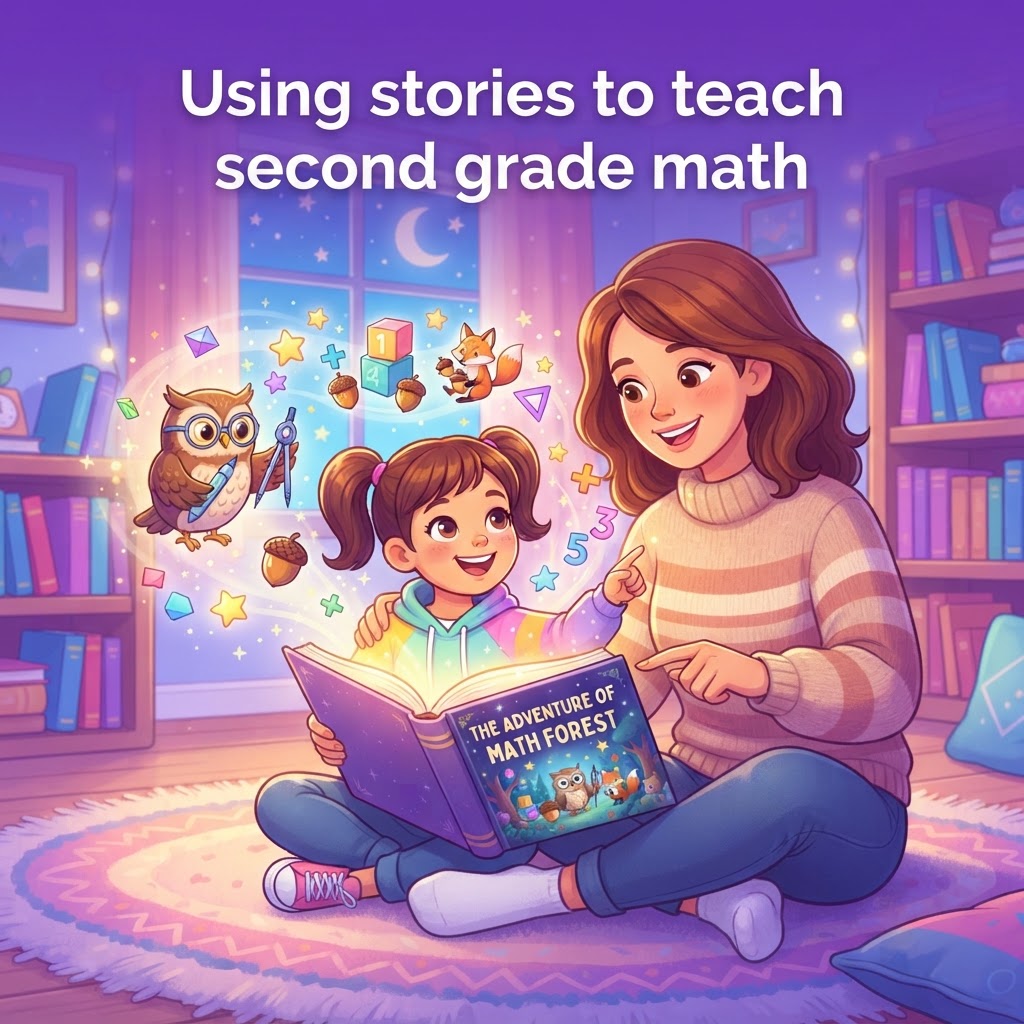
Second graders are ready for bigger numbers, more complex problem solving, and deeper math talk—but they still learn best when ideas feel concrete and meaningful. That is why second grade math stories work so well. A story gives children a reason to count, compare, measure, and explain their thinking.
For teachers, teaching math with stories is not about turning every lesson into read-aloud time. It is about using narrative to anchor math in situations children can picture. When a class helps a character split apples into groups, measure a garden path, or count coins at a shop, the math becomes easier to discuss and remember.
Why do stories help second graders learn math?
Stories help second graders learn math because they give numbers a purpose. When children can imagine a problem happening to a character, they are more likely to stay engaged, use language, and remember the strategy later.
This fits what we know from child development and learning science. Jerome Bruner’s work on narrative thinking showed that stories help children organize information in ways that make sense. In elementary classrooms, that matters because seven- and eight-year-olds are still building abstract reasoning. A narrative context acts like a bridge between concrete experience and symbolic math.
Story-based lessons also support several evidence-based practices at once:
- They make word problems more meaningful.
- They encourage students to explain their reasoning aloud.
- They create natural opportunities for drawing, acting out, and using manipulatives.
- They help teachers connect new skills to prior knowledge.
The National Council of Teachers of Mathematics has long emphasized that children learn math best when it is connected to meaningful contexts. The What Works Clearinghouse also recommends visual representations and explicit mathematical discussion—both of which fit naturally into math stories for second grade.
Just as importantly, stories lower resistance. A child who freezes at “solve these 10 problems” may eagerly help a lost puppy count steps home.
Which second grade math skills work best with stories?
Many core second grade math skills work well in story form, especially skills that involve relationships, sequences, and real-life problem solving. The strongest fits are addition and subtraction, place value, measurement, time, money, and early geometry.
Here are some natural matches:
- Addition and subtraction within 100 or 1,000: characters combine, compare, give away, or find missing amounts.
- Place value: bundles, collections, and trading tens and ones fit story settings well.
- Measurement: children can compare ribbon lengths, garden rows, or animal tracks.
- Time and money: schedules, shops, and event planning make these concepts concrete.
- Geometry: shape hunts, map routes, and building challenges add purpose to spatial thinking.
Stories are especially useful when students need help making sense of word problems. If your class is still strengthening foundational number sense, it can help to review approaches from first grade math stories and then increase the complexity for second grade.
What are five story-based math activities teachers can use?
These second grade math activities work because they combine narrative, talk, and hands-on problem solving. Each one can be used in whole group, small group, or centers.
1. Story problem theater
Turn addition and subtraction into a mini drama. Give students a short scenario, assign roles, and have them act out the math before solving it on paper.
Example: “Maya the mail carrier has 27 letters. She delivers 9. How many are left?”
Why it works:
- Students see the action before they compute.
- It supports retelling, a key comprehension skill.
- It helps children identify whether the problem is joining, separating, or comparing.
Teacher tip: Pause after the acting and ask, “What happened first? What changed? What number do we know? What are we trying to find?”
2. Place value village
Create a story world where characters live in Tens Town and Ones Cottage. Students move objects, draw base-ten blocks, or bundle straws as the story changes.
Example: “The toy shop packed 4 tens of kites and 7 single kites for a festival. How many kites is that?”
Why it works:
- It gives place value language a memorable visual.
- It helps students explain regrouping in simple terms.
- It supports children who still need concrete models.
You can prepare reusable prompts with story templates so each lesson starts quickly.
3. The classroom shop challenge
Set up a small store story where a character must buy supplies, make choices, or count change. This is one of the most practical math stories for second grade because it blends money, comparison, and mental math.
Example: “Leo has 45 cents. He wants a pencil for 18 cents and an eraser for 12 cents. Does he have enough? How much will he have left?”
Why it works:
- It connects directly to real life.
- It encourages multiple strategies.
- It invites partner talk and justification.
Extension idea: Let students write the next chapter by adding a new item or budget.
4. Measurement mystery
Give students a short mystery story that can only be solved through measuring. The class measures objects, compares lengths, or chooses the best tool.
Example: “A squirrel left tiny tracks near the reading corner. Which strip of paper matches the track length: 9 cm, 12 cm, or 15 cm?”
Why it works:
- Measurement becomes purposeful instead of random practice.
- Students use precise language.
- It supports estimation and checking.
The NAEYC guidance on developmentally appropriate practice reminds educators that young children learn best through active, meaningful experiences. A measurement mystery does exactly that.
5. Build-a-story word problem workshop
Have students create their own math stories from a simple structure: character + goal + numbers + question. This moves students from solving problems to composing them.
Example frame:
- Character: “A baker”
- Goal: “is packing cupcakes”
- Numbers: “36 cupcakes, 4 boxes”
- Question: “How many in each box if they are shared equally?”
Why it works:
- Writing a story reveals conceptual understanding.
- Students practice math vocabulary in context.
- Teachers can quickly assess misconceptions.
This is also a strong bridge to literacy instruction. If you use stories across the day, tools like create your own personalized bedtime story can help you generate fresh contexts for class practice or homework.
How can teachers differentiate story-based math lessons?
Differentiation is easier with stories because you can adjust the numbers, language, support, and extension without changing the whole lesson. The class can stay in one shared context while students work at the right level.
Try these adjustments:
- For students who need support: use smaller numbers, sentence frames, visuals, and manipulatives.
- For multilingual learners: preteach key vocabulary, act out verbs like “altogether” or “left,” and let students explain in pairs first.
- For students ready for more challenge: add a second step, ask for two strategies, or have them write the sequel problem.
- For intervention groups: keep the same characters across lessons so cognitive load stays low.
- For advanced students: invite them to detect errors in a character’s solution.
You can also save differentiated versions in your story library so leveled prompts are easy to reuse during centers or small-group rotations.
How can InstaTales support second grade math lessons?
InstaTales can support second grade math by helping teachers create fast, personalized story contexts for the exact skill they are teaching. Instead of starting from a blank page, you can generate a short narrative that matches your math objective, your class interests, and your students’ reading level.
That is useful when you need:
- a warm-up story problem tied to a standard
- a center activity with student-friendly characters
- differentiated versions of the same task
- a take-home story for family math practice
For classroom use, InstaTales for teachers can help you build story-based assignments without spending your planning period writing every prompt by hand. A teacher might create one story about a soccer team counting goals, another about a pet shop measuring cages, and a third about a bakery using place value—all aligned to second grade targets.
The real value is flexibility. You can keep the math constant while changing the story to fit student interests, seasons, or units. If your class is also using stories in literacy and content areas, browse the InstaTales blog for cross-curricular ideas that make learning feel connected.
Frequently Asked Questions
Are second grade math stories better than regular word problems?
Not necessarily better in every case, but often more engaging and easier for children to understand. A fuller story gives students context, motivation, and visual cues that can make problem solving feel less abstract.
How often should teachers use story-based math lessons?
Two or three times a week is a realistic starting point. Many teachers use stories for warm-ups, problem-solving blocks, centers, or Friday review lessons.
Can teaching math with stories still meet academic standards?
Yes. Stories are a delivery method, not a separate curriculum. As long as the task targets grade-level skills like place value, measurement, time, money, or operations, it can align closely with standards.
What makes a good math story for second grade?
A good math story is short, clear, and centered on one main math idea. It should use familiar situations, simple language, and numbers that match students’ current skill level.
Should students write their own math stories?
Yes, when they are ready. Writing their own problems helps students show understanding, use math vocabulary, and think about how operations connect to real situations.
Get a new bedtime story every week
Free, personalized, and delivered to your inbox. No spam, ever.
Ready to Create a Personalized Bedtime Story?
Use our free AI bedtime story generator to create a personalized illustrated story for your child in 30 seconds — no credit card needed.
Popular story types:
Maya Rodriguez
Lead Content Editor & Early Literacy Specialist
Maya is a former early childhood educator and literacy specialist with over a decade of experience helping children develop a love of reading. She leads content at InstaTales, where she writes about the science of storytelling, child development, and how families can use personalized AI stories to build literacy and emotional resilience.
instatales.ai