10 Geography Storytelling Tips for Kids
Want to make geography fun with stories? Here are 10 tips for using storytelling to teach geography.
✦ Key Takeaways
- •Start with the place, because setting is what turns a story into geography storytelling.
- •Linking the unfamiliar to the familiar helps children understand geography faster.
- •The best geography stories include real cultural details, not just landmarks.
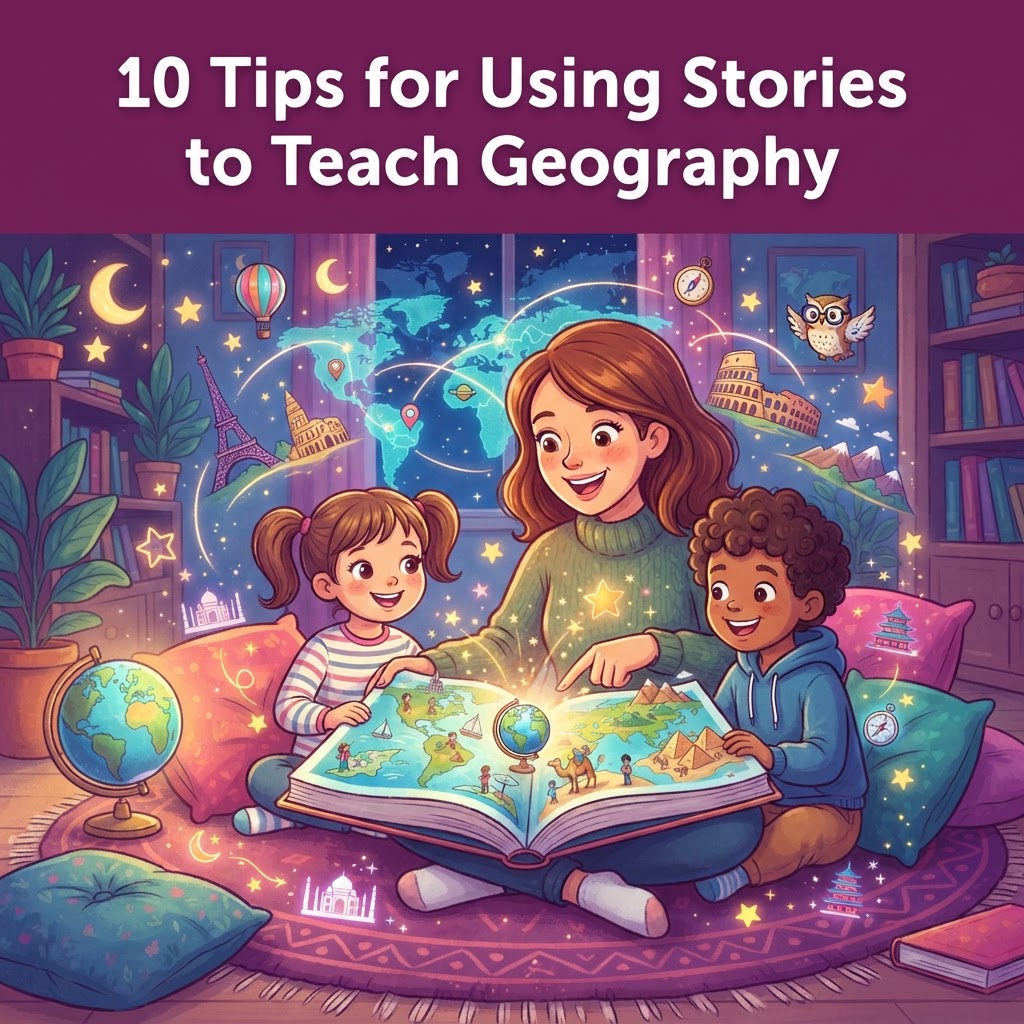
Stories are one of the easiest ways to make geography feel alive for young children. Instead of memorizing place names, kids can meet a child in Kenya, follow a boat down the Amazon, or imagine a snowy walk in Norway. That emotional connection matters: organizations like the Harvard Center on the Developing Child emphasize that children learn best through warm, language-rich interactions that connect new ideas to meaningful experiences.
If you are interested in teaching geography through stories, the goal is not to pack in facts. It is to help children notice places, people, landscapes, weather, movement, and culture in ways they can remember. These geography stories tips will help you use storytelling for home, bedtime, and classroom learning.
Why should geography stories start with a vivid setting?
Start with the place, because setting is what turns a story into geography storytelling. When children can picture the desert, rainforest, village, coastline, or city, they begin building a mental map.
Use just a few strong details:
- the air feels hot and dry
- houses sit close together on a steep hill
- fishing boats rock beside the shore
- monkeys chatter high in the trees
For younger children, keep the setting simple and concrete. If you want to create your own personalized bedtime story, choose one clear location first, then build the adventure around it.
How can you connect new places to a child’s own world?
Linking the unfamiliar to the familiar helps children understand geography faster. A child who has never seen a mountain range can still understand it if you compare it to the big hill near home, only “much taller and stretching for miles.”
Try prompts like:
- “This river is wider than the one in our town.”
- “Their winter is colder than ours.”
- “The market sounds busy, like our weekend street fair.”
This is one of the most useful teaching geography through stories strategies because it reduces overwhelm. Children learn new spatial ideas best when they can anchor them to something they already know.
What kinds of cultural details make geography storytelling richer?
The best geography stories include real cultural details, not just landmarks. Food, clothing, music, celebrations, homes, and daily routines help children see that places are shaped by people as well as land.
Focus on respectful, everyday details:
- what families eat for breakfast
- how children travel to school
- what games they play
- what the weather means for daily life
For accurate inspiration, the National Geographic Education resources are especially helpful. When you include culture, avoid stereotypes and remember that no country has only one way of living.
How can maps turn a story into a geography lesson?
Maps make stories concrete. Even a simple globe or printed map helps children connect the imagined journey to a real place on Earth.
Pause before or after the story and show:
- where the story begins
- where the character travels
- nearby oceans, mountains, or borders
- how far the journey might be
You do not need a formal atlas. The Library of Congress map collections are a great source of real-world maps and visuals. In a classroom, this is an easy bridge between read-aloud time and written geography work, especially when using InstaTales for teachers.
Why do journeys and routes help children understand space?
A journey gives geography structure. When a character travels from one place to another, children naturally learn about distance, direction, and sequence.
For example, a story might move:
- from village to market
- from mountain trail to valley
- from one country to another by train
This helps children grasp that places are connected. It also opens the door to cross-curricular learning. If you enjoy combining subjects, these science storytelling ideas can pair well with stories about climates, habitats, and landforms.
How can sensory details make locations easier to remember?
Sensory language makes places stick in memory. When children hear what a place sounds, smells, feels, and looks like, they form stronger mental images.
Use lines like:
- “The sand felt warm under her toes.”
- “The air smelled salty by the sea.”
- “Snow crunched under every step.”
- “The market glowed with red, yellow, and blue fabrics.”
This matters because young children learn through concrete experience, even imaginary experience. Good geography storytelling uses the senses to turn abstract places into felt experiences.
What is the best way to introduce geography words in a story?
Teach new geography vocabulary inside the story, then explain it in plain language. Children are more likely to remember words like peninsula, island, valley, equator, or border when they appear in a meaningful scene.
A simple pattern works well:
- Use the word in context.
- Define it quickly.
- Repeat it later.
For example: “Their home sat in a valley, a low area between mountains.” This method supports vocabulary growth without making the story feel like a quiz.
How can you keep geography stories accurate and respectful?
Accuracy matters, especially when stories introduce children to places they have never visited. Use trusted sources, check pronunciation when possible, and avoid reducing a whole country to one animal, one food, or one image.
A few best practices:
- verify facts about climate, wildlife, and landmarks
- represent people as individuals, not symbols
- show both similarities and differences
- include modern life, not only “traditional” scenes
This is also a child development issue. Research and guidance from groups such as NAEYC and UNICEF consistently stress that children build empathy through nuanced, respectful representations of others.
Why should you add hands-on activities after the story?
Hands-on extensions deepen learning. A short activity after the story helps children turn language into understanding.
Easy options include:
- drawing the setting
- tracing the route on a map
- building a landform with clay
- tasting a related food
- acting out the journey with toys
These follow-ups are especially effective for ages 3-8, who learn well through movement and play. If you want a fast start, using ready-made story templates can make it easier to match a story with an activity.
How can you revisit places across many stories?
Repetition builds real knowledge. Instead of introducing a new country every night, return to the same region in different stories so children notice patterns over time.
You might do one week on Japan, one month on African landscapes, or a mini-series on world rivers. Save favorites in your story library so children can compare places, re-read beloved journeys, and build a stronger sense of the world.
This is one of the most overlooked geography stories tips. Children rarely learn geography from one story alone. They learn it from many small, connected encounters.
What makes geography storytelling work so well for young children?
Geography storytelling works because it blends emotion, language, imagination, and knowledge. A child may forget a worksheet, but they often remember the girl who crossed a windy bridge in Peru or the boy who watched lanterns float on a river in Thailand.
When you use stories well, you are teaching more than map skills. You are teaching curiosity, empathy, vocabulary, and a sense that the world is both large and connected. That is why teaching geography through stories can be such a powerful tool for parents, homeschoolers, and teachers alike.
Frequently Asked Questions
What age is best for teaching geography through stories?
Children can begin as toddlers with simple place-based stories about weather, animals, and homes. By ages 4-10, they can handle maps, cultural details, and more specific geography terms.
Do geography stories need to be fact-heavy?
No. The best stories use a few accurate facts inside an engaging narrative. Children remember geography better when facts are tied to characters, setting, and action.
How long should a geography story be for young kids?
For ages 1-4, aim for 3-7 minutes with strong repetition and clear settings. For ages 5-10, longer stories can work well if the journey, place, or problem stays easy to follow.
How can parents use maps without making reading feel like school?
Keep the map moment short and playful. Point to the place before or after the story, trace the route with a finger, and ask one simple question like, “Do you think this is near the ocean?”
Can personalized stories help children learn geography?
Yes. Personalized stories often increase attention because the child feels part of the adventure. When a child becomes the traveler, explorer, or helper in the story, place-based learning feels more meaningful.
How can teachers use geography storytelling in class?
Teachers can pair stories with maps, art, writing prompts, and small group discussion. For more ideas, explore resources on the InstaTales blog or use story-based lessons through InstaTales for teachers.
Ready to Create a Personalized Bedtime Story?
Use our free AI bedtime story generator to create a personalized illustrated story for your child in 30 seconds — no credit card needed.
Popular story types:
Maya Rodriguez
Lead Content Editor & Early Literacy Specialist
Maya is a former early childhood educator and literacy specialist with over a decade of experience helping children develop a love of reading. She leads content at InstaTales, where she writes about the science of storytelling, child development, and how families can use personalized AI stories to build literacy and emotional resilience.
instatales.ai