AI Stories for Creative Writing Practice
Want to help your child practice creative writing? AI story generators can provide prompts, models, and inspiration for young writers.
✦ Key Takeaways
- •AI story generators support creative writing best when they provide structure and inspiration without taking over the child’s voice.
- •The best way to use AI stories as prompts is to stop early and hand the story back to the child.
- •Generated stories can work as short mentor texts that children analyze before writing their own.
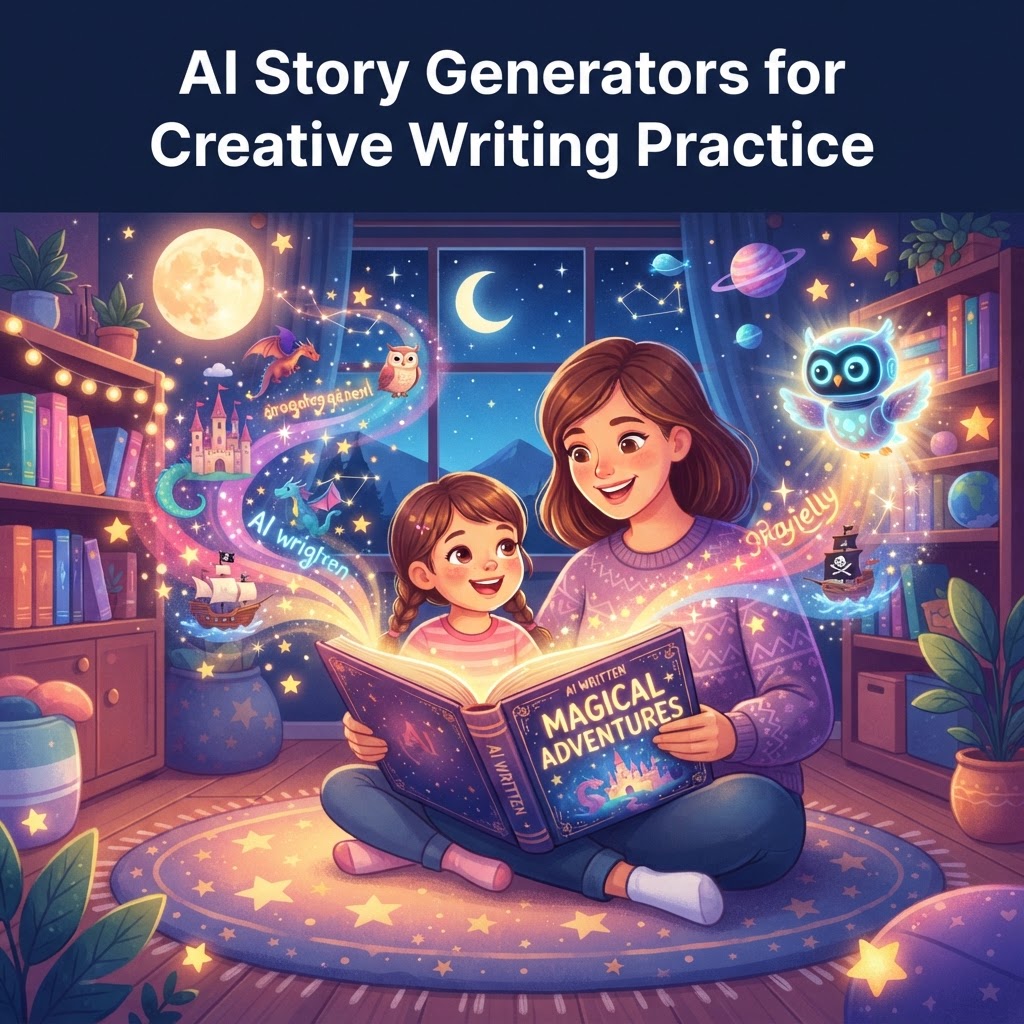
If you want to build stronger young writers, AI story generators can be a useful starting point. Used well, ai stories for creative writing give children ideas to respond to, examples to study, and a low-pressure way to experiment with language.
For parents and teachers, the key is simple: use AI as a scaffold, not a shortcut. Children learn most when they still do the thinking, talking, planning, drafting, and revising. That approach aligns with writing research from the Institute of Education Sciences, which emphasizes explicit writing instruction, planning, and feedback, and with guidance from Reading Rockets, which highlights modeling and discussion as essential supports for young writers.
How can AI story generators support creative writing practice?
AI story generators support creative writing best when they provide structure and inspiration without taking over the child’s voice. They can help children get unstuck, expand ideas, and practice story elements like character, setting, problem, and solution.
This matters because many children do not struggle with imagination—they struggle with starting. A blank page can feel overwhelming. An AI prompt such as “A penguin finds a key under the snow” gives a clear entry point, which lowers stress and frees up mental energy for storytelling.
For younger children, especially ages 1-5, “creative writing” often begins as oral storytelling, drawing, and dictation. The National Association for the Education of Young Children notes that emergent writing grows from talk, play, and meaningful marks on a page. In practice, that means a preschooler can tell a story aloud while an adult writes it down, and an older child can turn the same idea into a full paragraph or short tale.
AI tools are most helpful for:
- generating story starters
- suggesting interesting settings or characters
- offering “what happens next?” choices
- modeling simple story structure
- encouraging reluctant writers to try one more sentence
If you are choosing a tool for home or school, our guide on how to choose the best AI story generator can help you look for safe, age-appropriate features.
How can parents and teachers use AI stories as writing prompts?
The best way to use AI stories as prompts is to stop early and hand the story back to the child. Instead of asking AI to write the whole piece, ask it to generate a beginning, a problem, or three possible endings.
This approach keeps the child in the role of author. In writing pedagogy, that matters: children improve when they practice generating ideas, organizing thoughts, and making craft choices themselves.
Here are simple ways to use ai writing prompts kids can actually respond to:
- Story starter: Ask AI for one opening sentence only.
- Choice board: Ask for three characters, three settings, and three problems. Let the child mix and match.
- Picture-to-story: Show a drawing and ask AI to suggest what might happen first.
- Problem generator: If a child has a character but no plot, ask AI for five age-appropriate problems.
- Ending challenge: Give the child a beginning and middle, then ask them to invent the ending before checking AI’s suggestion.
A good adult prompt might be: “Give me 3 story ideas for a 7-year-old about friendship, each in one sentence.” Short outputs are better than full stories because they leave room for original thinking.
At home, families can create your own personalized bedtime story from a child’s favorite themes, then pause and ask, “What would you change?” That small shift turns passive reading into active composition.
In the classroom, InstaTales for teachers can support quick warm-ups, independent writing centers, or differentiated prompts for mixed ability groups.
How can generated stories become mentor texts for analysis?
Generated stories can work as short mentor texts that children analyze before writing their own. This is useful because many young writers need to see what a story does before they can do it independently.
Teachers have long used mentor texts to highlight craft moves. An AI-generated story can serve the same purpose when it is short, clear, and age-appropriate. Because it is customizable, you can create models at the exact reading level or topic your child needs.
Ask children to notice:
- how the story begins
- what the main character wants
- where the problem appears
- which words show feelings
- how dialogue is punctuated
- how the ending connects back to the beginning
For example, if the AI creates a story about a nervous rabbit starting school, you might ask:
- “What makes the first sentence interesting?”
- “Where do we learn the rabbit’s problem?”
- “Which describing words could we borrow in our own writing?”
- “How would the story change if it were told by the rabbit?”
This kind of guided noticing supports writing transfer. Instead of copying, children learn to name and reuse techniques like repetition, dialogue, sensory details, or a satisfying ending.
It also helps to save strong examples in your story library so children can revisit them later. Re-reading and comparing models builds pattern recognition, which is a big part of learning to write well.
How can children collaborate with AI without losing their own voice?
Children can collaborate with AI successfully when the adult protects authorship. The child should make the key decisions, while AI offers options, questions, or gentle support.
A simple routine works well:
- The child chooses the character, setting, and problem.
- AI suggests two or three possible next events.
- The child picks one, combines ideas, or rejects them all.
- The adult asks follow-up questions: “Why did that happen?” “How did the character feel?”
- The child revises the story in their own words.
This matters because voice develops through decision-making. If AI does all the composing, children may produce polished sentences but miss the learning. If AI acts more like a brainstorming partner, children still practice narrative thinking.
You can also use “collaborative drafting”:
- Child writes the first sentence.
- AI suggests the next sentence.
- Child rewrites it better.
- Repeat for one short paragraph.
That turns AI into a comparison tool rather than a replacement writer. Many children enjoy “beating the robot” by improving on its idea.
For reluctant writers, collaborative storytelling can reduce pressure and increase motivation. For children with varied learning needs, it can also provide flexible entry points, much like the supports discussed in our article on AI stories for special needs children.
What are 10 AI writing prompts kids can try today?
The most effective prompts are specific, playful, and open-ended. Good ai story inspiration gives children something concrete to imagine while still leaving room for creativity.
Try these 10 prompts:
- A tiny dragon loses its fire the day of the school talent show.
- A lunchbox opens into a different world every Monday.
- A shy cloud follows a child home and needs help making friends.
- The library has a secret shelf that only appears in the rain.
- A robot pet learns one surprising human feeling.
- Two siblings find a map inside a cereal box.
- A mermaid and a mountain goat become pen pals.
- Every time a child sneezes, one object in the room starts talking.
- A brave teddy bear must rescue its sleeping owner’s missing dream.
- The moon asks one child for help fixing the night sky.
To deepen the writing, add one challenge after the prompt:
- include three feeling words
- write one line of dialogue
- use all five senses
- start with action
- end with a surprise
You can also turn prompts into a weekly routine. Pair one short writing task with weekly reading challenges or browse more ideas on the InstaTales blog if your child likes themed activities.
How can adults use AI story inspiration safely and well?
Adults should use AI story tools with clear boundaries, active supervision, and realistic expectations. The goal is not more screen time or perfect writing—it is better conversation, stronger ideas, and more joyful practice.
A few smart guidelines help:
- keep sessions short
- review outputs before sharing with children
- prefer age-appropriate, child-focused tools
- ask children to change or question what AI produces
- treat generated text as a draft, not the final answer
It also helps to balance on-screen prompting with off-screen writing, drawing, acting, or oral storytelling. If that is a concern in your home or classroom, our guide to healthy balance with screen time offers practical strategies.
Finally, remember that not every child needs the same support. Some children need silly prompts. Others need visual structure, repetition, or social-emotional themes. The best ai stories for creative writing are the ones that meet a child where they are and invite them to say, “I have an idea.”
Frequently Asked Questions
Are AI story generators good for reluctant writers?
Yes, they can be very helpful for reluctant writers because they reduce the pressure of starting from a blank page. A short prompt or partial story often makes writing feel more playful and manageable.
At what age can children use AI for creative writing?
Children of many ages can benefit, but the activity should match development. Younger children may dictate stories or respond through drawing, while older children can draft, revise, and analyze story structure more independently.
Will AI make kids dependent on writing tools?
It can if adults let AI do all the composing. The solution is to use AI for brainstorming, modeling, and idea generation while keeping the child responsible for key writing decisions.
How long should an AI-supported writing session last?
For most children, 10-20 minutes is enough for one focused session. Short, regular practice usually works better than long sessions that feel tiring or overly screen-based.
Can teachers use AI stories in the classroom?
Yes, teachers can use them for warm-ups, mentor texts, differentiated prompts, and collaborative writing activities. The most effective classroom use keeps the focus on student thinking, discussion, and revision.
What should I look for in an AI story tool for kids?
Look for age-appropriate content, simple controls, customization options, and strong safety practices. It also helps if the tool lets you save drafts, revisit stories, and adapt prompts for different interests or learning needs.
Get a new bedtime story every week
Free, personalized, and delivered to your inbox. No spam, ever.
Ready to Create a Personalized Bedtime Story?
Use our free AI bedtime story generator to create a personalized illustrated story for your child in 30 seconds — no credit card needed.
Popular story types:
Maya Rodriguez
Lead Content Editor & Early Literacy Specialist
Maya is a former early childhood educator and literacy specialist with over a decade of experience helping children develop a love of reading. She leads content at InstaTales, where she writes about the science of storytelling, child development, and how families can use personalized AI stories to build literacy and emotional resilience.
instatales.ai