AI Story Illustrations: Are They Good Enough?
AI-generated illustrations for children's stories have come a long way. Here's what to expect, how to choose styles, and quality comparisons.
✦ Key Takeaways
- •AI story illustrations are much better than they were even a year or two ago.
- •Some illustration styles are much more reliable than others.
- •The best illustration style depends on your child’s developmental stage, not just your personal taste.
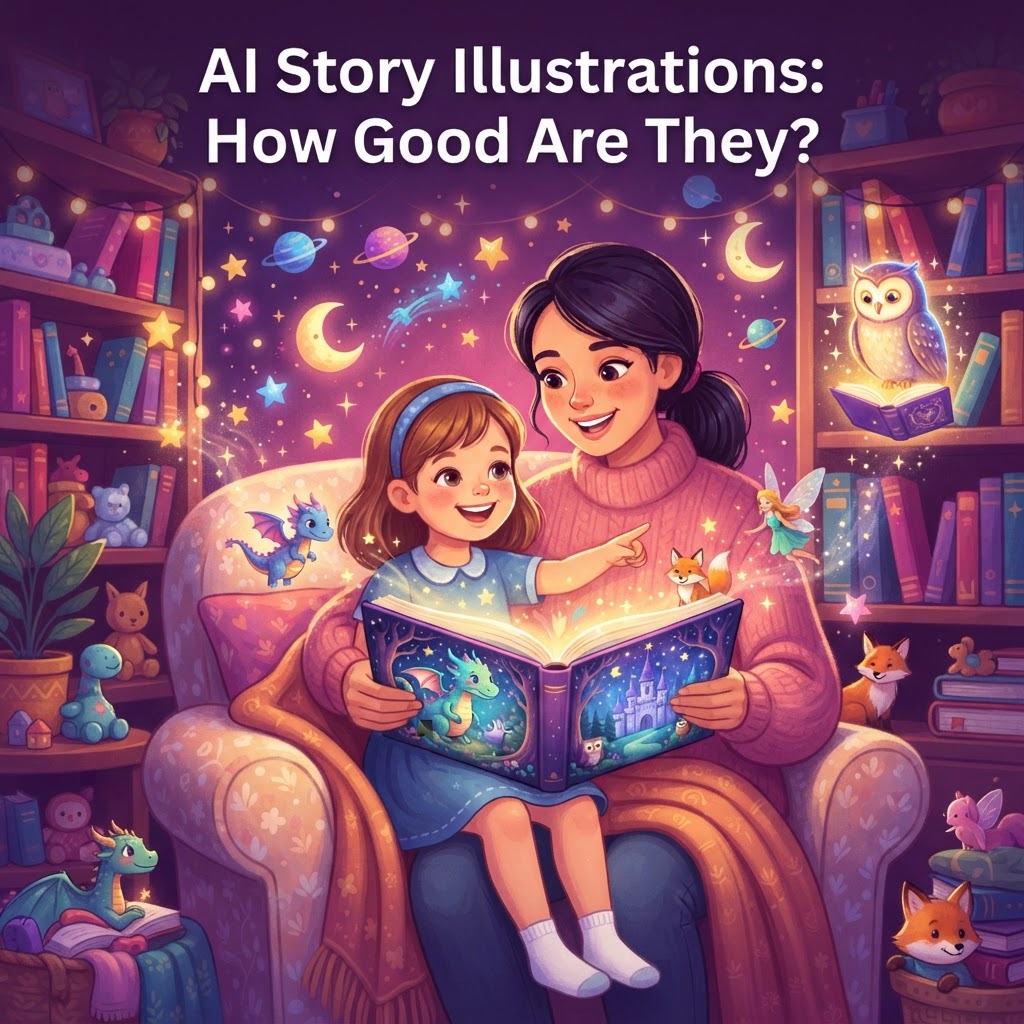
Parents often ask a fair question: are AI story illustrations actually good enough for children’s books and bedtime stories? The short answer is yes—often surprisingly good—but the quality depends on the style, the age of the child, and how carefully the images are generated and reviewed.
Today’s ai story illustrations can be charming, expressive, and highly personalized. They can also be inconsistent from one page to the next. If you want to create your own personalized bedtime story, it helps to know which visual styles work best, what “good quality” really looks like, and how to match illustrations to your child’s stage of development.
What is the current state of AI story illustrations?
AI story illustrations are much better than they were even a year or two ago. For many families, they are now more than good enough for digital bedtime stories, read-alouds, and personalized keepsakes.
The biggest improvement is in style control. Modern tools can produce soft watercolor scenes, bright cartoon characters, cozy storybook pages, and even semi-realistic fantasy art with much better color harmony and composition than early models. That matters because children respond strongly to mood, facial expression, and visual clarity.
That said, ai illustration quality is still uneven. AI is excellent at creating one beautiful image. It is less reliable at keeping a character’s face, clothes, or proportions exactly the same across 10 pages. Small errors can also appear in hands, background objects, and text inside the image.
From a child development perspective, that inconsistency matters more for some ages than others. The Harvard Center on the Developing Child emphasizes the value of shared attention and responsive interaction, and clear images support that process during reading. The National Association for the Education of Young Children also stresses that young children learn best from developmentally appropriate, engaging materials.
So, where are we now?
- Best use cases: bedtime stories, personalized adventures, classroom prompts, family keepsakes
- Good but imperfect: multi-page visual consistency, exact details, complex action scenes
- Still risky: print-ready picture books without human review, culturally specific details, text embedded in artwork
If you are curious about the technology behind it, this guide on how AI story generators work for parents gives a helpful foundation.
How does ai illustration quality compare across popular styles?
Some illustration styles are much more reliable than others. In general, cartoon and storybook styles are the safest choices, while highly realistic images are the hardest for AI to get consistently right.
Here is a practical quality comparison of the most common styles parents see in AI story tools:
Watercolor
Watercolor AI illustrations often look beautiful and gentle. They work well for calm bedtime stories because the soft edges and blended colors create a soothing mood.
Strengths:
- Dreamy, cozy, and emotionally warm
- Great for animals, nature scenes, and bedtime themes
- Hides minor AI imperfections well
Limitations:
- Faces can sometimes look vague
- Action scenes may feel less clear for very young children
Cartoon
Cartoon style usually offers the strongest clarity. It is one of the best options for younger children because expressions, shapes, and actions are easy to read.
Strengths:
- Clear emotions and strong visual storytelling
- Consistent characters more often than other styles
- Bright colors and simple forms suit early readers
Limitations:
- Can feel less magical if overdone
- Some tools default to overly generic characters
Realistic
Realistic AI art can look impressive at first glance, but it is the least dependable for children’s stories. When it works, it looks cinematic. When it fails, the mistakes feel obvious.
Strengths:
- Rich detail for fantasy, nature, and adventure themes
- Can appeal to older children who want “grown-up” visuals
Limitations:
- Uncanny faces, awkward hands, and stiff expressions
- Less forgiving when details are wrong
- Can feel too intense for bedtime
Storybook
Storybook style is often the sweet spot for families. It combines the warmth of traditional picture books with enough structure to keep scenes readable.
Strengths:
- Balanced detail and softness
- Familiar “book-like” feel
- Good for a wide age range
Limitations:
- Quality depends heavily on the prompt and tool
- Some outputs blur into a generic fantasy look
For most parents comparing ai art for children's books, the safest ranking is usually:
- Storybook
- Cartoon
- Watercolor
- Realistic
How should you choose an illustration style for your child's age?
The best illustration style depends on your child’s developmental stage, not just your personal taste. Younger children usually need simple, emotionally readable images, while older children can enjoy more detail and visual complexity.
The CDC developmental milestones remind us that children’s attention, language, and visual processing change quickly in the early years. Art educators often make similar recommendations: start with clear shapes, strong contrast, and recognizable emotions before moving toward nuance and dense visual scenes.
Here is a simple guide:
-
Ages 1-3: Choose cartoon or very simple storybook art.
Look for big faces, clear actions, limited background clutter, and warm colors. If you want more ideas, this guide to toddler-friendly story tools pairs well with style selection. -
Ages 4-6: Choose storybook, cartoon, or soft watercolor.
At this age, children can follow richer scenes, but they still benefit from obvious expressions and visual repetition. Gentle fantasy, animals, and familiar settings work especially well. -
Ages 7-10: Choose storybook, watercolor, or selective realism.
Older children often enjoy more detailed worlds, layered backgrounds, and moodier art. For this group, stronger narrative illustrations can support comprehension and imagination, especially in chapter-style stories. This article on AI story tools for elementary readers explores that stage in more depth.
A useful rule: the younger the child, the clearer the picture should be. Beautiful art is not always the most readable art.
What makes ai art for children's books look high quality?
High-quality AI art for children’s books is easy for a child to understand at a glance. The most important signs of quality are not technical perfection alone, but clarity, warmth, and consistency.
When educators and parents evaluate picture-book visuals, they usually look for these markers:
- Character consistency: Does the child, animal, or hero look like the same character on every page?
- Facial readability: Are emotions obvious and appropriate?
- Age-appropriate detail: Is the image engaging without overwhelming the child?
- Clear action: Can a child tell what is happening quickly?
- Supportive color use: Do the colors match the story’s mood?
- Safe visual tone: Does the image feel comforting rather than confusing or intense?
- Inclusive representation: Are skin tones, family structures, and cultural details handled respectfully?
One overlooked point in ai illustration quality is composition. A lovely image can still fail if the focal point is unclear. In children’s visual literacy, the eye should land quickly on the main character or action.
This is where AI still needs thoughtful human oversight. Parents may need to regenerate an image if:
- the background is too busy,
- a character looks different from page to page,
- the image feels emotionally flat,
- or small errors distract from the story.
In short, “high quality” for children means emotionally clear, developmentally appropriate, and visually consistent.
When do AI story illustrations work best, and when do they still fall short?
AI story illustrations work best when personalization matters more than perfect artistic control. They are especially strong for bedtime stories, quick custom adventures, and child-centered stories that would be hard to commission traditionally.
They shine when you want:
- your child as the main character,
- a fast visual for tonight’s story,
- a custom theme like dinosaurs, ballet, or space,
- repeatable reading routines with fresh images.
This can be especially helpful for motivation. Children are often more engaged when they recognize themselves, their interests, or their family in a story. That same personalization can support language growth, especially in multilingual homes, though the visual style should still stay simple and consistent.
But AI still falls short in a few important ways. It struggles with:
- exact continuity across many pages,
- complex group scenes,
- nuanced cultural symbolism,
- highly specific educational diagrams,
- truly original artistic voice over a long book.
That is why AI images are often best viewed as excellent family-reading visuals rather than automatic replacements for professional picture-book illustration. They are good tools—but not hands-free tools.
How can parents get better results from AI story illustrations?
Parents can improve AI story illustrations dramatically with a few simple choices. The biggest wins come from choosing one style, keeping descriptions consistent, and reviewing images before sharing them with a child.
Try these practical steps:
- Pick one visual style and stick with it. Mixing watercolor and realism in one story usually hurts consistency.
- Describe the main character simply. Include hair, skin tone, pajamas or favorite outfit, and one or two defining features.
- Ask for one clear action per image. “Jumping in puddles” works better than “running, laughing, twirling, and holding a kite.”
- Use emotional words. Cozy, cheerful, sleepy, brave, gentle, and curious help AI create child-friendly moods.
- Check every page for continuity. Children notice when a red dragon suddenly becomes blue.
- Re-generate when needed. One extra try can improve a page a lot.
- Save the best versions. Keeping favorites in your story library makes it easier to re-read the images your child responded to most.
If you are making stories regularly, a simple routine helps: choose a style, generate a short story, review the images, and keep only the clearest set. Over time, you will quickly learn what visual approach best fits your child.
Frequently Asked Questions
Are AI story illustrations good enough for bedtime stories?
Yes, in many cases they are. For digital bedtime stories and personalized family reading, AI images are often charming, clear, and engaging enough—especially in cartoon or storybook styles.
Which AI illustration style is best for toddlers?
Cartoon and simple storybook styles are usually best for toddlers. They offer clear faces, bold shapes, and easy-to-follow action without too much background detail.
Why do AI illustrations sometimes change from page to page?
AI tools can struggle with character consistency across multiple images. The same child or animal may appear with slightly different clothes, facial features, or proportions unless the prompt and style stay very consistent.
Is realistic AI art a good choice for children's books?
Sometimes, but usually for older children rather than toddlers or preschoolers. Realistic images can be striking, but they also make AI mistakes more noticeable and may feel less warm for bedtime reading.
Can AI replace human illustrators for children's books?
Not fully. AI is excellent for speed, personalization, and experimentation, but human illustrators still lead in consistency, storytelling nuance, and original artistic voice.
What should parents check before showing AI images to a child?
Look for emotional clarity, visual comfort, and basic accuracy. If a character looks unsettling, overly busy, or inconsistent, it is worth regenerating the image before reading together.
Ready to Create a Personalized Bedtime Story?
Use our free AI bedtime story generator to create a personalized illustrated story for your child in 30 seconds — no credit card needed.
Popular story types:
Maya Rodriguez
Lead Content Editor & Early Literacy Specialist
Maya is a former early childhood educator and literacy specialist with over a decade of experience helping children develop a love of reading. She leads content at InstaTales, where she writes about the science of storytelling, child development, and how families can use personalized AI stories to build literacy and emotional resilience.
instatales.ai