How AI Story Generators Work for Parents
Curious about how AI story generators work? Here's a parent-friendly explanation of the technology behind personalized children's stories.
✦ Key Takeaways
- •An AI story generator is usually using a large language model, or LLM, to predict what words should come next in a story.
- •An LLM turns a short prompt into a story by filling in gaps using learned story structure.
- •Personalization works by combining your child’s details with rules about tone, reading level, and story structure.
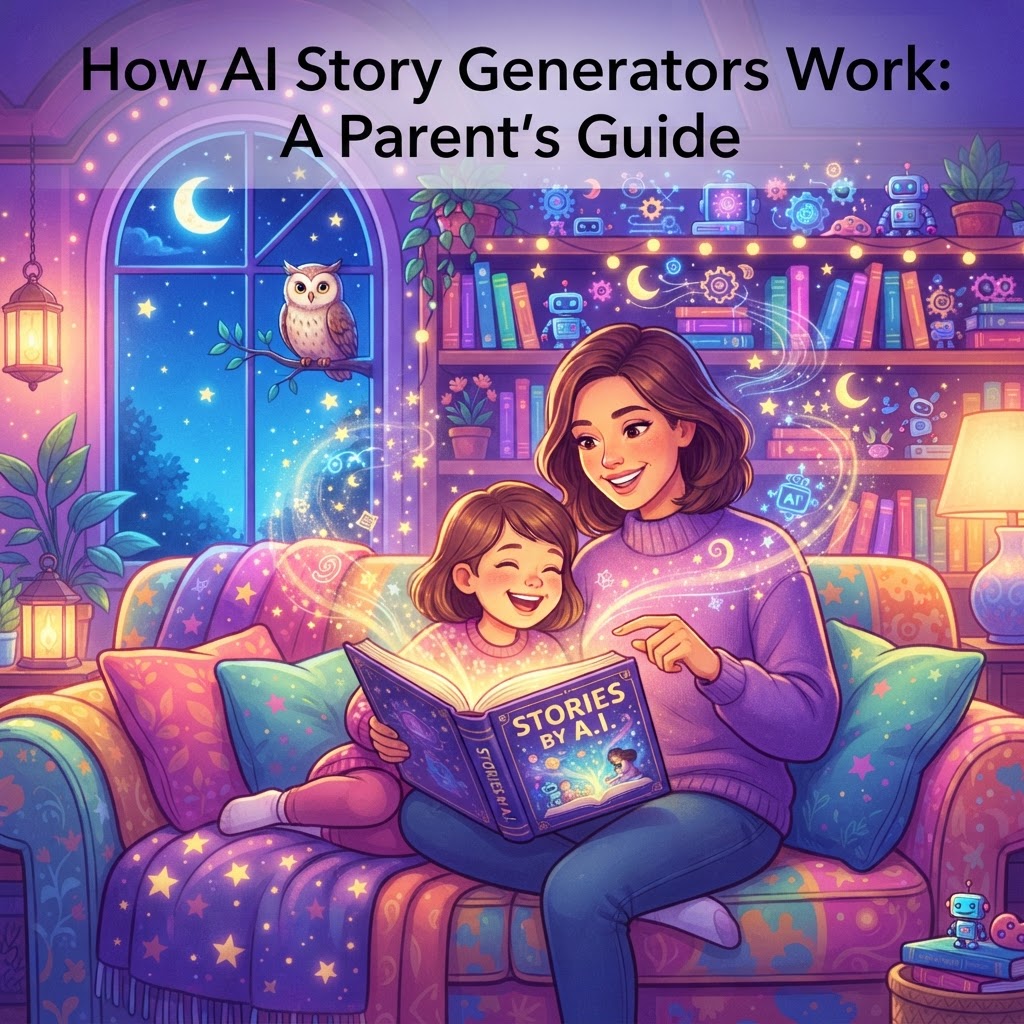
If you have ever typed in your child’s name, favorite animal, and a bedtime theme, then watched a brand-new story appear in seconds, it can feel a little magical. The good news is that how AI story generators work is not magic at all—it is a mix of language prediction, personalization rules, image generation, and safety checks designed to make storytelling faster and more flexible for families.
For parents, the easiest way to understand AI storytelling technology is to think of it as a very fast creative assistant. It takes your ideas, follows story patterns it has learned, and turns them into a tale that feels custom-made for your child. If you want to create your own personalized bedtime story, understanding the basics can help you use the tool with more confidence.
What is happening when an AI story generator writes a story?
An AI story generator is usually using a large language model, or LLM, to predict what words should come next in a story. In simple terms, it is making one tiny writing decision after another, very quickly, based on patterns it learned from reading enormous amounts of text during training.
A helpful analogy is predictive text on your phone, but much more advanced. Instead of guessing the next word in a short message, an LLM can build whole paragraphs that sound like a fairy tale, a jungle adventure, or a sleepy bedtime poem.
That does not mean the model “thinks” like a person. It does not have childhood memories or a moral point of view. What it does have is a strong ability to recognize patterns in language, such as:
- how stories usually begin
- how characters speak and act
- what makes a plot feel calm, funny, or exciting
- how bedtime stories often end with comfort and closure
This is the foundation of llm for kids stories: pattern recognition shaped into age-appropriate storytelling.
How does an LLM turn a few details into a full bedtime story?
An LLM turns a short prompt into a story by filling in gaps using learned story structure. If you type “Maya, age 5, loves dinosaurs and the moon,” the model uses those details as instructions, then builds a likely narrative around them.
A good parent-friendly analogy is a choose-your-own ingredients recipe. You provide the main ingredients—name, age, interests, setting, tone—and the model uses a recipe for storytelling to create the finished dish.
Most systems follow a process like this:
- Read the prompt: The AI identifies key details like names, age level, topic, and mood.
- Plan the response: It predicts a likely structure, such as beginning, problem, adventure, and calm ending.
- Write sentence by sentence: It chooses the most fitting next words based on the story so far.
- Adjust style: It may simplify vocabulary for younger children or make the plot more detailed for older ones.
This is why one child can get a gentle story about a bunny losing a shoe, while another gets a space mission with robot friends. The engine is the same, but the prompt changes the path.
If you are exploring options, our guide to free AI story generator picks for kids can help you compare tools and features.
How does personalization work without a human author typing every line?
Personalization works by combining your child’s details with rules about tone, reading level, and story structure. The AI is not pulling a ready-made book off a shelf; it is generating a new version based on the inputs you provide.
Think of it like a skilled camp counselor who knows hundreds of story patterns. Give that counselor a child’s name, favorite color, and fear of thunderstorms, and they can tell a story that feels personal on the spot.
Personalization often includes:
- the child’s name or nickname
- favorite animals, hobbies, or places
- age-based vocabulary and sentence length
- bedtime tone, such as soothing or playful
- themes like friendship, courage, routines, or school readiness
This matters because children often respond well to familiar details. Research on early language development and back-and-forth interaction, including work highlighted by the Harvard Center on the Developing Child, shows that children learn through meaningful, responsive experiences. When a story includes details a child cares about, attention and engagement are often stronger.
For families, personalization can also support repetition. You can generate a favorite format again and again using new settings or characters, or start from ready-made story templates when you want a quick bedtime win.
How are illustrations made for children’s AI stories?
AI illustrations are usually created by a separate image model that turns text descriptions into pictures. In other words, the story generator writes a scene description, and the image system uses that description to produce artwork that matches it.
A simple analogy is hiring an illustrator who receives a brief that says, “Draw a smiling fox in pajamas under a starry sky, in soft watercolor style.” The image model does that at speed, creating a fresh picture rather than searching a stock-photo library.
In practice, the system may use prompts like:
- character details
- colors and mood
- art style
- setting and action
- age-appropriate visual cues
The best children’s platforms also try to keep illustrations visually gentle and consistent from one page to the next. That is important for young readers, who rely on predictable characters and clear scenes to follow the story.
Because image generation is improving quickly, results can vary. Sometimes parents may notice extra fingers, odd background details, or characters who look slightly different between pages. That is not unusual in current AI storytelling technology, and it is one reason human review still matters.
What do safety filters actually do?
Safety filters are the guardrails that help block content that is not suitable for children. They work before, during, and after story generation to reduce the chance of violent, sexual, hateful, frightening, or otherwise inappropriate material appearing.
The easiest analogy is a children’s librarian plus an airport security checkpoint. One part checks what goes in, another monitors what comes out, and both are there to keep the experience safer.
A children’s AI system may use safety tools to:
- reject unsafe prompts
- remove adult themes
- avoid graphic violence or scary details
- limit personal data collection
- flag biased or harmful language
- steer stories toward supportive, age-appropriate endings
These filters matter because language models are powerful, but not perfect. The American Academy of Pediatrics encourages thoughtful, active adult involvement with children’s media, and that principle applies here too. Safety systems help, but parent oversight is still the strongest filter of all.
Why do parents still matter when AI helps tell the story?
Parents still matter because the biggest learning benefit comes from the relationship around the story, not just the story itself. AI can generate the text, but adults provide warmth, context, questions, and emotional connection.
This is where child development research is very clear. Studies on dialogic reading, including work by Grover Whitehurst and colleagues, found that children build stronger language skills when adults ask questions, pause for responses, and connect the story to real life. The NAEYC also emphasizes interactive, intentional use of digital tools rather than passive consumption.
In practice, that means you can make any AI story better by:
- asking, “What do you think happens next?”
- connecting events to your child’s day
- explaining unfamiliar words
- noticing feelings in the characters
- re-reading favorite stories for comfort and learning
That is also why some families like to save strong stories in your story library and revisit them later. Repetition helps children feel mastery, and it gives parents more chances to deepen the conversation.
If you are wondering how AI fits alongside print books, this comparison of AI bedtime stories and traditional books offers a balanced look.
How can families get the best results from AI storytelling technology?
Families get the best results when they treat AI as a creative tool, not a babysitter or replacement for shared reading. The most helpful approach is to guide the prompt, review the output, and stay involved.
A few practical tips make a big difference:
- Be specific: Include age, tone, favorite characters, and bedtime goals.
- Choose calm endings: Ask for soothing language and reassuring conclusions.
- Preview first: Scan stories before reading them aloud.
- Personalize thoughtfully: Use fun details, but avoid sharing sensitive private information.
- Use stories as conversation starters: Let the story open the door to talk about fears, friendships, or routines.
For educators, the same principles apply in group settings. Personalized prompts can support writing practice, SEL themes, and reading motivation, especially when paired with discussion and follow-up activities through InstaTales for teachers or more resources on the InstaTales blog.
When parents understand how AI story generators work, the technology becomes much less mysterious. It is not replacing imagination. It is giving families another way to spark it.
Frequently Asked Questions
Are AI story generators safe for young children?
They can be safer when they include strong moderation, age settings, and content filters. Parents should still preview stories and stay involved, especially for younger children.
Does an LLM copy stories from books?
Not usually in the way people imagine. A large language model learns patterns from training data and generates new text word by word, though quality systems should also work to avoid plagiarism and overly familiar phrasing.
Can AI stories support reading development?
Yes, especially when adults read with children and talk about the story. Personalized content can boost attention, but the strongest learning still comes from shared reading and conversation.
How do AI story illustrations match the text?
A separate image model reads a text description of the scene and creates artwork to fit it. The result is generated from the prompt rather than pulled from a simple image database.
What is the best prompt for a children’s AI story?
The best prompts are clear and specific. Include your child’s age, interests, desired tone, favorite setting, and the kind of ending you want, such as comforting, silly, or confidence-building.
Should AI stories replace regular books?
No. AI stories work best as one part of a healthy reading life that also includes picture books, library visits, and parent-child storytelling.
Ready to Create a Personalized Bedtime Story?
Use our free AI bedtime story generator to create a personalized illustrated story for your child in 30 seconds — no credit card needed.
Popular story types:
Maya Rodriguez
Lead Content Editor & Early Literacy Specialist
Maya is a former early childhood educator and literacy specialist with over a decade of experience helping children develop a love of reading. She leads content at InstaTales, where she writes about the science of storytelling, child development, and how families can use personalized AI stories to build literacy and emotional resilience.
instatales.ai