AI Storytelling vs Screen Time: Why Interactive Stories Are Better for Children in 2026
Not all screen time is equal. Discover why AI storytelling is fundamentally different from passive screen consumption — and how it delivers the developmental benefits of traditional reading through modern technology.
✦ Key Takeaways
- •The American Academy of Pediatrics revised its screen time guidance in 2024, shifting from a blanket 'limit all screens' approach to a more nuanced framework: prioritize quality and context over quantity.
- •Brain imaging research reveals that interactive story time results in qualitative neural activation, whereas passive video watching triggers primarily sensory cortex activity with minimal language network engagement. During passive video watching: - Primarily sensory cortex activation (visual and auditory processing) - Minimal language network engagement - Reduced prefrontal cortex activity (the seat of reasoning and self-regulation) - Dopamine spikes from novelty, creating craving cycles During interactive story time: - Full language network activation (Broca's and Wernicke's areas) - Prefrontal cortex actively engaged (following narrative logic, predicting outcomes) - Limbic system engaged (emotional processing through characters) - Imagination and mental imagery centers active - Bonding hormones (oxytocin) elevated during parent-child reading This is not a marginal difference.
- •Rather than a rigid minute-per-day rule, consider this quality hierarchy: Tier 1 — Prioritize and actively encourage: - AI storytelling with parent co-reading (30–45 min/day) - Video calls with grandparents and extended family - Supervised educational interactive tools Tier 2 — Allow with clear time boundaries: - Quality children's programming (PBS, educational documentaries) - Creative digital tools (age-appropriate drawing, music, simple coding) - Digital books and audiobooks Tier 3 — Strictly limit or avoid: - Algorithmic social media platforms (not appropriate under 13) - Passive entertainment streaming without time limits - Games designed around compulsive engagement mechanics AI storytelling belongs firmly in Tier 1 — alongside reading physical books — when practiced as an interactive, co-engaged family ritual.
AI Storytelling vs Screen Time: Why Interactive Stories Are Better for Children in 2026
In 2026, 'screen time' has become one of the most debated topics in parenting. But the conversation has evolved beyond simple minute-counting. Mounting evidence shows that not all screen time is equal — and AI storytelling represents a fundamentally different category of digital engagement from passive entertainment.
Why do the old screen time rules no longer apply to my children?
The American Academy of Pediatrics revised its screen time guidance in 2024, shifting from a blanket 'limit all screens' approach to a more nuanced framework: prioritize quality and context over quantity. The reason is clear: interactive, co-engaged digital activity has fundamentally different effects on child development than passive entertainment consumption.
The key question is no longer 'how much screen time?' but 'what kind?'
Research from Harvard's Center on the Developing Child identifies three categories of digital engagement:
- Passive consumption — cartoons, social media scrolling, YouTube autoplay (lowest developmental benefit, highest risk of overconsumption)
- Interactive engagement — educational apps, creative tools, skill-building games (moderate to high benefit when age-appropriate)
- Co-engagement — any digital activity done together with a parent or caregiver (highest benefit across all categories)
AI storytelling falls into categories 2 and 3. When done as a shared reading ritual, it is squarely in the highest-value tier.
How is AI storytelling neurologically different from watching videos?
Brain imaging research reveals that interactive story time results in qualitative neural activation, whereas passive video watching triggers primarily sensory cortex activity with minimal language network engagement.
During passive video watching:
- Primarily sensory cortex activation (visual and auditory processing)
- Minimal language network engagement
- Reduced prefrontal cortex activity (the seat of reasoning and self-regulation)
- Dopamine spikes from novelty, creating craving cycles
During interactive story time:
- Full language network activation (Broca's and Wernicke's areas)
- Prefrontal cortex actively engaged (following narrative logic, predicting outcomes)
- Limbic system engaged (emotional processing through characters)
- Imagination and mental imagery centers active
- Bonding hormones (oxytocin) elevated during parent-child reading
This is not a marginal difference. It is qualitative.
Which benefits does AI storytelling offer over passive screen time?
1. Active Language Development
During AI story time:
- Children encounter 30+ unique words per 1,000 vs. 9 in typical conversation
- New vocabulary appears in meaningful, personally relevant context
- Discussion and questions naturally extend language acquisition after the story ends
During passive TV watching:
- Most dialogue uses simple, familiar vocabulary
- No personalization means no contextual relevance
- No natural opportunity for vocabulary discussion
2. Emotional Intelligence and Empathy
Personalized stories develop empathy by letting children safely inhabit other perspectives through characters they care about. Passive entertainment is designed primarily to provoke simple emotional reactions — excitement, fear, humor — for maximum engagement time.
Personalized AI stories go further: when the character in the story faces the same challenge your child is navigating in real life, the emotional processing becomes therapeutic. Children internalize coping strategies from characters in ways that direct advice rarely achieves.
3. Sustained Attention and Executive Function
AI stories have a beginning, middle, and end. Following a 15-minute narrative requires sustained attention — a cognitive skill being actively eroded by short-form video content designed to maximize rapid context-switching.
Children who engage in regular story time show measurably:
- Better attention spans across learning contexts
- Stronger impulse control
- Improved working memory (holding plot details while processing new information)
- Greater ability to delay gratification
4. Parent-Child Connection
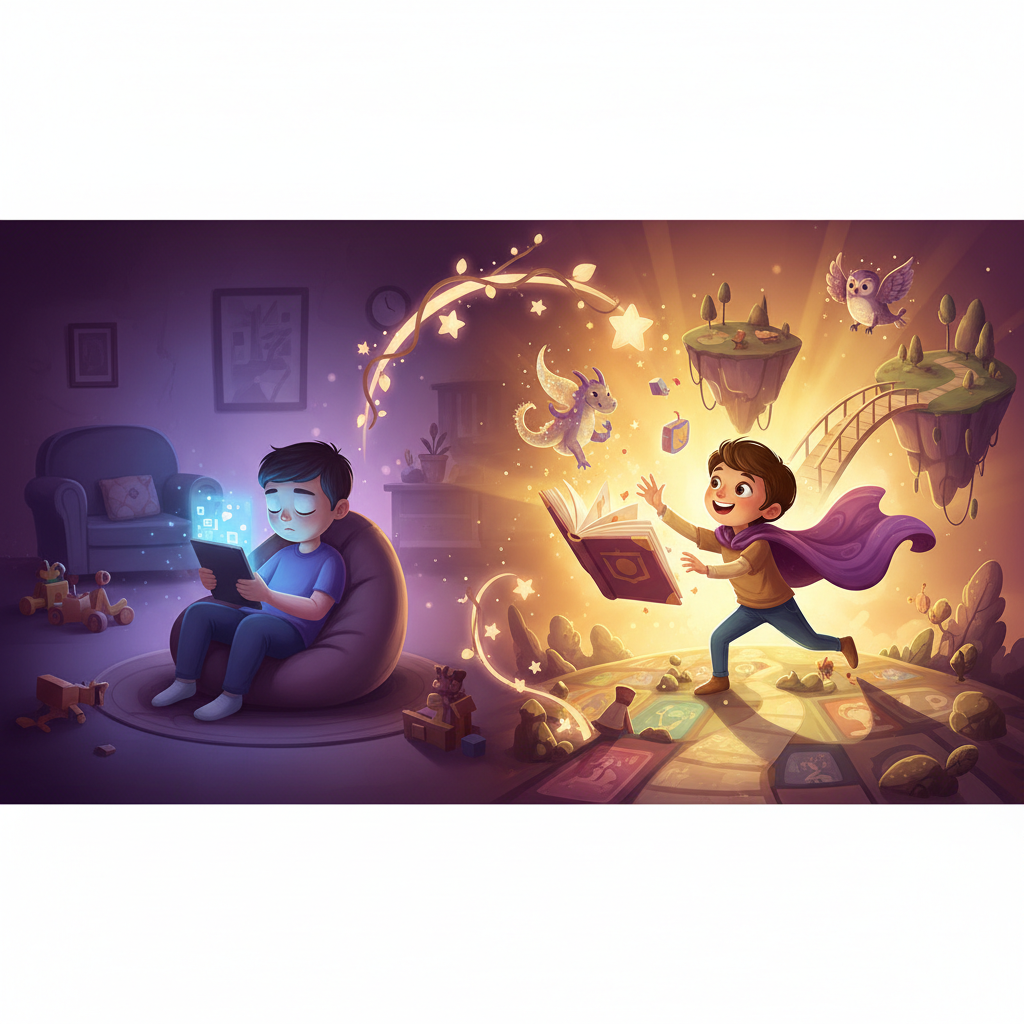
AI storytelling is ideally done together. Passive screen time often functions as a separation activity — child engaged with device, parent elsewhere. Research consistently shows that parental co-engagement multiplies all developmental benefits, regardless of the activity.
The shared experience of a personalized story — laughing at a funny character, gasping at a plot twist, discussing the lesson at the end — is irreplaceable relationship currency between parent and child.
5. Natural, Satisfying Stopping Points
Passive video content is specifically engineered to prevent stopping: autoplay removes friction, infinite scroll eliminates natural endpoints, cliffhanger algorithms create urgency for the next episode. This is intentional design for maximum consumption time — not designed with children's wellbeing in mind.
A story has an ending. A satisfying, complete narrative arc that closes neatly. This makes AI story time a healthy ritual with a natural conclusion, rather than a battle over when to stop.
6. Cultural and Language Development
Leading AI story platforms support 20+ languages. For bilingual families or those maintaining heritage languages, personalized stories in a second language provide engaging, contextual exposure impossible to replicate with standard entertainment options.
What is the best framework for managing my family’s digital engagement?
Rather than a rigid minute-per-day rule, consider this quality hierarchy:
Tier 1 — Prioritize and actively encourage:
- AI storytelling with parent co-reading (30–45 min/day)
- Video calls with grandparents and extended family
- Supervised educational interactive tools
Tier 2 — Allow with clear time boundaries:
- Quality children's programming (PBS, educational documentaries)
- Creative digital tools (age-appropriate drawing, music, simple coding)
- Digital books and audiobooks
Tier 3 — Strictly limit or avoid:
- Algorithmic social media platforms (not appropriate under 13)
- Passive entertainment streaming without time limits
- Games designed around compulsive engagement mechanics
AI storytelling belongs firmly in Tier 1 — alongside reading physical books — when practiced as an interactive, co-engaged family ritual.
How do I make AI story time a successful daily ritual?
The 'Story First' Rule
Establish AI story time as the first daily screen interaction — not a reward offered after passive screen time. This frames storytelling as the anchor, not the exception.
Make It a Non-Negotiable Ritual
Same time, same place, same sequence. Bedtime is ideal because:
- It replaces the passive screen consumption window when children are most vulnerable to it
- The calming content actively supports sleep onset
- It becomes the event children anticipate and look forward to all evening
Involve Children in Story Creation
Let children help design tonight's adventure:
- "Where should we set the story?"
- "What challenge should your character face?"
- "What do you want your character to learn?"
This transforms passive consumption into active creative co-authorship — the highest form of digital engagement.
Observe the Difference
Track your child's mood, sleep quality, and behavior for two weeks — one week with AI story time at bedtime, one week with passive screen time. Most families report a striking difference in evening regulation and sleep quality.
Are there common concerns parents have about AI storytelling?
"Isn't AI storytelling just replacing human creativity?" No. AI generates the scaffold; you provide the relationship, expression, questions, laughter, and love. The best AI stories are springboards for human connection, not replacements for it. Think of it as a co-author who does the heavy lifting so you can focus entirely on the relationship.
"Will my child prefer AI stories over real books?" The evidence suggests the opposite. Children introduced to storytelling through personalized AI tools often develop stronger enthusiasm for all forms of reading and narrative. Engagement with AI stories builds the habit and love of story that transfers naturally to physical books.
"My child already gets too much passive screen time. Will this help?" For many families, AI storytelling provides a genuinely compelling alternative that competes with passive entertainment on engagement. When children are the hero of an illustrated adventure with their own name and interests, many choose it enthusiastically over television — especially once the nightly ritual is established.
"Is AI storytelling considered screen time by pediatricians?" The AAP's updated guidance explicitly distinguishes between types of digital engagement. Interactive, educational co-engagement — which includes parent-led AI storytelling — is viewed significantly more favorably than passive consumption. Most pediatricians consider quality interactive story time analogous to reading with an illustrated digital book.
Is AI storytelling worth incorporating into my child’s life?
AI storytelling is not screen time in the concerning sense. When done right — personalized, interactive, co-engaged with a parent — it is closer to a modern library book than to social media. It uses technology to deliver an ancient, proven developmental activity: a story, told with love.
The question for 2026 families is not 'should I limit AI story time?' It is 'how do I make personalized AI storytelling the centrepiece of my child's daily reading life?'
Frequently Asked Questions
Q: What age is AI storytelling appropriate for? A: From infancy. Even for babies, the parent-child reading interaction has profound developmental benefits. AI stories calibrated for toddlers use very simple vocabulary, short sentences, and soothing pacing appropriate for the youngest listeners.
Q: How do I get my child to prefer stories over YouTube? A: Start with a story featuring your child as the hero facing something from their real life right now. The personalization creates immediate, compelling engagement. Once beloved characters are established over weeks, most children actively request story time over other screen activities.
Q: Can AI stories help with bedtime resistance? A: Consistently, yes. Children who know a personalized adventure awaits them are significantly more willing to begin the bedtime routine. The anticipation of hearing about their character transforms bedtime from a battle into something children look forward to.
Q: Should AI story time count toward daily screen time limits? A: If you follow quality-based guidance, interactive co-engaged story time with a parent is in a different category from passive consumption. That said, all screens should have reasonable daily limits — most families find 20–30 minutes of AI story time at bedtime is the sweet spot: enough for a rich, complete story experience without compromising sleep.
Ready to Create a Personalized Bedtime Story?
Use our free AI bedtime story generator to create a personalized illustrated story for your child in 30 seconds — no credit card needed.
Popular story types:
Maya Rodriguez
Lead Content Editor & Early Literacy Specialist
Maya is a former early childhood educator and literacy specialist with over a decade of experience helping children develop a love of reading. She leads content at InstaTales, where she writes about the science of storytelling, child development, and how families can use personalized AI stories to build literacy and emotional resilience.
instatales.ai