AI vs. Traditional Bedtime Books: Which Is Better for Your Child?
AI-generated bedtime stories or classic children's books — which is better? An honest comparison of cost, variety, personalization, bonding, and educational value.
✦ Key Takeaways
- •Yes — novelty in storytelling actively supports children's language development and cognitive growth.
- •Repetition is not a bug in your child's reading habits — it's a feature.
- •Personalisation transforms a child from a passive listener into the hero of their own story — and that shift has real engagement benefits.
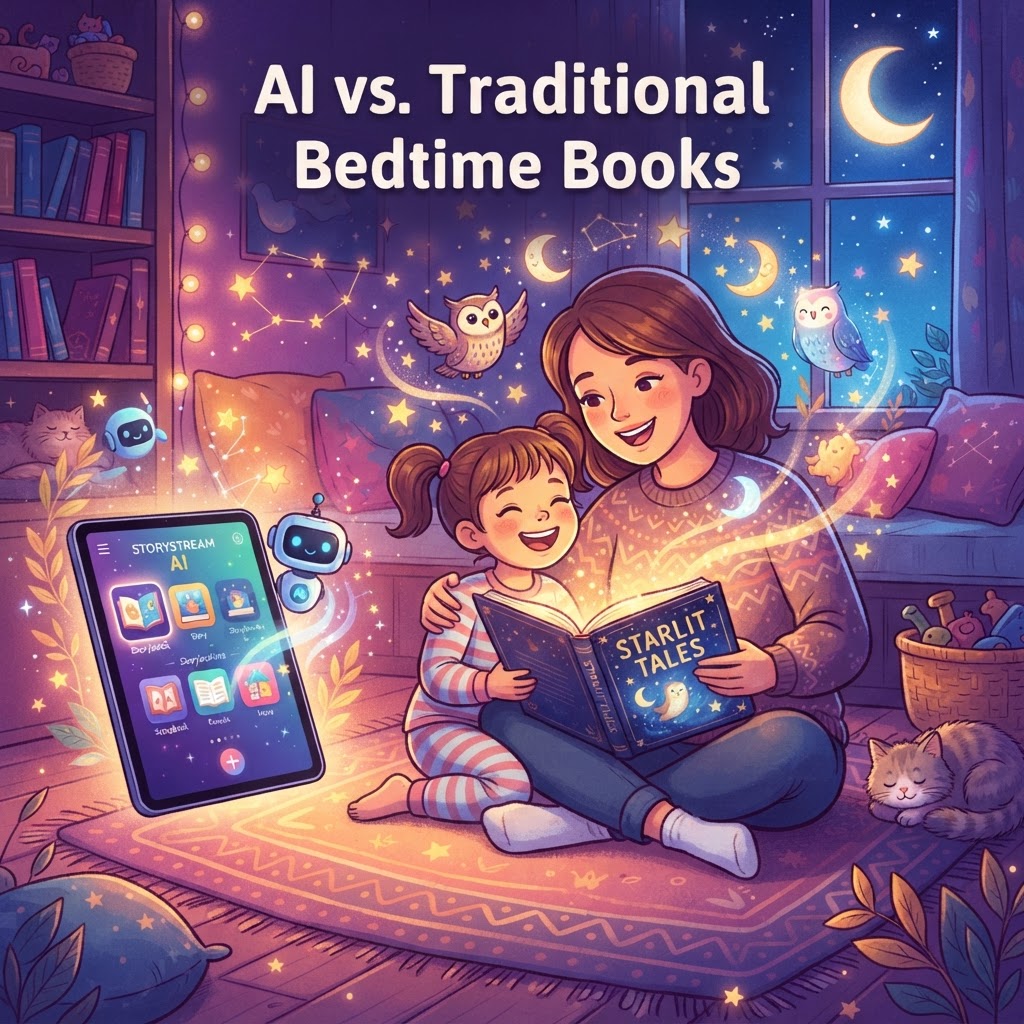
Every parent has been there: it's 8 p.m., your child wants one more story, and you've already read The Very Hungry Caterpillar four times this week. Do you reach for another book from the shelf, or pull up an AI story generator on your phone? As AI-powered storytelling tools become more sophisticated, this is a question more families are asking. The honest answer isn't "one or the other" — it's about understanding what each does best and building a bedtime routine that uses both wisely.
Does Variety in Bedtime Stories Actually Matter for Children?
Yes — novelty in storytelling actively supports children's language development and cognitive growth. When children encounter new vocabulary, settings, and plot structures, their brains are working hard to build new neural connections. Research from the American Academy of Pediatrics confirms that reading aloud to children — across a wide range of stories — is one of the most powerful tools for early literacy.
Traditional bookshelves have limits, though. Most families own between 20 and 50 children's books, and those titles get rotated frequently. AI story generators like InstaTales can produce an effectively unlimited range of storylines, characters, and themes — meaning a child who loves dinosaurs today and astronauts tomorrow can always get a story that feels fresh and exciting.
Why Do Children Love Hearing the Same Story Over and Over?
Repetition is not a bug in your child's reading habits — it's a feature. Young children, particularly those aged 1 to 5, seek repetition because it builds comprehension, emotional security, and language mastery. When a toddler asks for Goodnight Moon for the fifteenth consecutive night, they are reinforcing vocabulary, internalising narrative structure, and finding comfort in predictability.
Classic physical books are ideal for this kind of ritual. The worn spine, the familiar cover, the same page turns — these sensory anchors are part of the experience. Child development specialists note that shared reading rituals help children feel safe, which is particularly valuable at bedtime when the goal is calm and emotional regulation.
AI-generated stories, by contrast, are best suited for novelty rather than ritual repetition. That makes them complementary, not competitive.
How Does Personalisation Change the Bedtime Story Experience?
Personalisation transforms a child from a passive listener into the hero of their own story — and that shift has real engagement benefits. When a child hears their own name, their pet, their school, or their best friend woven into a narrative, their attention and emotional investment increase dramatically.
Traditional books, no matter how beautifully written, are created for a general audience. The characters look and act a certain way, and the child must project themselves into the story. With tools like InstaTales, parents can input specific details — a child's name, favourite animal, a current fear or milestone — and receive a story tailored to that exact child on that exact evening.
This is particularly powerful during transitions: a new sibling arriving, starting school, or dealing with a fear of the dark. A personalised story that speaks directly to what a child is experiencing can be far more effective than a general picture book on the same topic.
Which Option Is More Cost-Effective for Families?
Over time, AI story generators are significantly more affordable than building a comprehensive physical book library. A quality hardcover children's book typically costs £8 to £15. Building a library of 50 diverse titles can easily cost £400 to £750. Subscription-based AI storytelling tools generally cost a fraction of that annually, while offering far greater variety.
That said, cost shouldn't be the only factor. The investment in a beloved physical book — one that a child keeps for years and perhaps passes to their own children — has a sentimental and developmental value that a digital story cannot fully replicate. A balanced approach might mean:
- Using AI tools for daily variety and new themes
- Purchasing physical books for milestones, favourites, and gifting
- Borrowing regularly from your local library to expand variety without cost
Does Shared Reading Create the Same Bonding Experience Regardless of Format?
The bonding in bedtime reading comes primarily from the parent's presence and voice — not the format of the story. Whether you are reading a dog-eared picture book or a freshly generated AI story aloud to your child, the neurological and emotional benefits of that shared moment are driven by eye contact, physical closeness, tone of voice, and responsive interaction.
Harvard's Center on the Developing Child highlights that "serve and return" interactions — where a child responds to a story and a parent reacts — are fundamental to healthy brain development. Both physical books and AI stories can be read aloud in this interactive way.
Where traditional books may have a slight edge is in the tactile experience — turning pages, pointing at illustrations, handling the physical object. For very young children (ages 1 to 3), board books with vivid imagery provide multi-sensory engagement that a screen-based story currently cannot fully match.
How Does Educational Quality Compare Between AI Stories and Traditional Books?
High-quality traditional children's books, written by experienced authors and vetted by editors and educators, often have a developmental intentionality that AI stories are still catching up to. Books like those from the Oxford Reading Tree or the works of Julia Donaldson are crafted with specific phonemic patterns, age-appropriate vocabulary, and pedagogical structure baked in.
AI story generators are improving rapidly, but quality varies. The best platforms use child development frameworks to guide vocabulary level, narrative complexity, and age-appropriate themes. When evaluating any AI tool, look for:
- Age-appropriate language calibration (does the story match your child's developmental stage?)
- Positive, values-aligned themes (kindness, resilience, curiosity)
- Avoidance of overstimulating content at bedtime
- Parental review options before a story is read aloud
The National Literacy Trust emphasises that reading for pleasure — regardless of format — is one of the strongest predictors of academic achievement. The best educational tool is the one your child actually wants to engage with.
A Simple Framework: When to Reach for a Book vs. an AI Story
Not every bedtime is the same. Here's a quick decision guide for parents:
Reach for a traditional book when:
- Your child asks for "the same one again" — honour that ritual
- You want tactile, screen-free engagement (especially under age 3)
- It's a special occasion or milestone worth marking
- You're working on a specific literacy skill with intentional texts
Use an AI story generator when:
- Your child wants something new but you've exhausted the shelf
- You want to address a specific topic (new sibling, school anxiety, a child's current obsession)
- Travel or circumstances mean you don't have books to hand
- You want to gently introduce new vocabulary or settings in a low-pressure way
InstaTales fits naturally into the second column — it's built for those moments when you need a story that feels personal, fresh, and right for tonight.
Frequently Asked Questions
Are AI-generated bedtime stories safe for young children?
Yes, when the platform is designed specifically for children. Reputable AI story generators use content filters, age-appropriate language guidelines, and parental controls to ensure stories are suitable. Always preview any tool before using it with your child, and choose platforms that are transparent about how their content is generated.
Can AI stories replace reading physical books with my child?
No — and they shouldn't try to. Physical books offer tactile engagement, rich illustrations, and the ritual comfort that children need, especially at bedtime. AI stories are best used as a complement to traditional books, adding variety and personalisation rather than replacing the experience of shared reading.
At what age can children start benefiting from AI bedtime stories?
Children as young as 2 to 3 can enjoy AI-generated stories when read aloud by a parent. The story is delivered through the parent's voice, which is what matters most for very young children. From around age 4 upward, children can also enjoy following along with text and illustrations if the platform provides them.
How do I know if an AI story is educationally appropriate for my child's age?
Look for platforms that allow you to set an age range and adjust vocabulary complexity. Good AI storytelling tools will calibrate sentence length, theme complexity, and vocabulary to the developmental stage you specify. If in doubt, read through the story yourself before sharing it with your child.
Do children learn as much from AI stories as from traditional books?
The evidence suggests that how a story is shared matters more than where it comes from. Reading aloud with warmth, pausing to ask questions, and discussing characters and events are the literacy-building behaviours that drive learning — regardless of whether the story came from a printed page or an AI generator.
Is it bad that my child wants the same book every night?
Absolutely not — it's developmentally healthy and normal. Repetition builds vocabulary, comprehension, and emotional security. Embrace the ritual of beloved books while using tools like AI story generators to introduce novelty when your child is ready for something new.
The goal of bedtime reading has always been the same: a calm child, a close connection, and a mind that drifts to sleep full of wonder. Whether that comes from a worn paperback or a freshly generated adventure, what matters most is that you show up and share the story together. If you'd like to explore what personalised bedtime storytelling looks like in practice, InstaTales is a good place to start.
Get a new bedtime story every week
Free, personalized, and delivered to your inbox. No spam, ever.
Ready to Create a Personalized Bedtime Story?
Use our free AI bedtime story generator to create a personalized illustrated story for your child in 30 seconds — no credit card needed.
Popular story types:
Maya Rodriguez
Lead Content Editor & Early Literacy Specialist
Maya is a former early childhood educator and literacy specialist with over a decade of experience helping children develop a love of reading. She leads content at InstaTales, where she writes about the science of storytelling, child development, and how families can use personalized AI stories to build literacy and emotional resilience.
instatales.ai