Best educational bedtime stories for 7-year-olds
Discover the best educational bedtime stories for 7-year-olds — themes, tips, and story ideas that will delight your child at bedtime.
✦ Key Takeaways
- •At age 7, most children are becoming more independent readers, more logical thinkers, and more interested in how the world works.
- •Educational bedtime stories appeal to 7-year-olds because they meet two needs at once: comfort and curiosity.
- •For most children, the ideal bedtime stories for 7 year olds last about 8 to 15 minutes.
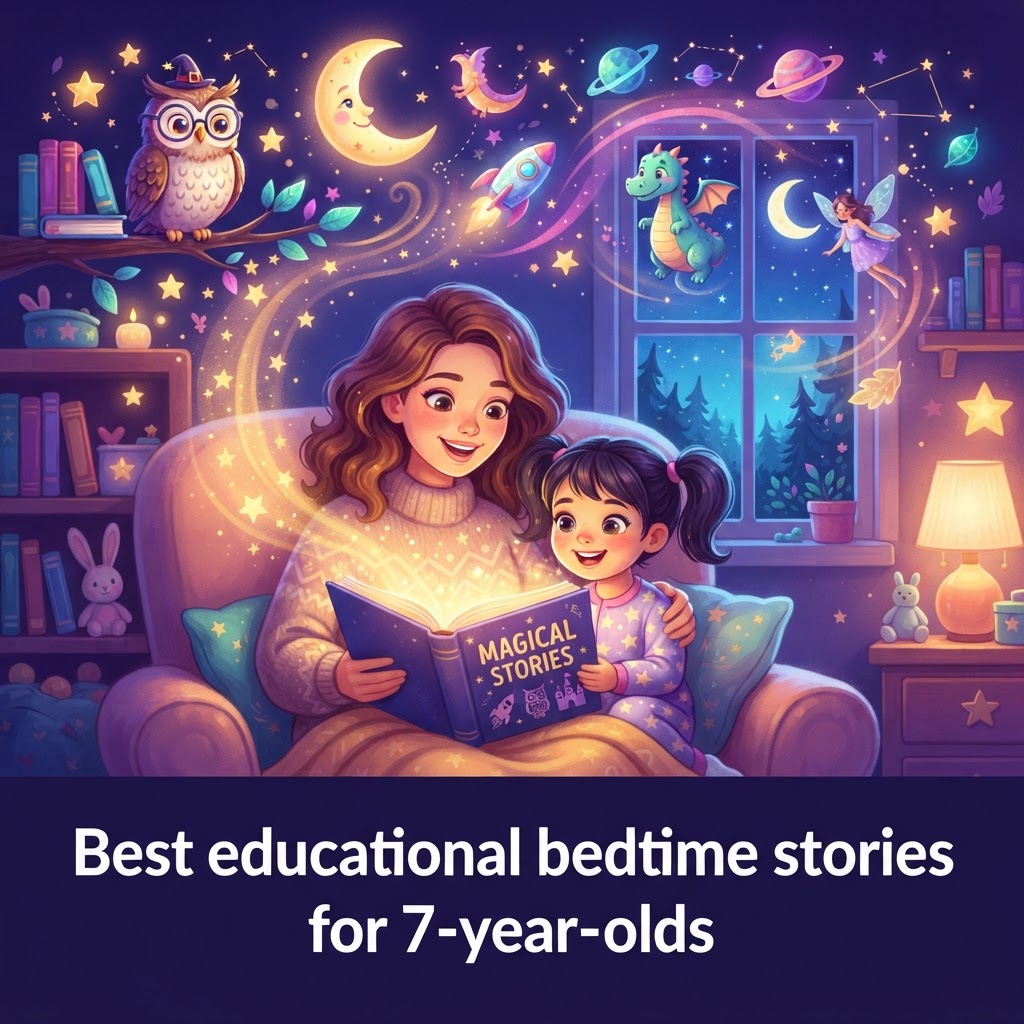
Seven-year-olds are in a sweet spot for stories: they still love the warmth of bedtime, but they are also ready for richer plots, bigger ideas, and more meaningful learning. The best educational stories for 7 year olds do not feel like mini lessons. Instead, they blend adventure, humor, wonder, and gentle skill-building so your child falls asleep feeling both calm and curious.
Parents often ask whether bedtime stories for 7 year olds should still be simple. The short answer is yes and no. At this age, children can handle more complex language and deeper themes, but they still need stories that feel safe, comforting, and easy to follow at the end of a busy day. That is exactly where strong educational bedtime stories shine.
What developmental milestones matter most for 7-year-olds?
At age 7, most children are becoming more independent readers, more logical thinkers, and more interested in how the world works. That makes this a wonderful age for kids educational stories that include facts, problem-solving, and emotional growth.
Many 7-year-olds can follow multi-step plots, understand simple cause and effect, and enjoy character motivation. They are also starting to compare ideas, ask deeper questions, and notice fairness, rules, and consequences. According to the CDC’s guidance for children ages 6 to 8, school-age children are building social skills, confidence, and more complex thinking.
You may also notice that your child:
- Asks “why” and “how” more often
- Enjoys collecting facts about favorite topics
- Understands jokes, wordplay, and surprise endings
- Cares more about friendships and teamwork
- Can sit with longer stories than they could a year ago
This is why educational stories for 7 year olds work so well when they include both learning and heart. A child this age wants information, but they still connect most deeply through character and imagination.
Why do educational bedtime stories appeal so much to 7-year-olds?
Educational bedtime stories appeal to 7-year-olds because they meet two needs at once: comfort and curiosity. A good story helps a child wind down while also feeding their growing desire to learn.
Shared reading is also strongly linked with language growth and parent-child connection. The American Academy of Pediatrics has long emphasized that reading aloud supports vocabulary, attention, and relationships. For 7-year-olds, bedtime stories can also reinforce school learning in a low-pressure way.
At this age, stories feel especially powerful because children can:
- Imagine themselves inside the plot
- Remember factual details more easily when they are part of a story
- Practice empathy by seeing a problem through a character’s eyes
- Learn without feeling tested or corrected
That matters. A story about a child who solves a garden mystery can teach observation, patience, and science vocabulary far more naturally than a lecture can.
How long should bedtime stories for 7 year olds be?
For most children, the ideal bedtime stories for 7 year olds last about 8 to 15 minutes. That is usually enough time for a satisfying plot without becoming too stimulating before sleep.
In word count, that often means roughly 800 to 1,500 words if you are reading aloud. Some children will happily listen longer, especially if the story is broken into chapters. The key is not the exact length, but the rhythm.
Look for stories that have:
- A clear beginning, middle, and ending
- One main idea or problem
- A calm emotional landing
- Just enough detail to spark interest without overwhelming tired listeners
If your child loves longer adventures, serialized bedtime reading can work beautifully. You can even rotate themes based on interests, like space adventures for 7-year-olds or ocean-themed bedtime stories, while keeping each night’s reading manageable.
Which themes work best in educational stories for 7 year olds?
The best themes for educational stories for 7 year olds are topics that invite wonder, problem-solving, and emotional connection. Seven-year-olds are ready for more than alphabet and counting stories; they want stories that help them understand the world.
Here are some especially strong themes:
- Science and nature: weather, animals, habitats, plants, space, magnets, shadows
- Social-emotional learning: friendship, inclusion, honesty, teamwork, disappointment, resilience
- History and culture: traditions, community helpers, inventions, life in other times and places
- Math and logic: patterns, measuring, mapping, sequencing, puzzles
- Ethics and decision-making: doing the right thing, apologizing, keeping promises, sharing responsibility
Themes often work best when paired with a child’s natural interests. A child who loves giggles may connect with learning through funny bedtime stories for 7-year-olds, while a fantasy-loving child may enjoy fairy tales for this age group that weave in problem-solving and moral choices. For dino fans, dinosaur bedtime stories can be a fun path into science vocabulary and prehistoric facts.
Research from the Harvard Center on the Developing Child also highlights how children build executive function through guided practice, language, and meaningful interaction. Story themes that ask children to predict, reflect, or connect ideas can support those growing thinking skills.
What should parents avoid in educational bedtime stories?
Parents should avoid stories that feel preachy, overstimulating, or emotionally too heavy right before sleep. The best kids educational stories teach gently rather than trying to force a lesson.
A few common pitfalls to watch for:
- Too much teaching, not enough story: If every paragraph sounds like a worksheet, children tune out.
- Scary tension without comfort: Suspense is fine, but bedtime stories need emotional safety.
- Fact overload: Seven-year-olds enjoy information, but they still need plot, humor, and character.
- Complex moral messaging: Keep the lesson clear and age-appropriate.
- Stereotypes or outdated assumptions: Choose stories that show respect, diversity, and healthy relationships.
A good rule is simple: if the story leaves your child worried, wired, or confused, it is not the right bedtime fit. Save more intense or debate-heavy topics for daytime reading.
How can parents make educational bedtime stories feel cozy instead of like homework?
The easiest way to keep educational bedtime stories cozy is to prioritize connection over performance. Your child does not need a quiz at the end; they need a calm, shared experience.
Try these practical bedtime habits:
- Let your child choose the topic: animals, inventors, space, feelings, or nature
- Ask just one easy question, such as “What was your favorite part?”
- Pause briefly to explain a new word, then move on
- Connect the story to real life without turning it into a lesson
- Keep lights soft and voices calm
Personalization helps too. When a story includes your child’s name, favorite topic, or current challenge, they often listen more deeply. That is one reason many families now create your own personalized bedtime story instead of searching for the perfect book every night.
If you want a quicker starting point, pre-made story templates can help parents build age-appropriate stories around reading level, topic, and tone. You can also save favorites in your story library so children can revisit beloved stories, which supports comprehension and confidence.
What are five educational bedtime story ideas that work especially well for 7-year-olds?
The best story ideas combine one clear learning goal with an engaging plot. Here are five bedtime-ready ideas that fit the interests and abilities of many 7-year-olds.
1. The Moon Map Mystery
A child notices that the moon looks different each night and sets out to solve the mystery. This story can introduce moon phases, observation, and simple note-taking.
2. The Garden Where Nothing Grew
A frustrated young gardener learns about sunlight, water, soil, and patience while trying to help a wilted patch bloom. This is a gentle way to explore plant science and resilience.
3. The Team That Couldn’t Agree
A group of friends must build a bridge for a school project, but they all have different ideas. The story teaches cooperation, listening, and basic engineering thinking.
4. The Dinosaur Detective Club
Children investigate clues about bones, footprints, and fossils to discover what type of dinosaur once lived nearby. This makes science feel playful and satisfies children who love facts.
5. The Lost Recipe from Around the World
A family searches for a missing recipe card and learns about ingredients, geography, and cultural traditions along the way. This story can build vocabulary and appreciation for diversity.
These kinds of bedtime stories for 7 year olds are memorable because they teach through action. Children do not just hear facts; they watch a character use them.
How can InstaTales help parents create personalized educational stories for 7-year-olds?
InstaTales can help by turning your child’s interests, reading level, and learning goals into one story that feels personal and bedtime-friendly. That means you can create educational stories for 7 year olds that match exactly what your child loves right now.
For example, you might generate a story about:
- A 7-year-old astronaut learning about planets
- A nervous new student practicing friendship skills
- A dinosaur fan solving a fossil puzzle
- A child learning about oceans, recycling, or emotions
This can be especially useful for parents who want variety without spending hours searching. It also supports re-reading and routine, since families can store favorites, revisit them, and build themed collections. Teachers and homeschoolers can even explore InstaTales for teachers for classroom reading prompts, literacy centers, or enrichment activities. For more inspiration, the InstaTales blog includes age-based story ideas and topic guides.
The real value is not just customization. It is the ability to create stories that feel both developmentally appropriate and genuinely delightful.
Frequently Asked Questions
What makes a bedtime story educational for a 7-year-old?
An educational bedtime story teaches something through the plot, characters, or setting rather than through direct instruction alone. It might build vocabulary, science knowledge, empathy, or problem-solving skills while still feeling fun and calming.
Are educational stories better than purely entertaining stories?
Not necessarily better, but they can be especially helpful when they are well written. The strongest stories often do both at once: they entertain your child and gently support learning.
How often should I read bedtime stories to my 7-year-old?
Even 10 minutes most nights can make a difference. Regular read-aloud time supports language, connection, and reading habits, even for children who can already read independently.
Can AI-generated bedtime stories be good for children?
Yes, if they are age-appropriate, emotionally safe, and reviewed by a parent first. Personalized AI stories can be a helpful tool when used thoughtfully and paired with shared reading.
What topics do most 7-year-olds enjoy in educational bedtime stories?
Many 7-year-olds love animals, space, dinosaurs, inventions, friendship stories, mysteries, and nature adventures. The best topic is usually one that connects with your child’s current interests.
Should bedtime stories for 7 year olds include a clear lesson?
A gentle takeaway is helpful, but it should not feel forced. Children learn best when the lesson grows naturally from what the characters do and discover.
Ready to Create a Personalized Bedtime Story?
Use our free AI bedtime story generator to create a personalized illustrated story for your child in 30 seconds — no credit card needed.
Popular story types:
Maya Rodriguez
Lead Content Editor & Early Literacy Specialist
Maya is a former early childhood educator and literacy specialist with over a decade of experience helping children develop a love of reading. She leads content at InstaTales, where she writes about the science of storytelling, child development, and how families can use personalized AI stories to build literacy and emotional resilience.
instatales.ai