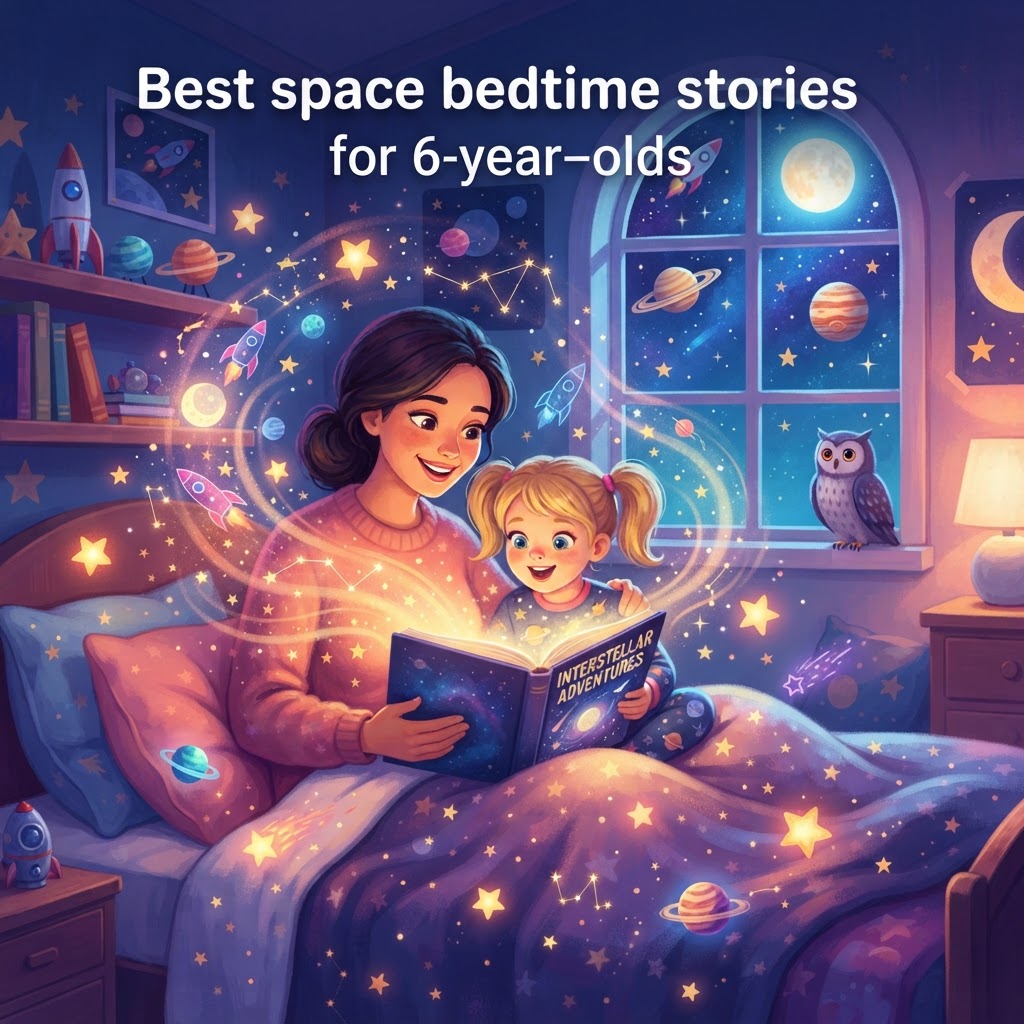
Best space bedtime stories for 6-year-olds
Discover the best space bedtime stories for 6-year-olds — themes, tips, and story ideas that will delight your child at bedtime.
✦ Key Takeaways
- •The best bedtime stories for 6 year olds match a child’s growing attention span, imagination, and emotional sensitivity.
- •Space bedtime stories are a great fit for 6-year-olds because they combine mystery, adventure, and distance in a way that feels exciting but still safe.
- •For most children, the ideal story length is about 8 to 12 minutes read aloud, or roughly 700 to 1,200 words.
If your child is suddenly asking where the stars go in the daytime, whether astronauts sleep in pajamas, or what lives on the moon, you are in a sweet spot for space stories for 6 year olds. At this age, children are curious enough to love big ideas and still young enough to want comfort, rhythm, and a happy ending. The best space bedtime stories blend wonder with reassurance, giving parents a reliable way to make bedtime calmer while feeding a 6-year-old’s growing imagination.
What developmental milestones matter when choosing bedtime stories for 6-year-olds?
The best bedtime stories for 6 year olds match a child’s growing attention span, imagination, and emotional sensitivity. A 6-year-old can usually follow a fuller plot than a preschooler, but still needs simple structure, clear cause and effect, and a comforting ending.
Around age 6, many children are developing:
- Stronger language skills and bigger vocabularies
- Better memory for story details and repeated phrases
- A growing sense of humor
- More interest in rules, fairness, and problem-solving
- Big feelings that can still surface at bedtime
The American Academy of Pediatrics notes that school-age children are building independence while still relying on familiar routines and secure relationships for regulation and confidence (HealthyChildren.org). Research from the Harvard Center on the Developing Child also highlights that executive function skills, such as attention, planning, and flexible thinking, are developing quickly in these years.
For parents, that means a great story should feel imaginative but not chaotic. Your child is ready for more than a simple goodnight book, but not for a long, complicated sci-fi plot full of danger.
Why do space bedtime stories appeal so much to 6-year-olds?
Space bedtime stories are a great fit for 6-year-olds because they combine mystery, adventure, and distance in a way that feels exciting but still safe. Space is “big” enough to spark awe, yet gentle stories can keep the emotional tone cozy and secure.
At six, children often ask endless “why” questions. Why do stars twinkle? How do rockets fly? Is there anyone on Mars? Kids space stories let parents welcome that curiosity without turning bedtime into a science lesson.
Space also naturally supports themes children this age love:
- Exploration and discovery
- Brave but manageable challenges
- Friendship and teamwork
- Silly aliens or talking planets
- Nighttime imagery that fits bedtime
That bedtime connection matters. Stars, moons, and quiet planets feel calmer than many high-energy story settings. If your child already enjoys best bedtime reads for this age, a space theme can add novelty without disrupting the soothing rhythm you want before sleep.
For factual inspiration, parents can also browse child-friendly astronomy content from NASA Space Place, which explains space concepts in a way young children can understand.
How long should a space bedtime story be for a 6-year-old?
For most children, the ideal story length is about 8 to 12 minutes read aloud, or roughly 700 to 1,200 words. That is long enough to feel satisfying, but short enough to avoid bedtime overstimulation.
A 6-year-old can often handle a more developed plot than a toddler. Still, bedtime is not the best time for a long story with multiple side characters, several problems, or a dramatic cliffhanger.
A strong bedtime structure looks like this:
- A familiar main character
- One clear problem or mission
- One or two gentle surprises
- A calm resolution
- A sleepy final image
If your child is already rubbing their eyes halfway through, the story is too long. If they keep asking, “What happened next?” after it ends, you probably found the sweet spot.
For children who love variety, it can also help to rotate genres. Space can pair beautifully with friendship-themed stories for 6-year-olds or even softer adventure stories for 6-year-olds, depending on your child’s mood.
Which themes work best in space stories for 6 year olds?
The best space stories for 6 year olds usually focus on wonder, emotional safety, and simple problem-solving. Children this age enjoy imaginative themes most when the emotional stakes stay manageable.
Here are the themes that tend to work especially well:
- Gentle exploration: visiting a moon garden, floating past friendly planets, or mapping stars
- Friendship in unusual places: meeting a shy alien, helping a robot, or teaming up with a sibling astronaut
- Bravery in small doses: trying something new, fixing a tiny spaceship problem, or flying through a dark patch with help
- Routine in magical settings: bedtime on a space station, brushing teeth before moon takeoff, or tucking in a comet
- Wonder and observation: noticing colors, sounds, shapes, and patterns in the night sky
- Kindness and care: helping lost space creatures, sharing snacks with aliens, or protecting a tiny planet
These themes work because they meet children where they are developmentally. Six-year-olds like stories that stretch their imagination but still feel emotionally predictable.
A nice rule of thumb is this: the setting can be wild, but the emotional arc should be steady. A rocket can zoom through sparkling rings, but the child should still understand who is safe, what the goal is, and how things will end.
What should parents avoid in space bedtime stories for 6-year-olds?
Parents should avoid stories that are too intense, too confusing, or too stimulating right before sleep. A story can be exciting without being loud, scary, or emotionally overwhelming.
Watch out for:
- High-stakes danger: crashing rockets, characters getting lost for a long time, or scary alien chases
- Dark imagery: black holes swallowing everything, lonely planets, or monsters hiding in space
- Too much science jargon: long explanations about galaxies, gravity, or engines can pull children out of the story
- Fast plot jumps: teleporting from scene to scene without clear transitions
- Unresolved endings: mystery can be fun, but bedtime usually calls for closure
- Overly moralizing lessons: children respond better to story-based learning than a lecture in disguise
This matters even more at bedtime, when tired children are less able to process complex emotions. If your child tends to worry at night, keep space stories cozy, predictable, and warmly illustrated in your language. Think “moon picnic,” not “survival mission.”
What are five great space bedtime story ideas for 6-year-olds?
The best story ideas are simple, vivid, and easy for a tired child to follow. These five concepts are ideal for kids space stories at bedtime and can be adapted to your child’s interests.
-
The Sleepy Rocket to Moon Market
A child boards a small rocket to buy moonberries for breakfast. Along the way, they meet a drowsy robot who needs help finding the softest cloud to nap on. -
The Star That Lost Its Twinkle
A tiny star feels embarrassed because it is not shining as brightly as the others. A kind child astronaut helps it discover that glowing softly is still beautiful. -
Captain Pillow and the Planet of Pajamas
A bedtime-loving explorer lands on a planet where every creature wears pajamas and shares favorite goodnight songs. The mission is not to save the planet, but to learn the coziest sleep routine in the galaxy. -
The Friendly Alien Next Door to Saturn
On a peaceful trip past Saturn’s rings, a child meets an alien who collects bedtime stories instead of toys. Together, they trade sleepy tales and learn that families can look different and still feel the same. -
The Little Comet Who Was Afraid of the Dark
A glowing comet worries about flying through the quiet parts of space. With gentle support from the moon, it learns that darkness can be calm, beautiful, and safe.
If your child is between age ranges or still likes simpler story arcs, you may also enjoy this guide to space bedtime stories for 5-year-olds.
How can parents use personalized space bedtime stories at home?
Personalized stories work especially well because they make a child feel seen, safe, and deeply engaged. When the hero has your child’s name, favorite stuffed animal, or real-life bedtime worry, the story becomes more comforting and memorable.
That is where InstaTales can be genuinely helpful. You can create your own personalized bedtime story with a space theme tailored to your child’s age, attention span, and interests. For example, you might create a story about your 6-year-old flying to the moon with their teddy bear, solving one small problem, and returning home in time for sleep.
Personalization works best when you include:
- Your child’s name
- One favorite space element, like rockets or stars
- One comfort object, like a blanket or stuffed toy
- A calm ending at home, in bed, or under the moon
If a story becomes a favorite, save it in your story library so you can reread it during the week. Repetition is not a problem at this age; in fact, familiar stories often help children settle faster because they already know the emotional path.
Frequently Asked Questions
Are space stories too exciting for bedtime?
Not if they are written with a calm structure and gentle stakes. The best space bedtime stories use wonder and imagination without adding fear, noise, or unresolved tension.
What makes bedtime stories for 6 year olds different from stories for younger children?
Six-year-olds can usually follow a longer plot and enjoy more problem-solving. They still need clear structure, emotional safety, and a reassuring ending, especially at bedtime.
How can I tell if a space story is too scary for my child?
If your child starts interrupting to ask whether the character is safe, looks tense, or has trouble settling afterward, the story may be too intense. Choose softer themes like exploration, friendship, and gentle discovery instead.
Can personalized stories help reluctant readers?
Yes. Personalized stories often increase attention and motivation because children feel connected to the character and plot. They can also build confidence when a child sees “someone like me” succeeding in the story.
Should space stories include real science facts?
A few simple facts can enrich the story, but too much information can interrupt the bedtime mood. For bedtime, aim for light, accurate details wrapped inside a soothing narrative.
How often should I rotate bedtime stories?
Many 6-year-olds enjoy hearing favorites again and again, so there is no need to rotate constantly. A good balance is to keep a few familiar stories in regular use while adding one new story each week.
Ready to Create a Personalized Bedtime Story?
Use our free AI bedtime story generator to create a personalized illustrated story for your child in 30 seconds — no credit card needed.
Popular story types:
Maya Rodriguez
Lead Content Editor & Early Literacy Specialist
Maya is a former early childhood educator and literacy specialist with over a decade of experience helping children develop a love of reading. She leads content at InstaTales, where she writes about the science of storytelling, child development, and how families can use personalized AI stories to build literacy and emotional resilience.
instatales.ai