Best space bedtime stories for 8-year-olds
Discover the best space bedtime stories for 8-year-olds — themes, tips, and story ideas that will delight your child at bedtime.
✦ Key Takeaways
- •Space bedtime stories are a great fit for many 8-year-olds because they blend imagination with logic.
- •The most important milestones at age 8 are stronger reasoning, deeper empathy, and a growing need for competence.
- •Space stories feel exciting at bedtime because they invite wonder while still leaving room for calm.
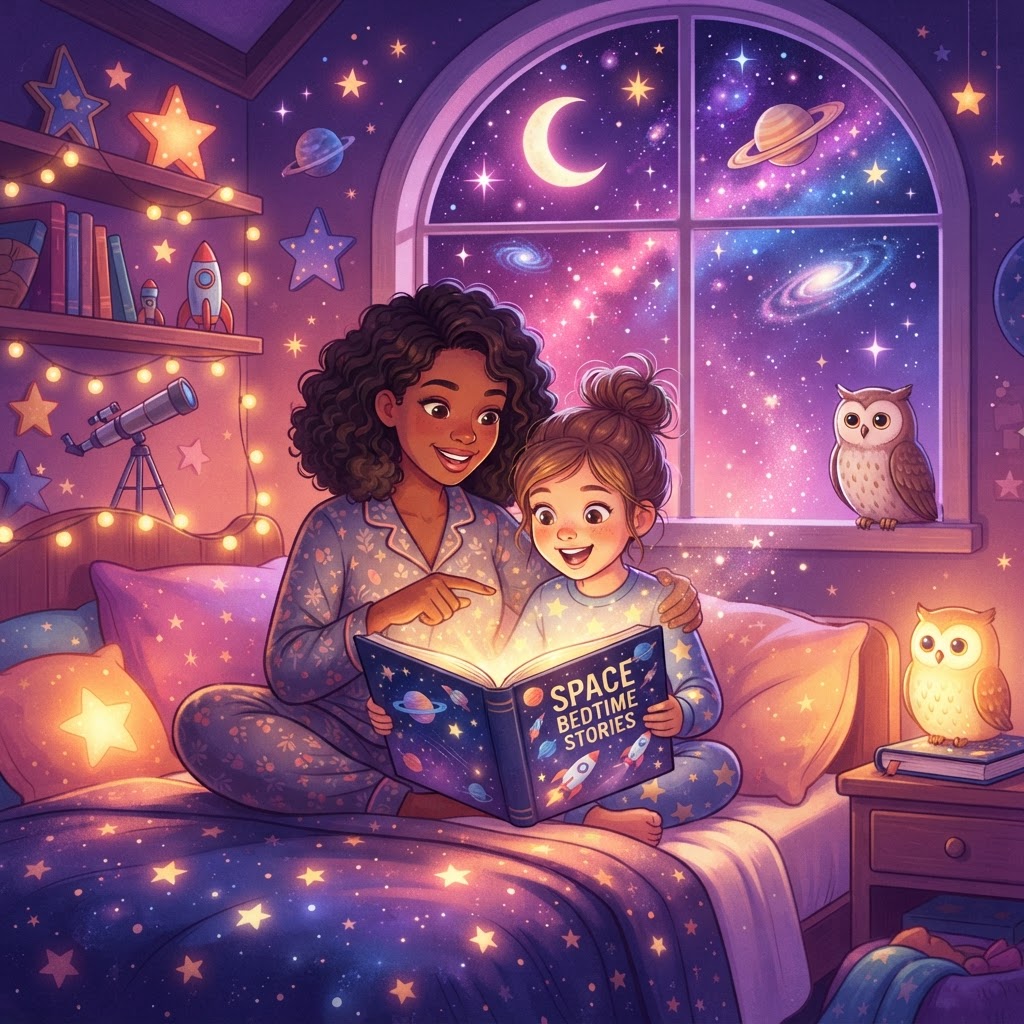
Choosing the best space bedtime stories for 8-year-olds is less about finding the “perfect” rocket story and more about matching your child’s growing mind. At this age, children want adventure, humor, and real stakes—but they still need bedtime stories to feel safe, calming, and satisfying. If you are looking for space stories for 8 year olds, this guide will help you pick stories that spark wonder without winding your child up before sleep.
Why are space bedtime stories such a good fit for 8-year-olds?
Space bedtime stories are a great fit for many 8-year-olds because they blend imagination with logic. At this age, children often love asking big questions, solving problems, and picturing worlds beyond their own.
Around age 8, many children are in what child development experts describe as the concrete operational stage. They can follow more complex plots, understand cause and effect, and enjoy stories with rules, missions, and discoveries. According to the CDC’s guidance on middle childhood, children in this age range are building stronger independence, social awareness, and reasoning skills.
That makes kids space stories especially appealing. Space offers:
- Big ideas children can grasp in story form
- Clear goals, like reaching a moon or solving a mystery
- Enough distance from real life to feel magical
- Built-in wonder without needing scary conflict
For many children, space feels exciting but not too close to home. A lost sock on Earth is annoying. A glowing moon map or a whispering asteroid? That is bedtime-story gold.
What developmental milestones matter when choosing bedtime stories for 8-year-olds?
The most important milestones at age 8 are stronger reasoning, deeper empathy, and a growing need for competence. In simple terms, 8-year-olds want stories that respect their intelligence and emotions.
When choosing bedtime stories for 8 year olds, look for stories that match these common traits:
- Longer attention span: Many 8-year-olds can follow a story for 10-15 minutes without losing the thread.
- Problem-solving skills: They enjoy clues, missions, and puzzles rather than random events.
- Emotional nuance: They understand friendship conflicts, worries, bravery, and disappointment more deeply.
- Rule awareness: They like systems—how a spaceship works, why a planet glows, what the mission requires.
- Growing independence: They enjoy capable main characters who make decisions and learn from mistakes.
The Center on the Developing Child at Harvard University has written extensively about how executive function and self-regulation develop during childhood. In story terms, that means many 8-year-olds enjoy narratives where characters pause, think, choose, and adapt.
This is also why very babyish stories may fall flat, while overly dark chapter-book plots may feel too intense for bedtime.
Why do space stories for 8 year olds feel especially exciting at bedtime?
Space stories feel exciting at bedtime because they invite wonder while still leaving room for calm. They help children “travel” somewhere huge and magical without introducing the everyday worries that realistic stories sometimes do.
Space naturally taps into several things 8-year-olds love:
- Mystery: What is on the other side of the moon?
- Mastery: Can the hero decode a star map or fix a tiny robot?
- Scale: Children are fascinated by big things—galaxies, comets, rings, and black skies full of stars.
- Hope: Space stories often center on discovery rather than danger.
There is also a practical bedtime advantage. Unlike fast-paced superhero tales, good space bedtime stories can be adventurous without being chaotic. A quiet moon landing, a kind alien pen pal, or a floating library among the stars can feel soothing as well as exciting.
If your child also enjoys imaginative genres, you might like these gentle magic stories for 8-year-olds or these cozy bedtime picks for 8-year-olds.
How long should space bedtime stories be for 8-year-olds?
For most 8-year-olds, the ideal bedtime story length is about 10-15 minutes. That usually means roughly 800-1,500 words, depending on your reading pace and how often your child stops to ask questions.
A story at this age should be long enough to feel meaningful but short enough to end before your child gets overstimulated. A good bedtime arc often includes:
- A clear setup
- One main problem or mystery
- A satisfying solution
- A calm final image
If your child is tired, aim shorter. If they are wide awake and love story time, you can stretch a little longer—especially if the story has a steady rhythm and a reassuring ending.
The key is not just word count. It is emotional pacing. A short story packed with danger can feel more activating than a slightly longer story about exploring a gentle moon garden.
What themes work best in kids space stories for this age?
The best themes for 8-year-olds mix wonder, competence, and emotional warmth. Space stories work especially well when they give children both adventure and reassurance.
Strong themes to explore include:
- Curiosity and discovery: A child finds a hidden planet, a map in the stars, or a message from a comet.
- Friendship: A space explorer and a robot learn to trust each other. If your child loves relationship-centered plots, try these friendship-focused bedtime stories.
- Problem-solving: A broken telescope, a missing moon key, or a puzzle hidden in the constellations.
- Courage in small doses: Not fighting monsters, but facing the dark, trying something new, or asking for help.
- Kindness across differences: Meeting aliens with unfamiliar customs can gently build empathy.
- Care for the universe: Stories about protecting a planet or cleaning up space debris can support values as well as imagination.
You can also blend space with other interests. A child who loves animals may enjoy a moon rescue story with star foxes or comet cats. In that case, these animal bedtime stories for 8-year-olds can offer good crossover inspiration.
For factual curiosity, NASA Space Place is a helpful child-friendly resource to pair with fictional reading.
What should parents avoid in space bedtime stories?
Parents should avoid stories that are too scary, too chaotic, or too heavy on facts right before bed. The goal is gentle engagement, not a late-night adrenaline spike.
Try to avoid:
- High-stakes peril: Exploding ships, endless chases, or characters trapped without help
- Confusing worldbuilding: Too many planets, rules, or side characters
- Lecturing disguised as story: If it reads like a science worksheet, many children tune out
- Bleak endings: Bedtime stories should leave emotional closure
- Age-mismatch humor or sarcasm: Some 8-year-olds enjoy irony, but bedtime usually works better with warmth
It also helps to avoid stories that make space feel lonely or frightening unless the ending strongly restores safety. Wonder is great. Dread is not.
A good rule: if a story makes your child more likely to ask for another glass of water, a hallway light, and three extra hugs, it may be better for daytime reading.
What are five great space bedtime story ideas for 8-year-olds?
The best story ideas for this age pair one memorable space hook with one clear emotional thread. Here are five ideas parents can use tonight.
-
The Moon Mailbox: An 8-year-old discovers a silver mailbox that only appears under moonlight. Each letter inside comes from a child on a different planet asking for help with a small problem.
-
The Sleepy Star Rescue: A tiny star has stopped shining because it is too tired. A child astronaut and a gentle robot travel across the night sky to help it rest and glow again.
-
The Library on Saturn’s Rings: A floating library holds stories from every world, but one book has gone missing. The hero must solve clues hidden in constellations before sunrise.
-
Comet Campout: A family sets up a magical camp on a slow-moving comet. During the night, they meet glowing space animals and learn that bravery can be quiet.
-
The Planet That Sang in Colors: A child hears a mysterious song coming from a faraway planet where music creates light. To understand it, they must listen carefully rather than act quickly.
These ideas work well because they combine adventure with calm resolution. If your child loves natural wonder as much as outer space, you may also enjoy these nature bedtime stories for 8-year-olds.
How can parents make space bedtime stories even more engaging?
Parents can make space stories more engaging by personalizing them and keeping the bedtime experience calm. Small details—your child’s name, favorite color, or beloved stuffed animal—can turn a good story into a treasured one.
Try these simple techniques:
- Let your child choose the setting: moon, Mars, Saturn, or “a secret planet”
- Add one familiar comfort object, like a blanket or toy rocket
- Keep one repeated phrase, such as “The stars were watching kindly”
- End with a restful image, like drifting home through soft starlight
This is also where InstaTales can help. You can create your own personalized bedtime story with space themes tailored to your child’s age, interests, and bedtime mood. If a story becomes a favorite, save it in your story library for easy re-reading, or use one of the ready-made story templates when you want a quick start.
Personalized stories can be especially useful for children who want to see themselves as the capable explorer, problem-solver, or friend in the story. That sense of ownership often increases attention, comfort, and bedtime joy.
Frequently Asked Questions
Are space bedtime stories too stimulating before bed?
Not if they are written with a calm rhythm and a reassuring ending. Choose stories focused on discovery, friendship, or gentle mystery rather than danger and fast action.
What makes a good bedtime story for an 8-year-old?
A good story for this age respects their growing intelligence while still feeling safe and cozy. It should have a clear plot, relatable emotions, and a satisfying resolution.
How often should I rotate bedtime stories?
Many 8-year-olds still enjoy repetition, even if they also want novelty. A helpful pattern is to rotate new stories during the week and return to favorites on tired or emotional evenings.
Can personalized space stories help reluctant readers?
Yes, personalized stories often increase engagement because the child feels more connected to the plot. Seeing their own name, interests, or favorite themes in a story can make reading feel more meaningful.
Should space stories include real science facts?
A few real facts can enrich the story, but too many can interrupt the bedtime flow. The best balance is light, accurate detail wrapped inside an imaginative narrative.
Are space stories only for children who already love science?
Not at all. Many children enjoy space stories because they offer wonder, adventure, and emotional warmth—even if they are more interested in characters than planets.
Ready to Create a Personalized Bedtime Story?
Use our free AI bedtime story generator to create a personalized illustrated story for your child in 30 seconds — no credit card needed.
Popular story types:
Maya Rodriguez
Lead Content Editor & Early Literacy Specialist
Maya is a former early childhood educator and literacy specialist with over a decade of experience helping children develop a love of reading. She leads content at InstaTales, where she writes about the science of storytelling, child development, and how families can use personalized AI stories to build literacy and emotional resilience.
instatales.ai