Sight-Words Through Stories That Really Stick
Stories are one of the most effective ways to build sight words in children. Here's how to use storytelling to develop this crucial skill.
✦ Key Takeaways
- •Stories are effective because they place high-frequency words inside meaningful, repeated, emotionally engaging language.
- •Children should start with the most useful, high-frequency words they see often in books and daily print.
- •The most effective activities are simple, playful, and built around rereading.
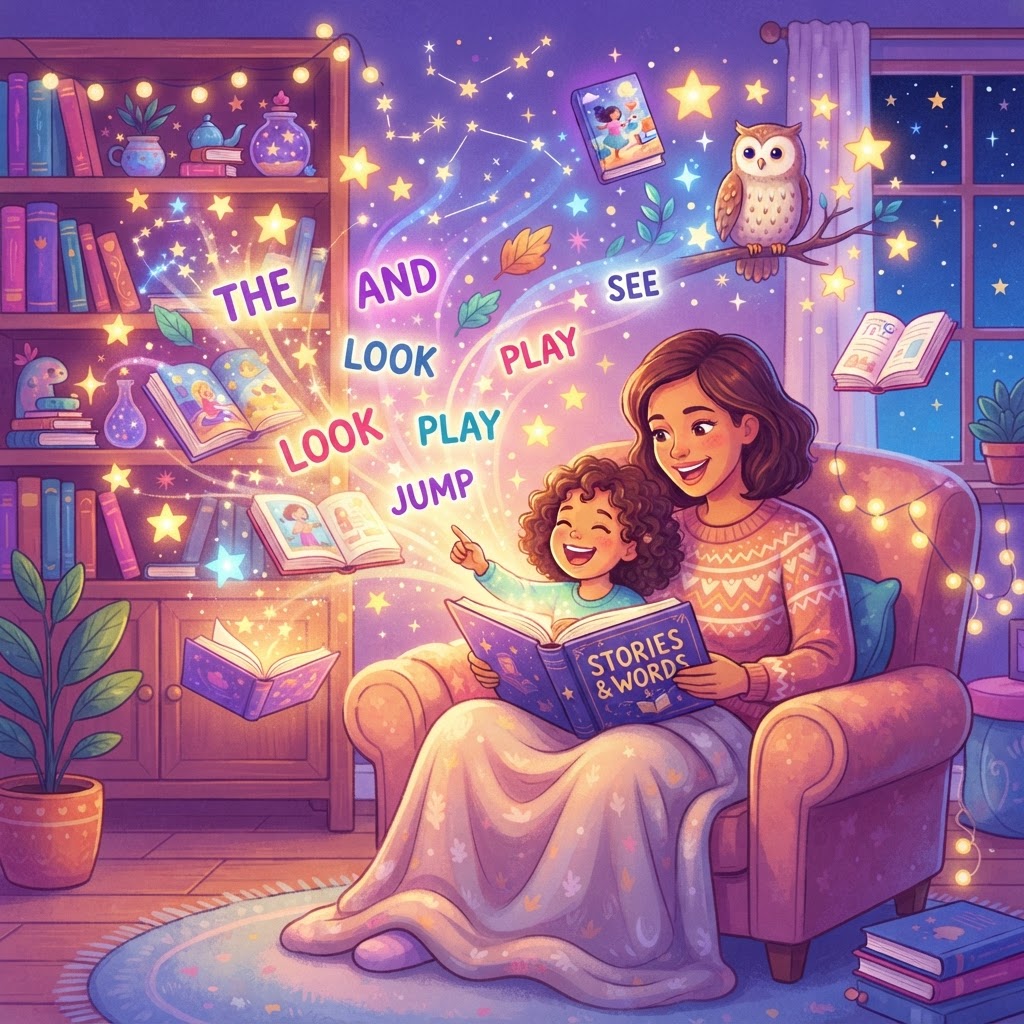
If you want to make early reading feel natural, sight-words through stories is one of the best places to start. Stories give children repeated exposure to common words like the, said, look, and you in a way that feels meaningful, memorable, and fun.
This matters because sight words are not just a list to memorize. Children learn them more deeply when they meet them again and again in connected text, hear them read aloud, and use them in familiar language. For parents and teachers focused on building sight-words in kids, story time can become a powerful literacy routine.
Why are stories so effective for sight-word development?
Stories are effective because they place high-frequency words inside meaningful, repeated, emotionally engaging language. Instead of memorizing words in isolation, children connect the printed word to a voice, a character, an action, and a sentence they understand.
Research supports this approach. Literacy scholar Linnea Ehri has shown that children learn words more securely when they connect spellings, sounds, and meaning, rather than relying on visual memorization alone. The Institute of Education Sciences also recommends explicit work with decoding and word recognition in connected reading, not just drills.
Stories help sight-word learning in several ways:
- Repetition: Story phrases often repeat key words naturally.
- Context: Children can guess and confirm a word from meaning.
- Motivation: A child will reread a favorite story more willingly than a flashcard stack.
- Memory support: Emotion, rhythm, and character attachment help words stick.
- Transfer: Children see how sight words actually function in sentences.
This is why story-based practice supports both sight-words development in children and broader reading growth. It also pairs well with how stories support reading development, because sight words work best when children meet them in real reading.
Which sight words should children learn first through stories?
Children should start with the most useful, high-frequency words they see often in books and daily print. The best early targets are short, common words that appear across many stories, such as I, the, a, to, we, you, is, my, and see.
For most children, it helps to focus on:
- 3-5 target words at a time
- Words that appear often in read-alouds
- Words that are important for simple sentences
- A mix of words the child can decode and words they need to recognize quickly
Dolch and Fry lists can be useful starting points, but children do not need to master a list in order. Choose words that fit the child’s age, interests, and current books. If your child loves animal stories, for example, a sentence like “Look at the dog” gives several beginner-friendly sight words in one meaningful line.
It also helps to remember that sight-word learning should not replace phonics. Many high-frequency words are partly decodable, and children benefit when adults point that out. If you want to support both skills together, this guide to phonics through stories can help.
What five story-based activities help build sight words in kids?
The most effective activities are simple, playful, and built around rereading. These five story-based strategies make building sight-words in kids easier without turning reading time into a test.
1. How can you do a sight-word hunt during story time?
Pick 1-3 target words before reading, then ask your child to spot them each time they appear. This works especially well with words like the, and, said, or look.
Try prompts such as:
- “Can you find the on this page?”
- “Point to you when we see it again.”
- “How many times did we read look?”
This keeps attention on print while preserving the flow of the story.
2. How can repeated story lines strengthen word recognition?
Use books or stories with predictable refrains and invite your child to join in on the repeated line. Repetition helps children notice the same word shapes in the same sentence frame.
For example, if the line is “I can see the moon,” pause before see and let your child supply it. Reading Rockets highlights repeated reading as a strong support for fluency and word recognition.
3. How can you use sticky notes or cards with a story?
Write target words on sticky notes or small cards, then match them to the same words inside the story. Children love the physical act of placing a note over a word, finding it again, and checking if it matches.
This works well because it combines:
- visual attention
- movement
- print matching
- immediate success
Keep it light. The goal is quick recognition, not perfection.
4. How can acting out a story reinforce sight words?
Acting out key lines helps children connect words with actions and meaning. If the sentence says “I can jump,” let your child jump while saying the line and pointing to the words.
Movement supports memory, especially for younger children. The National Center on Improving Literacy also emphasizes engaging, meaningful literacy experiences that fit children’s development.
5. How can sentence rebuilding turn stories into sight-word practice?
After reading, rebuild one short sentence from the story using word cards. A sentence like “We see the cat” can be cut apart and rearranged for the child to rebuild.
This activity helps children:
- notice word order
- reread familiar words
- connect spoken and written language
- develop confidence with simple text
It also overlaps nicely with building vocabulary through stories, since children learn both what words look like and what they mean in context.
How often should children practice sight words with stories?
Children make the best progress with short, frequent practice. Ten minutes of story-based sight-word work several times a week is usually more effective than one long session.
A practical routine might look like this:
- Read aloud once for enjoyment
- Reread once with 2-3 target sight words in mind
- Do one quick activity like a word hunt or sentence rebuild
- Revisit the same story the next day or later in the week
Rereading matters. When children return to a familiar story, they use less mental energy on plot and more on print. That is one reason favorite books are so powerful for sight-words development children need in the early years.
If a child becomes frustrated, scale back. Fewer words, shorter stories, and more adult modeling usually lead to better learning.
How can you use InstaTales to create sight-words through stories?
InstaTales can help by turning sight-word practice into a personalized reading experience. When a story includes your child’s name, favorite theme, and a few carefully chosen target words, rereading becomes much more likely.
Here is a simple way to use InstaTales well:
Choose a small set of target words
Start with 3-5 sight words, such as the, I, see, my, and you. These should be words your child is ready to notice often.
Build a simple, repetitive prompt
When you create your own personalized bedtime story, ask for:
- short sentences
- repeated phrases
- one familiar setting
- target sight words used multiple times
- a warm, age-appropriate plot
A sample prompt might be:
Create a bedtime story for a 5-year-old about Maya and a sleepy bunny. Use simple repeated sentences and include the sight words the, see, my, and you many times.
Reread and save winning stories
If a story works well, save it in your story library so your child can revisit it. Repetition is where much of the learning happens.
Use templates or classroom support
If you want a quicker starting point, browse story templates for repeatable formats. For educators, InstaTales for teachers can make it easier to create differentiated story practice for small groups or literacy centers.
The key is to use personalization thoughtfully. The goal is not more content; it is better-matched content that gives children repeated, joyful encounters with the right words.
Frequently Asked Questions
What age can children start learning sight words through stories?
Many children can begin noticing sight words around ages 4-6, depending on language exposure and readiness. Younger children also benefit from hearing repeated words in read-alouds, even before they read independently.
Do sight words need to be taught separately from phonics?
No. Sight words and phonics work best together. Some high-frequency words are irregular, but many can still be partly sounded out and discussed during reading.
How many sight words should I teach at one time?
For most young children, 3-5 target words at a time is enough. A small set allows for repetition without overload.
Is rereading the same story really helpful?
Yes. Rereading helps children become familiar with the language, notice recurring words, and build confidence. Favorite stories are often the strongest tools for word recognition.
Can personalized AI stories help reluctant readers?
They can, especially when the story includes the child’s interests, name, or favorite topics. Personal relevance often increases attention, enjoyment, and willingness to reread.
What if my child memorizes the story but not the words?
That is normal at first. Gently point to target words, vary the activity, and ask the child to find the word in a new sentence or a new story to build true recognition.
Ready to Create a Personalized Bedtime Story?
Use our free AI bedtime story generator to create a personalized illustrated story for your child in 30 seconds — no credit card needed.
Popular story types:
Maya Rodriguez
Lead Content Editor & Early Literacy Specialist
Maya is a former early childhood educator and literacy specialist with over a decade of experience helping children develop a love of reading. She leads content at InstaTales, where she writes about the science of storytelling, child development, and how families can use personalized AI stories to build literacy and emotional resilience.
instatales.ai