How Stories Build Problem-Solving Skills
Want to help your child develop problem solving? Discover how stories naturally build this skill — and how to maximize the benefit.
✦ Key Takeaways
- •Stories are effective because they package problem solving into a form children naturally understand: a character wants something, meets an obstacle, tries solutions, and learns from the result.
- •When children follow a story problem, they are using several key thinking systems at once.
- •Research suggests that stories support the building blocks of problem solving, especially language, inference, memory, and self-regulation.
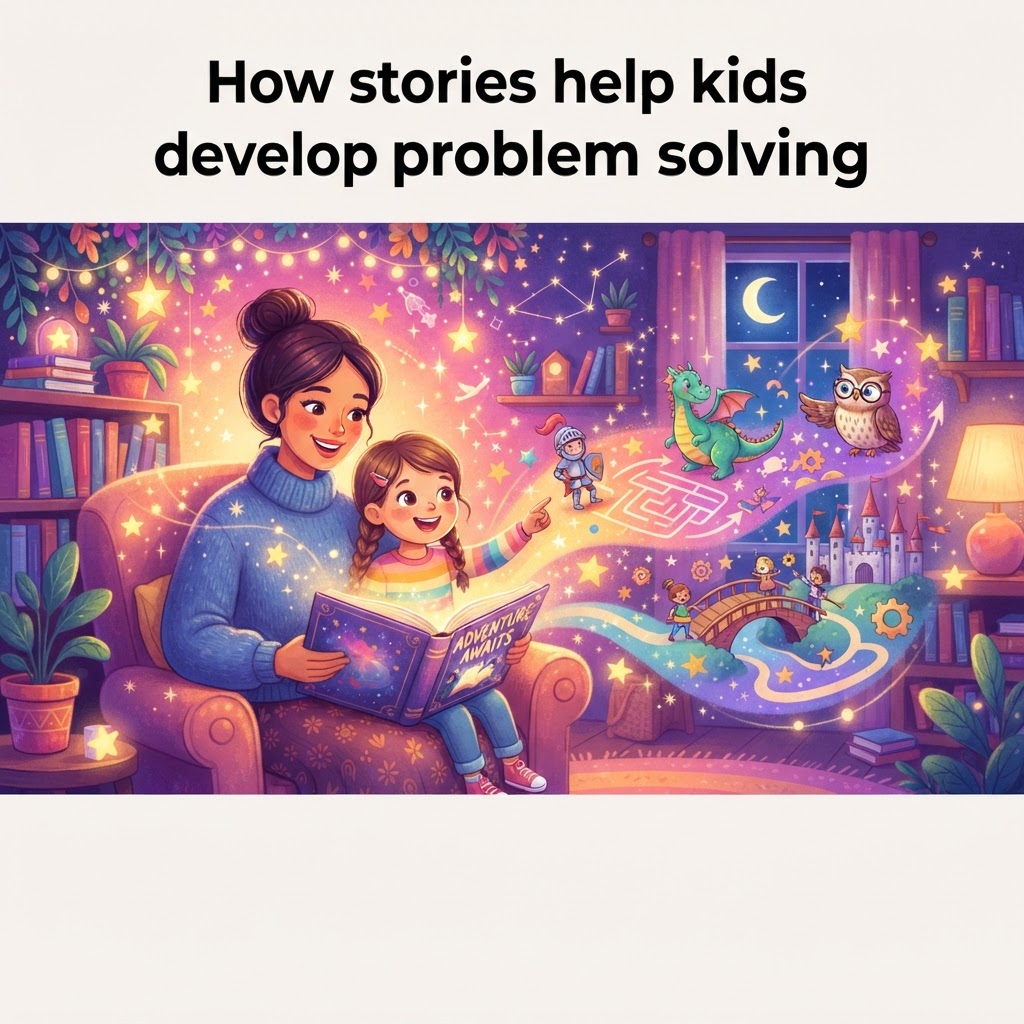
Stories do more than entertain children before bed. They give kids a safe, repeatable way to practice noticing a problem, thinking through options, and understanding what happens next. That is why problem-solving development stories can be such a powerful part of everyday learning.
For young children, problem solving grows through experience, not lectures. When a character loses a toy, helps a friend, or finds a new path home, children mentally rehearse the same steps they will need in real life: focus, predict, choose, and adapt. Used well, stories for problem-solving help build both thinking skills and confidence.
Why are stories so effective for problem-solving development?
Stories are effective because they package problem solving into a form children naturally understand: a character wants something, meets an obstacle, tries solutions, and learns from the result. That sequence makes abstract thinking visible.
In real life, problem solving can feel messy. In a story, the same skill is slowed down and organized. Children can see the challenge, follow the clues, and notice how one choice leads to another.
This matters because young children learn best through patterns. In problem-solving and storytelling, the pattern is clear:
- There is a goal
- Something gets in the way
- The character tries one or more solutions
- The outcome teaches a lesson
Over time, children begin to expect this pattern. They start asking, “What could the character do now?” That question is the heart of problem solving.
If you want more examples of this in action, our guide to building problem-solving through stories explores story elements that support flexible thinking.
What happens in a child’s mind during a story problem?
When children follow a story problem, they are using several key thinking systems at once. In simple terms, stories exercise the brain’s “planning and meaning-making” network.
First, children use working memory to hold onto important details: who wants what, what went wrong, and what has already been tried. Second, they use inhibitory control to ignore less important details and stay focused on the main problem. Third, they use cognitive flexibility to consider a new idea when the first solution fails. These are all part of executive function, a set of skills strongly linked to learning and self-regulation, as explained by Harvard’s Center on the Developing Child.
Stories also build causal reasoning. Narrative researchers Joseph Trabasso and Paul van den Broek showed that comprehension depends on connecting events through cause and effect. In other words, children understand a story better when they can answer questions like, “Why did that happen?” and “What happened because of it?”
That same thinking transfers beyond books. A child who can track story causes and consequences is practicing the same mental habit needed to solve everyday problems.
What does research say about problem-solving and storytelling?
Research suggests that stories support the building blocks of problem solving, especially language, inference, memory, and self-regulation. While no single study says “bedtime stories alone create problem solvers,” the evidence is strong that regular read-alouds and story discussion strengthen the underlying skills.
One classic study by Whitehurst et al. (1988) found that dialogic reading—an interactive style where adults ask questions and invite children to talk about the story—improved preschoolers’ language development more than passive reading. That matters because better language helps children explain problems, compare options, and reflect on solutions.
Research by Morrow (1988) and later studies on retelling found that repeated story reading and retelling improve comprehension. Retelling pushes children to organize events, remember steps, and explain how a problem was solved.
Narrative comprehension research by van den Broek also shows that children build understanding by making inferences and linking events causally. That is closely tied to problem solving because good problem solvers do not just notice what happened; they ask why it happened and what might happen next.
Reading together is also supported by pediatric guidance. The American Academy of Pediatrics recommends shared reading from infancy because it supports language, relationships, and early learning through back-and-forth interaction, not just exposure to words alone source.
For families who want practical literacy support, the University of Florida Literacy Institute offers clear, research-based family reading resources.
Which stories support problem-solving best?
The best stories for problem-solving are not necessarily the longest or most educational-sounding. They are the ones with a clear challenge, understandable stakes, and at least one thoughtful attempt to fix the problem.
Look for stories that include:
- A relatable problem, such as sharing, waiting, losing something, or trying again
- A character with a clear goal
- More than one possible solution
- Consequences that make sense
- A satisfying reflection or lesson at the end
Age matters too. Toddlers benefit from simple cause-and-effect plots. Preschoolers enjoy stories where a character tries a few different ideas. Older children can handle more complex dilemmas, including teamwork, planning, and trade-offs.
Story type also matters. Stories that build imagination can strengthen flexible thinking, which is why they pair well with stories that grow imagination. And because children need to listen closely to follow clues, problem-solving stories also complement listening skills through stories.
How can parents use story time to build problem-solving skills?
Parents can build problem-solving skills during story time by making reading interactive. A few well-timed questions do more than a long explanation.
Here are 5 practical strategies that work well:
1. Pause before the solution appears
Stop at a key moment and ask, “What do you think the character could do?” This encourages prediction and helps children generate options instead of waiting for the book to do all the thinking.
2. Ask “why” and “what happened because of that?”
These questions build causal reasoning. They help children connect actions to consequences, which is central to both story comprehension and real-world problem solving.
3. Invite more than one answer
If your child offers one solution, ask for another. This small habit builds cognitive flexibility and teaches that many problems have multiple workable solutions.
4. Connect the story to real life
Say, “That reminds me of when you couldn’t find your shoes. What helped then?” This helps children transfer skills from stories to everyday situations.
5. Re-read and retell
Re-reading is not “just repetition.” It gives children another chance to notice clues, revise their thinking, and explain the problem in their own words. That is one reason story retelling is such a useful literacy routine.
If your child also enjoys making up their own endings, that can support later expressive skills too. Our article on how stories build storytelling skills explores that next step.
How can InstaTales make stories for problem-solving easier to use?
InstaTales can make stories for problem-solving easier by helping you match the story challenge to your child’s age, interests, and current needs. Personalization matters because children engage more deeply when the problem feels familiar and the character feels like “someone like me.”
You can create your own personalized bedtime story with a challenge your child is actively learning to handle, such as patience, sharing, trying again, or asking for help. A shy child might benefit from a story about speaking up. A frustrated child might benefit from a story where the hero’s first plan fails, but the second one works.
To get more benefit from personalized stories, try this simple flow:
- Choose one specific everyday challenge
- Make the goal clear
- Include two possible solutions in the plot
- Pause to ask what your child would do
- Re-read the story later to notice new ideas
It also helps to save strong favorites in your story library so your child can revisit them. Re-reading familiar problem-solving stories often leads to deeper thinking, because children stop focusing only on “what happens” and start noticing “why it works.”
For educators or homeschoolers, personalized stories can also support small-group discussion, partner retelling, and social-emotional learning tasks in age-appropriate ways.
Stories will not solve every challenge a child faces. But they do give children a safe place to practice the habits that good problem solvers use every day: paying attention, thinking ahead, trying again, and learning from outcomes.
Frequently Asked Questions
Can bedtime stories really improve problem-solving skills?
Yes, especially when adults make reading interactive. Stories help children practice prediction, cause-and-effect thinking, and flexible decision-making in a low-pressure setting.
What age should I start using stories for problem-solving?
You can start in toddlerhood with very simple stories. Even young children can follow basic problems like “lost,” “stuck,” or “need help,” and those early patterns matter.
Are personalized stories better than regular books?
They can be, especially when the story matches a child’s real-life challenge or interest. Personalized stories often increase attention and discussion, which is where much of the learning happens.
How many questions should I ask during a story?
A few is enough. One prediction question, one cause-and-effect question, and one reflection question usually works better than stopping on every page.
What if my child gives a “wrong” answer to a story problem?
That is still useful. Ask, “What do you think would happen if the character tried that?” and treat it as a thinking exercise, not a test.
Do stories help with school skills too?
Yes. The same story habits that support problem solving also support listening, vocabulary, comprehension, and memory. Those skills all contribute to classroom learning and everyday independence.
Explore More Stories
Ready for more? - free AI bedtime story generator
Get a new bedtime story every week
Free, personalized, and delivered to your inbox. No spam, ever.
Ready to Create a Personalized Bedtime Story?
Use our free AI bedtime story generator to create a personalized illustrated story for your child in 30 seconds — no credit card needed.
Popular story types:
Maya Rodriguez
Lead Content Editor & Early Literacy Specialist
Maya is a former early childhood educator and literacy specialist with over a decade of experience helping children develop a love of reading. She leads content at InstaTales, where she writes about the science of storytelling, child development, and how families can use personalized AI stories to build literacy and emotional resilience.
instatales.ai