How Stories Build Kids’ Sight Words
Want to help your child develop sight words? Discover how stories naturally build this skill — and how to maximize the benefit.
✦ Key Takeaways
- •Sight words are high-frequency words children learn to recognize quickly and accurately.
- •Stories help children store sight words through repeated, meaningful print exposure.
- •Research suggests that story reading supports the foundations of sight-word learning, especially print knowledge, vocabulary, and word recognition.
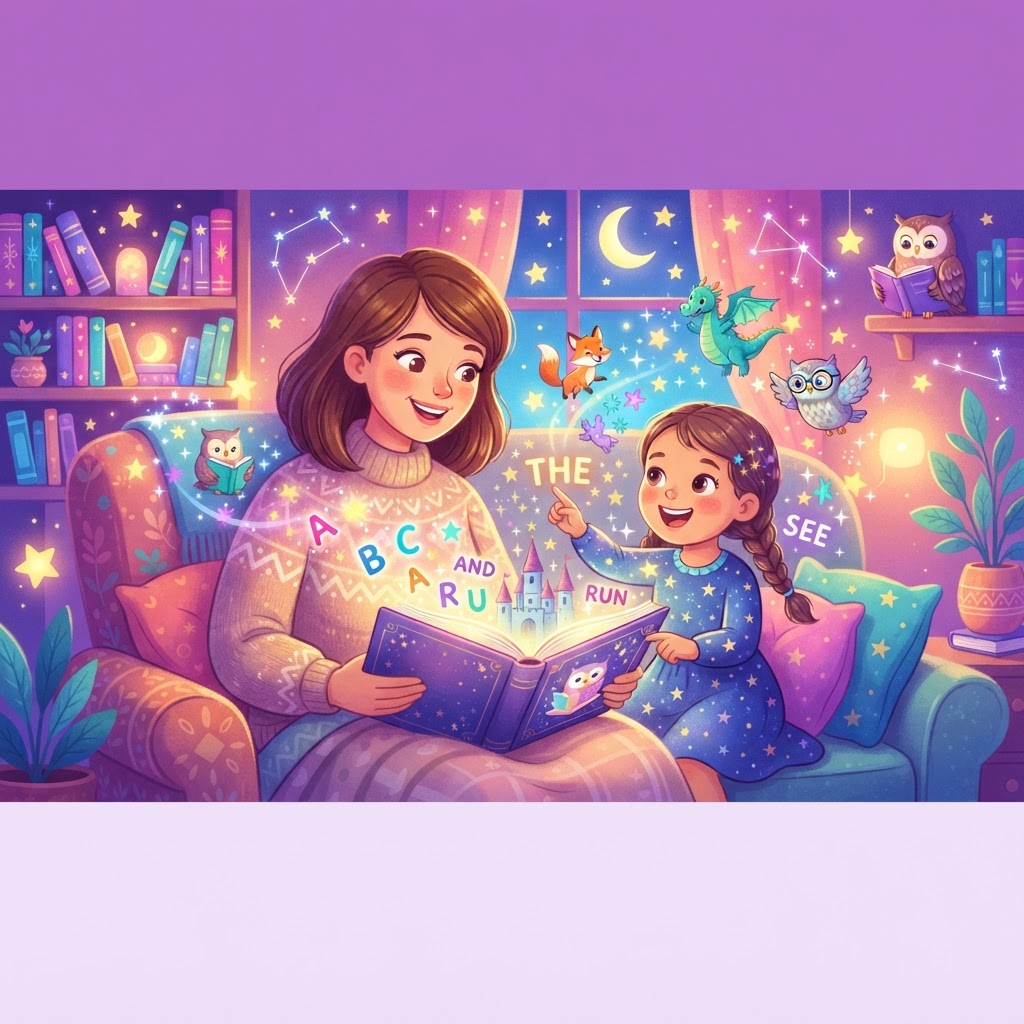
If your child can “read” the, and, or said the moment they see them, they are building sight words. The good news is that this skill does not have to come from drills alone. Sight-words development stories can make practice feel natural, meaningful, and far more enjoyable for young children.
Stories work because children hear and see the same useful words again and again in a memorable context. When parents use stories for sight-words alongside phonics and shared reading, children get repeated exposure, stronger recall, and more motivation to keep reading.
What are sight words, and why do stories help children learn them?
Sight words are high-frequency words children learn to recognize quickly and accurately. Stories help because they place those words inside meaningful sentences, instead of presenting them as isolated items on a card.
Some sight words are fully decodable, like in or can. Others are partly irregular, like said, one, or was. In both cases, children benefit when they meet these words often, hear them read aloud, and connect the printed form to meaning.
That is why sight-words and storytelling work so well together. In a story, a child does not just see the word look. They see it while a character looks for a dragon, a lost teddy, or a hidden moon. Meaning makes the word stick.
Stories also support other early literacy skills at the same time. As children listen and join in, they strengthen stronger reading skills, oral language, and attention to print.
How do stories help the brain store sight words?
Stories help children store sight words through repeated, meaningful print exposure. The brain learns words best when children connect the sounds in the word, the letters on the page, and the word’s meaning all at once.
Researchers often describe this process as orthographic mapping. Linnea Ehri’s work shows that children do not truly learn words “by shape” alone. They bond the letters in a word to the sounds they represent, which allows fast and automatic recognition later. The UFLI explanation of orthographic mapping offers a clear, research-based summary of this process.
Stories support orthographic mapping in a few key ways:
- Repetition: High-frequency words appear again and again across books.
- Context: The sentence helps children predict and confirm the word.
- Attention: Illustrations and plot keep children engaged long enough to notice print.
- Sound-letter links: When adults point to words and read slowly, children can connect spoken language to written language.
David Share’s 1995 self-teaching hypothesis adds another piece. He argued that each successful reading encounter helps children build word-specific knowledge. In simple terms, every time a child works out or recognizes a word in a story, the word becomes easier to recognize next time.
This is also why stories should support, not replace, phonics. Children build the strongest sight-word memory when story exposure and phonics through stories work together.
What does research say about stories and sight-word development?
Research suggests that story reading supports the foundations of sight-word learning, especially print knowledge, vocabulary, and word recognition. While no single bedtime story teaches all sight words, regular shared reading creates the conditions children need to remember common words quickly.
Several findings matter here:
- Ehri’s research on word reading shows that automatic recognition develops when children form secure links between letters, sounds, and meaning.
- Share (1995) found that reading itself acts as a “self-teaching” mechanism, helping children build mental representations of words.
- Mol and Bus (2011) reported in a meta-analysis that storybook reading supports language and emergent literacy outcomes, especially when children are actively engaged.
- The What Works Clearinghouse practice guide on foundational reading skills highlights explicit work with print, decoding, and word recognition as key building blocks of early reading.
- Literacy experts at Reading Rockets note that high-frequency words become easier when children meet them often in connected text, not only in drills.
The strongest takeaway is this: stories are not a shortcut around instruction. They are a powerful, evidence-based way to make word learning stick. They also strengthen story-based vocabulary growth, which helps children understand and remember what they read.
Which kinds of stories are best for sight-word learning?
The best stories for sight-word learning are short, engaging, and rich in repeated high-frequency words. Children learn more when the story is easy to follow and invites them to notice the same useful words several times.
Look for these features:
- Repeated sentence patterns, such as “I see the…” or “We can go…”
- High-frequency words woven naturally into the text
- Strong picture support so children can connect meaning to print
- Predictable structure that encourages children to join in
- Age-appropriate length so attention stays high
For toddlers and preschoolers, simple repetitive stories are ideal. For early readers, short stories that combine familiar sight words with decodable words work especially well.
It also helps to revisit favorite stories. Re-reading is not “cheating.” It is one of the fastest ways to build automatic recognition, fluency, and confidence.
What practical strategies help parents and teachers build sight words through stories?
A few small changes during story time can make sight-word learning much stronger. The goal is not to turn bedtime into a lesson, but to help children notice important words in a calm, playful way.
Try these five strategies:
-
Pick one to three target words per week.
Choose useful words like the, is, come, or said. When those words appear in a story, pause briefly and point them out. -
Point to the word as you read it.
This builds print awareness and helps children link the spoken word to the written one. Keep it light and brief. -
Invite your child to “read” the repeated word.
If a sentence pattern repeats, let your child fill in the target word. This active response improves attention and recall. -
Re-read favorite stories on purpose.
Children often learn sight words after multiple comfortable exposures. The second, third, and fifth readings matter. -
Connect the word beyond the book.
After the story, look for the same word on a cereal box, a label, or a simple note. This shows children that words travel across contexts.
For classrooms, these same strategies work well in small groups, literacy centers, and read-aloud time. The key is consistency, not pressure.
How can InstaTales support sight-word practice in a natural way?
InstaTales can make sight-word practice more personal, repeatable, and motivating. Personalized stories help children pay attention because the characters, themes, and adventures already matter to them.
Here is how to use InstaTales effectively:
- Use create your own personalized bedtime story to generate a short story around your child’s favorite topic, such as dinosaurs, mermaids, trucks, or space.
- Add 2-4 target sight words you want to reinforce, and prompt for repeated sentence patterns.
- Keep stories short for younger children so the repeated words stand out.
- Re-read the same story across several nights and save it in your story library for easy review.
- After reading, ask your child to spot one target word on a page and say it aloud.
This approach is especially useful for children who resist flash cards but love stories about themselves. A child is often more willing to notice look, come, or here when those words appear in a story starring their own name, pet, or favorite toy.
If you want a balanced literacy routine, use personalized stories alongside phonics, conversation, and free reading. You can also explore more story-based literacy ideas on the InstaTales blog.
Why is it important not to rely on memorization alone?
Sight words should be learned through recognition, not guesswork. Memorizing long lists without sound-letter knowledge can create fragile reading habits, especially when children face new words.
A better approach is to treat sight words as part of the full reading system. Children need:
- phonemic awareness
- phonics
- vocabulary
- comprehension
- lots of meaningful reading
Stories support all of these at once. That is why they are so effective. They make repeated word exposure feel purposeful, emotional, and fun.
Frequently Asked Questions
Can stories replace sight-word flash cards?
Stories can reduce the need for heavy flash-card practice, but they usually work best alongside a few focused review activities. Stories give children meaningful repetition, which helps words stick better.
How many sight words should my child practice at once?
For most young children, 1 to 3 target words at a time is plenty. A small set keeps practice manageable and increases the chance of true automatic recognition.
Are personalized stories good for early readers?
Yes. Personalized stories can boost motivation because children care more about text that includes their name, interests, or favorite characters. Higher engagement often leads to more re-reading and better word retention.
What if my child can say a sight word in one book but not in another?
That is normal. Children often recognize words first in familiar contexts, then gradually transfer that knowledge to new books and settings through repeated exposure.
Do sight words still matter if my child is learning phonics?
Yes. Sight words and phonics support each other. Many high-frequency words are easier to read automatically after children build sound-letter knowledge through phonics instruction.
How often should we re-read the same story?
Several times across a week is often ideal for young children. Re-reading strengthens familiarity, confidence, and automatic word recognition without adding pressure.
Ready to Create a Personalized Bedtime Story?
Use our free AI bedtime story generator to create a personalized illustrated story for your child in 30 seconds — no credit card needed.
Popular story types:
Maya Rodriguez
Lead Content Editor & Early Literacy Specialist
Maya is a former early childhood educator and literacy specialist with over a decade of experience helping children develop a love of reading. She leads content at InstaTales, where she writes about the science of storytelling, child development, and how families can use personalized AI stories to build literacy and emotional resilience.
instatales.ai