Growth Mindset Stories for Kids: Parent Guide
A growth mindset is one of the most important things kids can learn. Here's how to use stories to teach them about effort, mistakes, and perseverance.
✦ Key Takeaways
- •Stories are effective because children learn best through examples, emotion, and repetition.
- •Carol Dweck’s research shows that children do better when they believe abilities can grow.
- •Stories model growth mindset best when the character’s journey includes struggle, support, and progress.
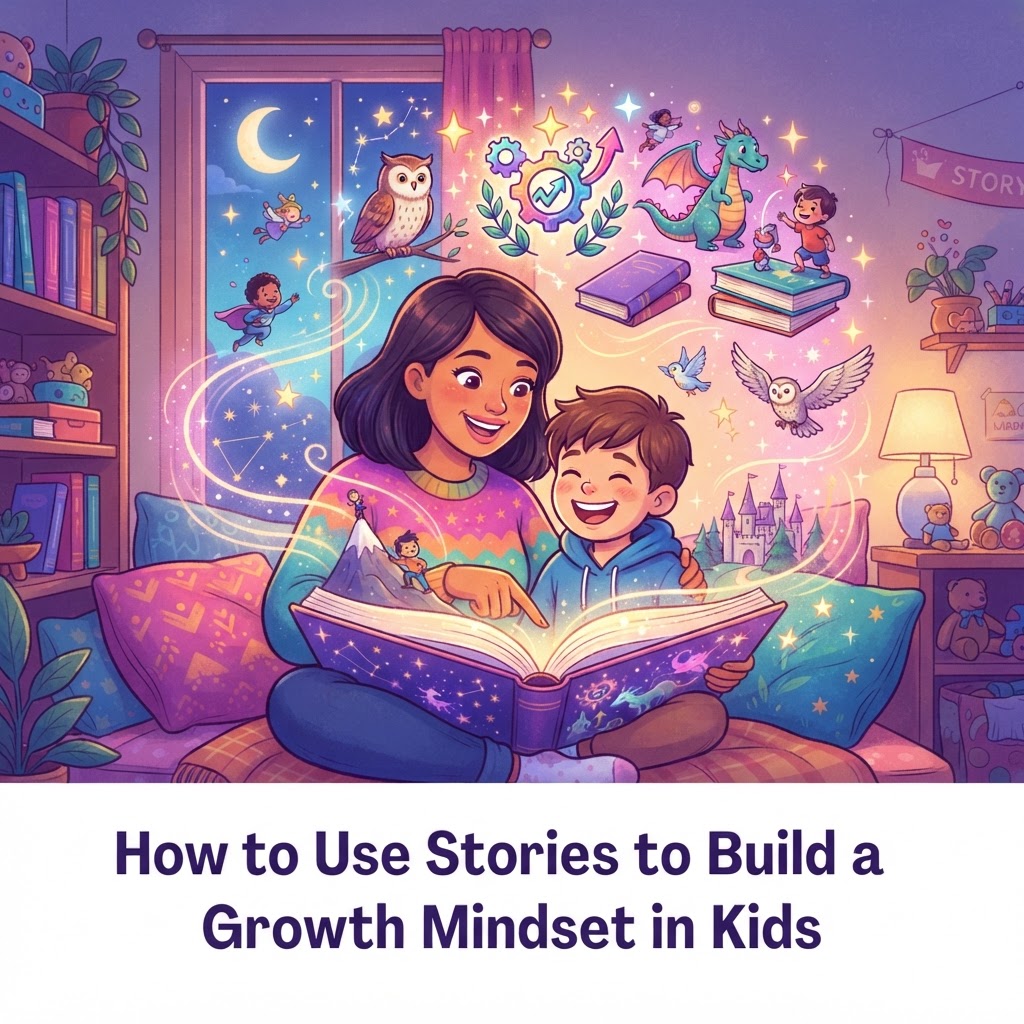
A growth mindset is the belief that abilities can improve with effort, practice, good strategies, and support. For young children, that idea can feel abstract until they see it in action. That is why growth mindset stories for kids work so well: stories turn effort, mistakes, and perseverance into something children can picture, feel, and remember.
When a character struggles, tries again, and grows, kids learn that success is not about being “naturally good” at something. It is about sticking with hard things. Whether you are reading at bedtime, planning a classroom lesson, or using AI to create your own personalized bedtime story, stories can become one of your best tools for building resilience.
Why are stories so effective for building a growth mindset?
Stories are effective because children learn best through examples, emotion, and repetition. A well-told story shows what persistence looks like in real life, which makes the lesson easier to understand and copy.
Research on child development shows that children make meaning through relationships and narratives. In a story, they can safely watch a character fail, feel frustrated, get help, and try again. That emotional distance matters. It helps children reflect without feeling judged.
Stories also give children language for hard moments. After hearing perseverance stories, a child may start saying things like:
- “I can keep practicing.”
- “That mistake helped me learn.”
- “I’m not good at this yet.”
That “yet” is powerful. It shifts a child from a fixed view of ability to a growing one.
This same story-based approach can also help children learn other life skills, like understanding time through stories or building healthy money habits with stories. The format works because children connect to characters before they connect to concepts.
What does Carol Dweck’s research tell parents and teachers?
Carol Dweck’s research shows that children do better when they believe abilities can grow. In simple terms, kids are more likely to persevere when adults praise effort, strategy, and progress instead of labeling them as simply “smart” or “talented.”
Dweck, a Stanford psychologist, is best known for her work on fixed mindset and growth mindset. A fixed mindset says, “I’m either good at this or I’m not.” A growth mindset says, “I can get better with practice.” You can learn more from Stanford’s profile of Carol Dweck and this helpful overview from the Harvard Graduate School of Education.
For parents and teachers, the practical takeaway is clear:
- Praise effort, not just outcomes.
- Normalize mistakes as part of learning.
- Highlight strategies, not just talent.
- Use the word yet when a child feels stuck.
For example, instead of saying, “You’re so smart,” try:
- “You kept working even when it got hard.”
- “That strategy helped.”
- “You made a mistake and then figured out a new way.”
Stories make these messages feel natural rather than preachy. Organizations like the National Association for the Education of Young Children also point out that young children benefit when adults focus on process, persistence, and learning.
How can stories model effort, mistakes, and perseverance?
Stories model growth mindset best when the character’s journey includes struggle, support, and progress. Children need to see that setbacks are normal, not signs that they should give up.
When choosing or creating stories, look for these elements:
- A character wants to learn something meaningful.
- The first attempt does not go well.
- The character feels disappointed, frustrated, or unsure.
- Someone offers help, guidance, or a new strategy.
- The character tries again.
- Progress happens gradually, not perfectly.
This matters because teaching growth mindset through stories is not about making every ending easy. In fact, a perfect hero is less helpful than a persistent one. A child learns more from “Lena spilled the paint, felt upset, took a breath, and tried again” than from “Lena was always amazing at painting.”
You can also point out the specific growth mindset moments in a story:
- “What mistake did the character make?”
- “What did they do next?”
- “Who helped them?”
- “What changed after more practice?”
Over time, children start noticing these patterns in their own lives. That is when story lessons begin to transfer into real behavior.
How should adults talk about a story to reinforce a growth mindset?
The best way to reinforce a growth mindset is to discuss the story right after reading it. A short conversation helps children connect the character’s experience to their own challenges.
Keep the discussion simple and concrete. Young children do not need a lecture. They need a few thoughtful questions and a warm adult who notices the process.
Try prompts like these:
- “What was hard for the character?”
- “Did they give up right away?”
- “What helped them keep going?”
- “What mistake helped them learn?”
- “Have you ever felt like that?”
You can also reflect back what you see in your child:
- “You kept listening, just like the character kept practicing.”
- “That part reminds me of when you learned to zip your coat.”
- “The character needed help, and that is okay too.”
For classrooms, this works well during read-aloud time, writing lessons, or project-based learning. Teachers can build a routine around a weekly story and follow-up discussion. If you want a more structured classroom approach, InstaTales for teachers can support personalized reading and writing activities around effort, revision, and persistence.
What are five growth mindset story prompts for kids?
The best growth mindset stories for kids are personal, specific, and just a little challenging. These five prompts are designed to spark stories about effort, mistakes, and perseverance.
1. What happens when a child learns a skill that feels impossible at first?
Prompt: Write a story about a child who wants to ride a bike, tie their shoes, or learn a song, but keeps getting it wrong before finally improving through practice.
Why it works: This prompt makes progress visible. It helps children see that learning usually looks messy before it looks smooth.
2. How does a character respond after making a big mistake?
Prompt: Write a story about a child who ruins a school project, knocks over a tower, or forgets an important line in a play, then finds a way to recover and keep going.
Why it works: Mistakes are central to growth mindset. This prompt shows that errors are not the end of the story.
3. What can a child do when they feel like quitting?
Prompt: Write a story about a child climbing a hill, solving a puzzle, or training for a race who wants to stop but remembers why they started.
Why it works: These are classic perseverance stories. They help children practice the inner dialogue of resilience.
4. How does asking for help make a character stronger?
Prompt: Write a story about a child who cannot finish something alone and learns that asking a parent, teacher, sibling, or friend for help is part of being brave.
Why it works: Growth mindset is not just about trying harder. It is also about using strategies and support.
5. What changes when a character adds the word “yet”?
Prompt: Write a story about a child who says, “I can’t do this,” and then learns to say, “I can’t do this yet.”
Why it works: The word “yet” gives children a simple mental script. It turns a dead end into a path forward.
If you want a quicker starting point, ready-made story templates can help you turn these prompts into a full bedtime story in minutes.
How can you use InstaTales to create perseverance stories children will want to hear again?
InstaTales can make perseverance-themed stories more effective because the child becomes part of the story. When children hear their own name, interests, and real-life challenges woven into a narrative, the lesson feels more personal and memorable.
A simple way to use InstaTales is to build a story around one current challenge. That could be learning to read, sharing with a sibling, swimming without floaties, or trying again after a tough day at school.
Here is a practical formula:
- Choose one real challenge your child is facing.
- Make the child the main character.
- Include one mistake or setback.
- Add a helper, tool, or strategy.
- End with progress, not perfection.
For example, if your child is frustrated with puzzles, create a story where they solve a mystery by trying different pieces, taking breaks, and asking for help. Then save it in your story library so you can re-read it when frustration comes up again. Repetition strengthens the message.
You can also use stories as part of a routine. A weekly “try again” story pairs nicely with weekly reading challenges, especially if your child likes goals and small wins. And if you want more ideas for using stories to teach life skills, the InstaTales blog has helpful examples on everything from routines to emotions.
Frequently Asked Questions
What age should I start using growth mindset stories with kids?
You can start very young, even with toddlers. Keep the language simple: “She tried again,” “He kept practicing,” and “Mistakes help us learn.”
What makes a good perseverance story for children?
A good perseverance story includes a real challenge, a setback, and gradual improvement. The character should struggle in a believable way and use effort, strategies, or help to move forward.
Should I praise effort all the time?
Praise effort when it is connected to a useful action, like practicing, focusing, problem-solving, or trying a new strategy. The goal is not empty praise, but helping children notice what actually helped them grow.
Can growth mindset stories help with school anxiety?
Yes, they can help by normalizing mistakes and showing that hard things get easier with support and practice. Stories are especially useful when a child feels afraid of getting something wrong.
How often should I read growth mindset stories?
A few times a week is enough to make a difference, especially if you revisit the same message in daily life. Re-reading one strong story can be more effective than rushing through many.
Can teachers use personalized stories in the classroom?
Yes. Personalized stories can support writing, discussion, social-emotional learning, and reading practice. They work especially well when tied to class goals like revision, persistence, and learning from mistakes.
Ready to Create a Personalized Bedtime Story?
Use our free AI bedtime story generator to create a personalized illustrated story for your child in 30 seconds — no credit card needed.
Popular story types:
Maya Rodriguez
Lead Content Editor & Early Literacy Specialist
Maya is a former early childhood educator and literacy specialist with over a decade of experience helping children develop a love of reading. She leads content at InstaTales, where she writes about the science of storytelling, child development, and how families can use personalized AI stories to build literacy and emotional resilience.
instatales.ai