Confidence Building Stories for Kids
Stories can be powerful confidence builders. Here's how to use them to help your child believe in themselves and face challenges.
✦ Key Takeaways
- •Stories are powerful confidence builders because they give children a safe place to rehearse challenge, effort, and success.
- •Stories build self-efficacy by showing children that effort, strategy, and support can lead to success.
- •The hero’s journey for kids should be small, relatable, and emotionally safe.
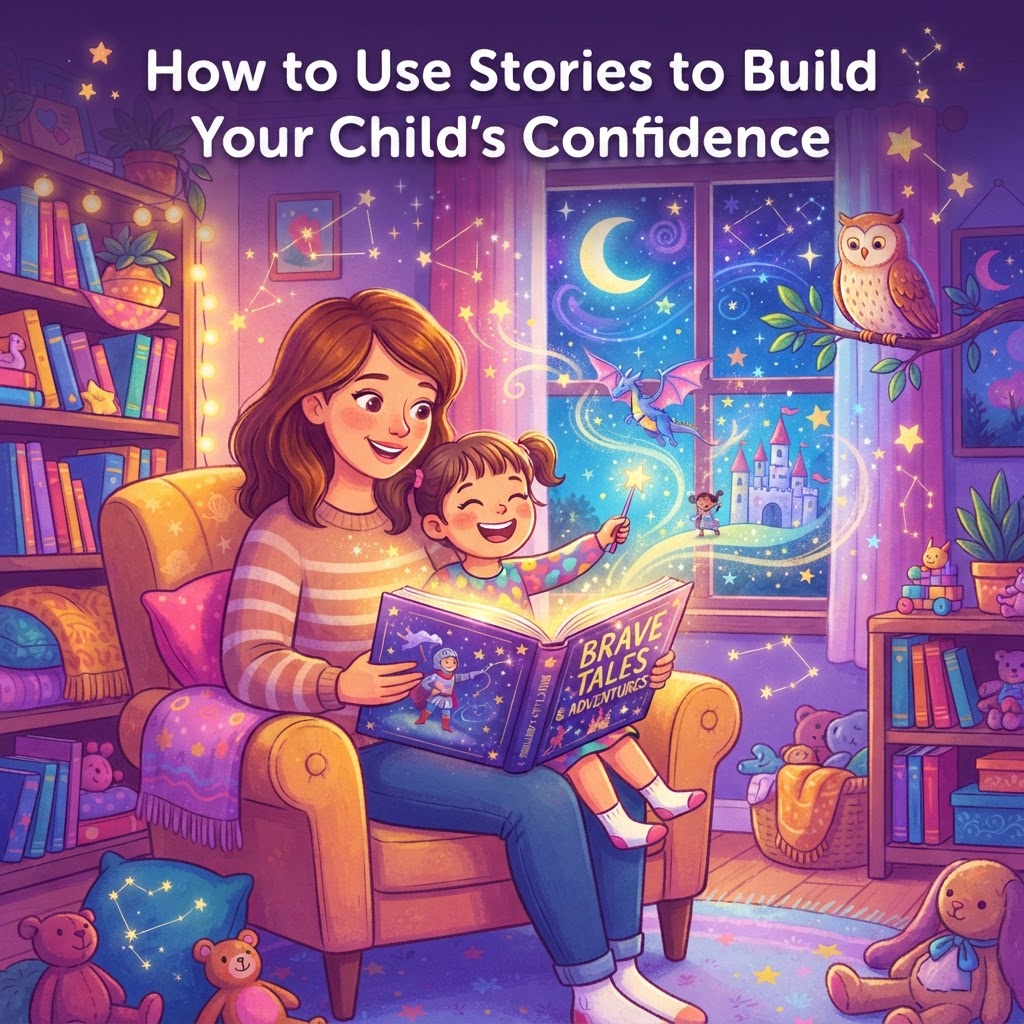
Stories help children practice courage before real life asks for it. When a child hears about a character who feels nervous, makes a mistake, keeps going, and succeeds, they begin to imagine, “Maybe I can do that too.” That is why confidence building stories, self-esteem stories for kids, and other empowering stories can be such a valuable part of bedtime, classroom reading, and everyday parenting.
The goal is not to tell children they are amazing all the time. Real confidence grows when kids see that hard things can feel hard and still be manageable. With the right story structure, you can help your child build self-belief, persistence, and a healthy willingness to try again.
Why are stories such powerful confidence builders?
Stories are powerful confidence builders because they give children a safe place to rehearse challenge, effort, and success. A child can “try on” bravery through a character long before they face the real moment themselves.
This matters because young children learn through repetition, imagination, and emotional connection. A lecture about “being confident” is easy to forget. A story about a worried bunny who learns to speak up at forest school is easier to feel, remember, and copy.
Well-crafted confidence building stories often include:
- A challenge the child recognizes
- Big feelings, named simply
- A supportive helper, such as a parent, teacher, or friend
- A small, believable win
- A clear message: progress matters more than perfection
Stories also create healthy emotional distance. Sometimes it is easier for a child to talk about “the dragon who was scared to roar” than to admit, “I’m scared to answer in class.” That distance lowers defensiveness and opens the door to honest conversation.
How do stories build self-efficacy in children?
Stories build self-efficacy by showing children that effort, strategy, and support can lead to success. In simple terms, self-efficacy is a child’s belief that they can handle a challenge.
Psychologist Albert Bandura’s research on self-efficacy shows that children grow more confident when they experience mastery, observe others succeeding, hear encouraging feedback, and learn to manage their emotions. The American Psychological Association explains that self-efficacy shapes how people think, feel, and act.
Stories support this in several ways:
- Vicarious learning: Kids watch a character like them solve a problem.
- Positive self-talk: They hear language such as “I can try one step at a time.”
- Emotional regulation: They learn that nerves, frustration, and mistakes are normal.
- Mastery rehearsal: They mentally practice what success could look like.
This is especially useful in early childhood, when social-emotional skills are still forming. Organizations like the CDC and NAEYC both emphasize the importance of helping children name feelings, build resilience, and develop problem-solving skills. Stories do all three at once.
What does the hero’s journey look like for kids?
The hero’s journey for kids should be small, relatable, and emotionally safe. Instead of saving the world, the child-hero learns to try, recover, and grow in an everyday challenge.
For children, the best “hero journey” usually looks like this:
- The ordinary world: Your child is doing something familiar.
- The challenge appears: A problem comes up, like stage fright or a hard puzzle.
- The helper arrives: A grandparent, friend, pet, or magical guide offers support.
- The first try goes imperfectly: The hero hesitates, makes a mistake, or needs a break.
- The hero tries again: They use a strategy, ask for help, or remember kind words.
- The return: They succeed in a believable way and feel proud of their effort.
That structure teaches a key confidence lesson: heroes are not fearless. Heroes feel unsure and act anyway.
This is also why representation matters. Children build confidence more easily when they see many kinds of capable heroes, including kids with different personalities, cultures, abilities, and family structures. If you want more on that, our guide to stories that teach kids about diversity explores how inclusive storytelling supports empathy and self-worth.
What kinds of confidence stories work best at different ages?
The best confidence stories match a child’s developmental stage and current challenge level. A story is most effective when it feels one step beyond what your child can already do, not ten steps beyond.
Ages 1-3
Keep stories simple, repetitive, and sensory. Focus on tiny moments of success: putting on shoes, waving hello, trying a new food, or climbing one more step.
Ages 4-6
This is a great age for self-esteem stories for kids that involve feelings, friendships, and first attempts. Think of stories about speaking up, joining a game, learning to swim, or making a mistake and fixing it.
Ages 7-10
Older children can handle more layered empowering stories. They benefit from plots that include self-doubt, problem-solving, persistence, and a more realistic sense of growth over time.
No matter the age, choose stories where the solution is earned. Confidence grows from believable progress, not instant perfection.
What are five confidence story prompts you can use tonight?
The best story prompts are specific enough to feel real and open enough to fit your child’s personality. These five prompts can be used as bedtime stories, writing starters, or personalized AI story ideas.
-
The Day You Tried Before You Were Ready
Your child is invited to do something that feels just a little scary, like riding a bike, answering a question, or joining a team. The story focuses on taking the first brave step. -
The Quiet Hero Who Found Their Voice
A gentle child notices something important and must decide whether to speak up. This works especially well for shy or thoughtful kids. -
The Mistake That Became a Map
Your child makes a mistake, feels embarrassed, and then discovers the mistake actually helps solve the problem. This prompt is excellent for perfectionists. -
The Tiny Helper with the Big Idea
Your child feels smaller, younger, or less capable than others, but their kindness or creativity saves the day. This builds competence without relying on “being the best.” -
The Mountain of “I Can’t Yet”
Your child faces something difficult and wants to quit. A helper teaches them to break the challenge into steps, turning “I can’t” into “I can’t yet.”
If you want to turn these into an ongoing habit, pairing them with a summer reading adventure can help children revisit confidence themes again and again.
How can you create personalized stories where your child is the hero?
Personalized stories build confidence fastest when they reflect your child’s real world, real worries, and real strengths. When children recognize themselves in a story, the lesson feels personal rather than preachy.
Here is a simple formula you can use:
-
Choose one current challenge.
Pick something specific: sleeping alone, trying soccer, reading aloud, or making a new friend. -
Make your child the main character.
Use their name, favorite toy, interests, or setting. A dinosaur-loving child will lean into the story faster if the adventure happens in a jungle full of fossils. -
Add one helper, not one rescuer.
The helper should encourage the hero, not solve everything for them. This keeps the confidence message clear. -
Give the hero a strategy.
Breathing slowly, asking for help, practicing, using kind self-talk, or trying one small step all work well. -
End with earned success.
The best ending is not “everything was easy.” It is “you did something hard, and now you know you can keep growing.”
This is where personalized storytelling can be especially useful. You can create your own personalized bedtime story around the exact challenge your child is facing, use ready-made story templates for quick inspiration, and save favorites in your story library so your child can revisit the same confidence lesson over time.
For even deeper reflection, try pairing bedtime stories with a story journal you make together. When children draw or talk about what the hero learned, they are more likely to carry that lesson into real life.
How should you read confidence-building stories so the lesson sticks?
The way you read matters almost as much as the story itself. A warm, interactive reading style helps children connect the character’s progress to their own lives.
Try these simple techniques:
- Pause and ask, “How do you think the hero feels right now?”
- Notice effort: “She kept trying even when it was tricky.”
- Connect gently: “This reminds me of when you felt nervous at swimming.”
- Avoid pressure: do not force your child to “learn the lesson”
- Re-read favorite stories, especially before a real challenge
Children often need repetition before a message becomes part of their self-talk. Re-reading the same empowering stories before school, a doctor visit, or a new activity can become a powerful confidence ritual.
Frequently Asked Questions
What are confidence building stories?
Confidence building stories are stories that help children see themselves as capable, resilient, and able to grow through effort. They usually include a challenge, supportive guidance, and a believable success.
Do self-esteem stories for kids really work?
Yes, especially when the stories are relatable and followed by conversation. They work best when they model effort, coping skills, and persistence instead of empty praise.
How often should I read empowering stories to my child?
A few times a week is enough to make a difference, and daily bedtime reading can be even more powerful. Repeating the same story before a known challenge often helps the lesson sink in.
What if my child does not want to be the hero in the story?
That is completely fine. Start with a character your child loves, such as an animal, toy, or magical creature, and let the hero share your child’s feelings in a less direct way.
Can teachers use personalized confidence stories in class?
Yes, as long as the stories are inclusive, age-appropriate, and respectful of each child’s privacy. Classroom stories can be especially effective for practicing perseverance, kindness, and speaking up.
What is the best message to include in a confidence story?
The most helpful message is: “You can feel unsure and still try.” That teaches children that confidence is not the absence of fear, but the growing belief that they can handle what comes next.
Ready to Create a Personalized Bedtime Story?
Use our free AI bedtime story generator to create a personalized illustrated story for your child in 30 seconds — no credit card needed.
Popular story types:
Maya Rodriguez
Lead Content Editor & Early Literacy Specialist
Maya is a former early childhood educator and literacy specialist with over a decade of experience helping children develop a love of reading. She leads content at InstaTales, where she writes about the science of storytelling, child development, and how families can use personalized AI stories to build literacy and emotional resilience.
instatales.ai