Light and Shadows for Kids: 5 Story Ideas
Feed your child's curiosity with these light and shadows stories that combine imagination with real science and discovery.
✦ Key Takeaways
- •Stories make science easier to understand because they give facts a character, a problem, and a visual scene.
- •Children do not need advanced physics to enjoy light and shadow science.
- •The strongest stories pair one clear science fact with one playful challenge.
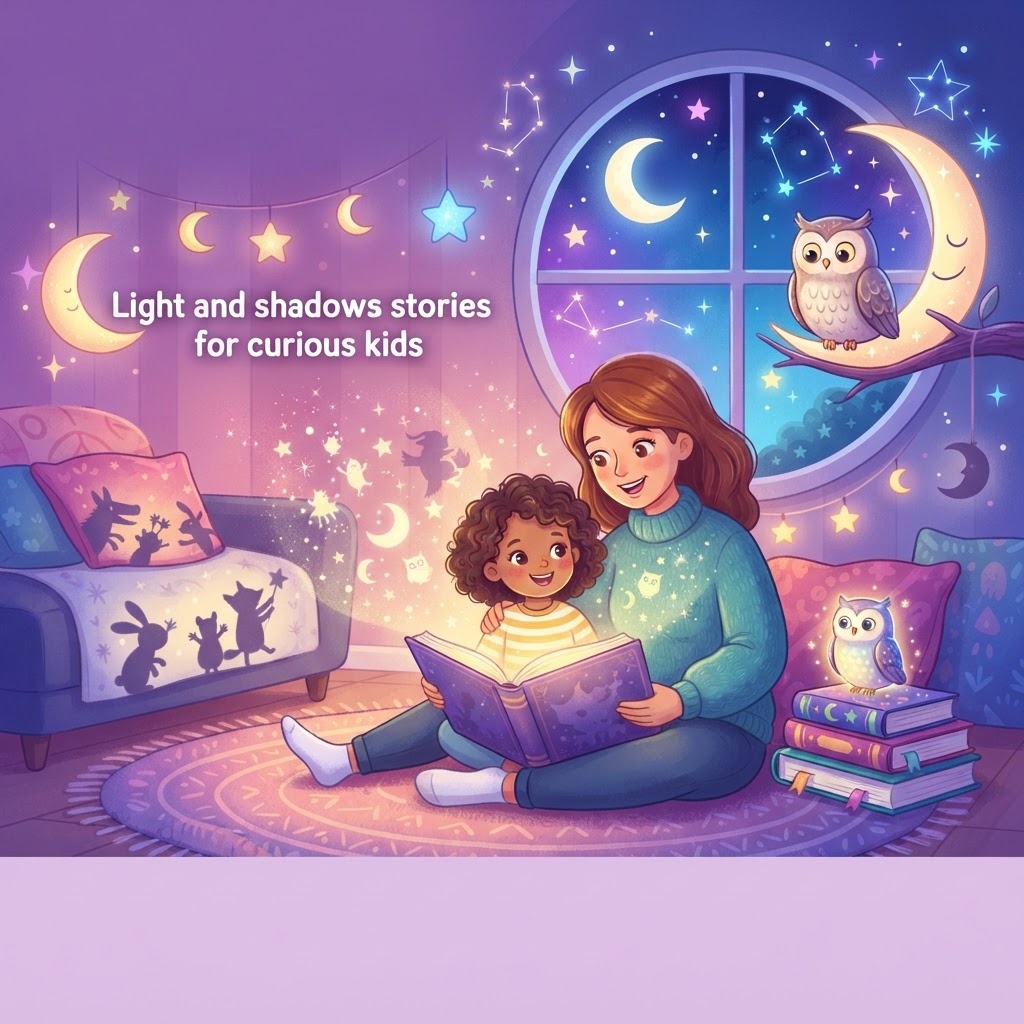
If your child asks, “Why is my shadow so long?” or “Can the moon make shadows too?” you already have the perfect opening for light and shadows for kids. The best light and shadows stories turn those everyday questions into gentle adventures, helping children imagine, test, and remember real science. For curious children, story time can become a doorway to observation, wonder, and discovery.
Why do light and shadows stories help kids remember science?
Stories make science easier to understand because they give facts a character, a problem, and a visual scene. Instead of memorizing a definition, children picture a flashlight, a wall, and a shadow that stretches or shrinks as the light moves.
This matters because young children learn best through meaning, repetition, and relationships. Developmental researchers such as Jerome Bruner argued that people naturally organize learning through narrative, and organizations like the National Association for the Education of Young Children support playful, inquiry-based STEM experiences in early childhood. The Harvard Center on the Developing Child also emphasizes that active, back-and-forth learning experiences help children build strong understanding.
For ages 1-10, stories do three important jobs at once:
- They make abstract ideas concrete
- They connect science to emotions and memory
- They invite children to ask “what happens if…?”
That is why curious kids light and shadows stories work so well. A child may forget the word opaque, but they will remember the dragon who could not cast a shadow through a glass window.
What light and shadow facts should curious kids learn first?
Children do not need advanced physics to enjoy light and shadow science. A few simple, accurate ideas are enough to build strong early understanding.
Here are the best starter facts for light and shadows for kids:
- Light travels in straight lines until it hits something.
- A shadow forms when an object blocks light.
- Opaque objects block light fully, while transparent materials let most light through.
- Shadow size can change when the light source moves closer or farther away.
- Outdoor shadows change during the day because the sun appears to move across the sky.
- Moonlight is reflected sunlight, so it can create softer shadows at night.
If you want a child-friendly science reference, Science Buddies offers clear, hands-on optics ideas, and NASA Space Place explains shadows in simple language children can grasp.
These facts are especially memorable when children hear them inside light and shadows adventures children can picture and retell.
Which light and shadows stories can spark wonder at bedtime?
The strongest stories pair one clear science fact with one playful challenge. That keeps the story magical without losing the real learning.
The Flashlight Forest Rescue
A child explorer builds a “forest” from pillows and chairs, then uses a flashlight to help a lost owl find its nest. Along the way, they notice that every stuffed animal makes a different shadow shape on the wall.
Real science fact: Shadows form when light is blocked, and the shape of a shadow depends on the object blocking the light.
This story works well for younger children because the cause and effect are simple and visible.
The Princess Who Measured Her Morning Shadow
A curious princess wakes up and finds her shadow long and skinny in the morning. At noon, it becomes shorter, and by evening it stretches again across the garden path.
Real science fact: Shadows change length and direction as the sun’s position changes in the sky.
This idea helps children notice a real outdoor pattern they can check for themselves the next day.
The See-Through Castle Mystery
A group of friends enters a castle with glass doors, wax-paper windows, and thick wooden gates. They discover that some materials let light pass through clearly, some let only a little through, and some block it completely.
Real science fact: Materials can be transparent, translucent, or opaque.
This is one of the most useful light and shadows stories for connecting science vocabulary to everyday objects.
The Shadow Puppet Detective Club
Two siblings put on a shadow puppet show, but the rabbit on the wall suddenly looks like a giant monster. They investigate and realize the flashlight moved much closer to their hands.
Real science fact: Moving a light source changes the size of a shadow.
Children love this because it feels like a mystery, and it leads naturally into a quick experiment after the story.
The Moonlight Map Adventure
A child camper follows a silver trail of moonlit shadows to find a hidden treasure box under a tree. On the way, they learn why moon shadows look softer than bright daytime shadows.
Real science fact: The moon does not make its own light; it reflects sunlight, and moonlight is much dimmer than daylight.
This is a lovely bedtime option because it keeps the mood calm while still feeding curiosity.
If your child already enjoys science-themed tales about gravity adventures, the water cycle, or bug-filled discoveries, light and shadow stories are a natural next step.
How can you prompt InstaTales for science-rich light and shadows stories?
A good prompt gives the story both heart and scientific accuracy. The simplest way is to name the character, the setting, the science fact, and the tone you want.
When you create your own personalized bedtime story, try this prompt formula:
- Child’s name, age, or favorite animal
- A familiar setting like a bedroom, garden, tent, or classroom
- One light-and-shadow fact to teach
- A gentle challenge or mystery
- A calm bedtime ending
Here are a few strong prompt examples:
- “Write a cozy bedtime story for my 4-year-old about Leo and a flashlight under a blanket fort. Teach that shadows form when light is blocked and that moving the flashlight changes shadow size.”
- “Create a science-rich story for a 6-year-old about a girl named Amara solving a castle mystery. Include transparent, translucent, and opaque materials in a simple way.”
- “Write a peaceful nighttime adventure for my 8-year-old about moonlight in the backyard. Explain that moonlight is reflected sunlight and that shadows look softer at night.”
To keep the science strong, ask for these features directly:
- “Use one real science fact three times in different ways”
- “Explain the science in age-appropriate language”
- “End with one question the child can test tomorrow”
Once you have a story your child loves, save it in your story library so you can revisit it. Re-reading is not “too repetitive.” In fact, repetition helps children absorb vocabulary, sequence, and concepts more deeply.
How can families extend light and shadow stories into real-world play?
The best follow-up is a tiny experiment, not a long lesson. Even five minutes of playful testing helps children connect the story to the real world.
Try one of these simple extensions:
- Flashlight wall play: Shine a light on toys and compare shadow shapes.
- Morning-noon-evening check: Look at the same outdoor object’s shadow at different times.
- Window test: Hold up plastic wrap, tissue paper, and cardboard to compare how much light passes through.
- Shadow puppet retell: Ask your child to act out the story using their hands.
You can also ask open questions instead of giving answers right away:
- “What do you think will happen if the flashlight moves closer?”
- “Why do you think the glass did not make a dark shadow?”
- “Which object made the biggest shadow?”
This approach matches what strong science teaching looks like in early childhood: observe, predict, test, and talk. It keeps curious kids light and shadows learning playful rather than pressured.
Frequently Asked Questions
What age are light and shadows stories best for?
They work well from toddlerhood through early elementary years. Younger children enjoy simple cause-and-effect stories, while older children can handle vocabulary like reflect, transparent, and opaque.
Can toddlers really understand light and shadows?
Yes, in a simple way. Toddlers may not explain the science, but they can notice that a flashlight makes a shadow and that a big object blocks more light.
What is the easiest light and shadow activity to do after a story?
A flashlight and a blank wall are enough. Move one toy closer to and farther from the light so your child can see the shadow change size.
How do I keep an AI-generated science story accurate?
Give the prompt one specific fact to teach and ask for age-appropriate wording. It also helps to check the idea against trusted sources like Science Buddies or NASA Space Place.
Are light and shadows stories useful in classrooms?
Absolutely. They support science, vocabulary, speaking, prediction, and observation all at once, which makes them a strong fit for early years and elementary learning.
How can I make my child want to hear science stories again?
Follow their interests and personalize the plot. A child who loves castles, animals, space, or camping is much more likely to engage with light and shadows adventures children can see themselves in.
Ready to Create a Personalized Bedtime Story?
Use our free AI bedtime story generator to create a personalized illustrated story for your child in 30 seconds — no credit card needed.
Popular story types:
Maya Rodriguez
Lead Content Editor & Early Literacy Specialist
Maya is a former early childhood educator and literacy specialist with over a decade of experience helping children develop a love of reading. She leads content at InstaTales, where she writes about the science of storytelling, child development, and how families can use personalized AI stories to build literacy and emotional resilience.
instatales.ai