The Water Cycle for Kids Through Stories
Feed your child's curiosity with these the water cycle stories that combine imagination with real science and discovery.
✦ Key Takeaways
- •Stories help children remember science because they give facts a sequence, characters, and emotion.
- •The water cycle is the way water moves around Earth again and again.
- •Good the water cycle stories mix imagination with accurate science.
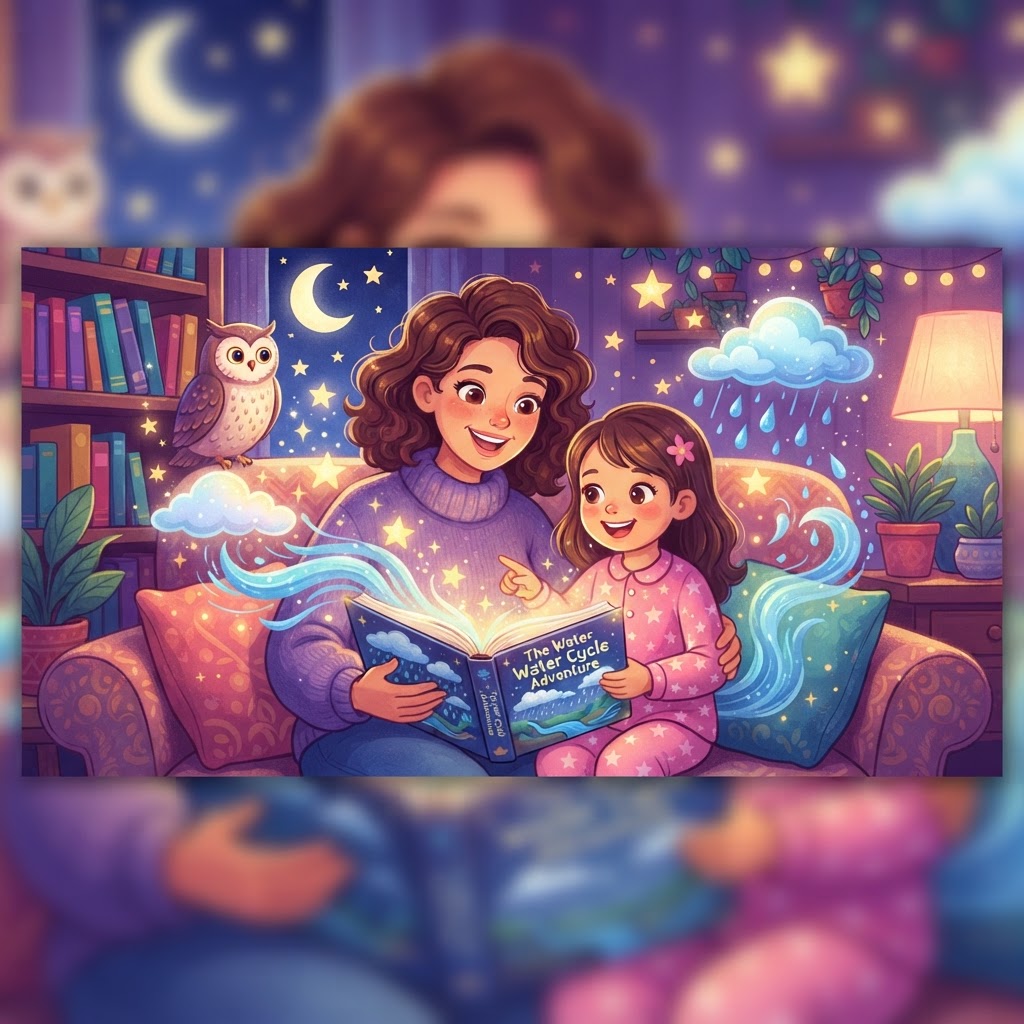
Science sticks better when children can see it, feel it, and imagine it. That is why the water cycle stories can be such a powerful way to teach big ideas to young minds. Instead of memorizing unfamiliar words, children follow a raindrop, a cloud, or a puddle through a journey that feels alive. For families raising curious kids, the water cycle becomes less like a diagram and more like an adventure they can retell at bedtime.
If your child already loves nature themes, story-based science also pairs beautifully with other topics, like ocean science stories or volcano adventures for young explorers. The goal is simple: connect wonder with real knowledge.
Why do the water cycle stories help curious kids learn science?
Stories help children remember science because they give facts a sequence, characters, and emotion. For young learners, that makes abstract processes like evaporation and condensation much easier to understand.
Early childhood research consistently shows that children learn best through meaningful language, repetition, and responsive conversation. The Harvard Center on the Developing Child explains that back-and-forth talk supports learning and memory, which is one reason shared story time works so well for science-rich topics (Harvard Center on the Developing Child). Organizations like NAEYC also emphasize hands-on, language-rich experiences in early science learning.
When you read the water cycle for kids as a story, children can:
- Follow a clear beginning, middle, and end
- Hear new vocabulary in context
- Revisit the same concepts through repetition
- Ask questions without feeling tested
- Build both literacy and science knowledge at once
That is what makes curious kids the water cycle topic such a strong fit for bedtime learning. A child may forget a definition, but they often remember that “Sunny the raindrop floated up when the sun warmed the pond.”
What is the water cycle for kids in simple words?
The water cycle is the way water moves around Earth again and again. Water warms up, rises into the air, forms clouds, falls as rain or snow, and gathers back in rivers, lakes, oceans, and soil.
A simple child-friendly version sounds like this:
- The sun warms water in puddles, lakes, and oceans.
- Some of that water turns into vapor and goes up. This is evaporation.
- High in the sky, the vapor cools and forms tiny drops in clouds. This is condensation.
- When the drops get heavy, they fall as rain, snow, sleet, or hail. This is precipitation.
- Water collects in the ground, streams, lakes, and oceans. Then the cycle starts again.
The U.S. Geological Survey offers a clear explanation of these stages and reminds us that Earth’s water is always moving through this system (USGS Water Science School). For children, the key idea is not just “water goes up and down,” but that the same water can travel through many places over time.
Which real facts should appear in the water cycle stories?
Good the water cycle stories mix imagination with accurate science. The fun comes from talking puddles and adventurous clouds, but the learning comes from facts that stay true to how water really moves.
Here are five strong facts to include in the water cycle adventures children enjoy most:
- The sun powers the cycle. Without heat from the sun, evaporation would not happen.
- Water can be liquid, gas, or solid. A child can meet rain, vapor, snow, and ice in one story.
- Clouds are made of tiny water droplets or ice crystals. They are not made of cotton or smoke.
- Precipitation is more than rain. Snow, sleet, and hail are all part of the water cycle.
- Water travels through land too. It can soak into soil, move underground, and flow into rivers and oceans.
For a classroom-friendly science explanation, National Geographic Education has a helpful resource on how water changes form and moves through Earth’s systems (National Geographic Education).
A quick rule for adults: if the story gives water a personality, keep the science underneath it real. A cloud can feel shy, but it still needs cooling air and condensed droplets to form.
What are five the water cycle stories children will want to hear?
Children love the water cycle when it feels personal, playful, and easy to picture. These five story ideas combine imagination with real science so you can turn facts into memorable bedtime adventures.
1. How does a puddle become a cloud?
A small puddle named Pippa sits on a warm sidewalk after the rain. As the sun shines, she feels lighter and lighter until she turns into invisible vapor and rises into the sky. Up high, the air grows cooler, and Pippa joins other tiny droplets to help make a fluffy cloud.
Real science fact: Heat from the sun causes evaporation, and cooler air helps water vapor condense into cloud droplets.
2. Why does a cloud finally let go of rain?
A cloud called Coco loves collecting tiny droplets from lakes, rivers, and ponds. At first Coco floats easily, but soon the droplets become too heavy to hold. They fall to Earth as rain, watering gardens, forests, and fields below.
Real science fact: Precipitation happens when water droplets in clouds grow large and heavy enough to fall.
3. What happens to rain after it lands?
Rory the raindrop lands on a hill during a spring shower. Part of the rain runs downhill into a stream, part sinks into the soil, and part is slurped up by a tree root. By the end, Rory learns that water can travel over land, underground, and through living things.
Real science fact: Rain can become runoff, soak into the ground, or support plants and animals.
4. Can snow be part of the water cycle too?
On a cold mountain, Nina forms as a snowflake inside a winter cloud. She drifts down onto a snowy peak and rests there until warmer weather arrives. When the spring sun returns, Nina melts and joins a rushing stream on her way to a river.
Real science fact: Water in the cycle may fall as snow or ice, then melt later and continue moving.
5. Where does ocean water go next?
Ollie the ocean drop bobs in salty waves and watches the sun warm the sea. He evaporates, leaves the salt behind, and becomes part of a cloud that travels inland. Later, he falls as rain over a farm and eventually finds his way back to the ocean.
Real science fact: When ocean water evaporates, the salt stays behind, which is why rain is fresh water.
These story seeds work especially well if your child likes patterns, repetition, and “what happens next?” thinking. You can also revisit the same journey with different settings, like a jungle, a city, or a snowy mountain.
How can parents and teachers prompt InstaTales for science-rich stories?
The best prompts are specific, age-matched, and fact-aware. If you want stronger results, tell the story generator exactly which science ideas must appear and how simple the language should be.
When you create your own personalized bedtime story, include these elements:
- Your child’s age
- A main character, such as a raindrop, cloud, puddle, or snowflake
- The exact science facts to include
- The reading tone: cozy, funny, adventurous, calming
- A short length target
- Repetition or key phrases for younger children
- 1-2 reflection questions at the end
Prompt formula
Try this structure:
- “Write a bedtime story for a 5-year-old about a raindrop named Rio.”
- “Explain evaporation, condensation, precipitation, and collection in simple words.”
- “Use gentle, playful language and repeat the phrase ‘round and round the water goes.’”
- “Include only accurate science.”
- “End with two questions a parent can ask after reading.”
If you want a faster start, browse the story templates and then customize the science details. Afterward, save favorites in your story library so children can revisit the same concept over time. Re-reading is especially useful for science because repeated exposure helps vocabulary and understanding grow.
Teachers can also adapt these prompts for centers, read-alouds, or take-home literacy activities. A story that teaches the water cycle for kids can become a writing prompt, drawing activity, or sequencing exercise the next day.
How can you help children remember the water cycle after story time?
Children remember science better when the story leads to talk, play, and simple review. The goal is not a quiz. It is helping the child retell the journey in their own words.
After reading the water cycle stories, try one of these easy follow-ups:
- Ask, “Where did the water go first?”
- Invite your child to draw the raindrop’s path
- Act out rising like vapor and falling like rain
- Use a bowl of water and a sunny window to talk about evaporation
- Compare rain, snow, and clouds in family conversation
For younger children, keep it concrete:
- “The sun warmed the water.”
- “The water went up.”
- “The cloud got full.”
- “The rain came down.”
For older children, add richer vocabulary:
- evaporation
- condensation
- precipitation
- runoff
- groundwater
This is also a wonderful place to connect topics across your child’s broader science interests. A child who understands water moving through oceans, storms, and land often becomes more interested in weather, habitats, and Earth science as a whole.
Frequently Asked Questions
What is the best age to teach the water cycle through stories?
Children as young as 3 or 4 can understand the basic idea that water goes up, forms clouds, and comes back down. Older children, around 6 to 10, are usually ready for words like evaporation and condensation.
How do I explain evaporation to a preschooler?
Say that the sun warms water and turns some of it into an invisible gas that floats up into the air. Using a puddle or wet towel as an example makes it easier to understand.
Are the water cycle stories better than facts alone?
For many children, yes. Stories help facts feel meaningful, and meaningful information is easier to remember and retell.
How long should a science bedtime story be?
For toddlers and preschoolers, 3 to 5 minutes is often enough. For early elementary children, 5 to 10 minutes usually works well, especially if you leave time for questions.
Can I use water cycle stories in the classroom?
Absolutely. They work well for read-alouds, sequencing practice, vocabulary lessons, and simple science discussions. They are especially helpful when paired with drawing or hands-on observation.
What should I include in an AI prompt for a water cycle story?
Include your child’s age, a main character, the specific science facts you want covered, and the tone of the story. Asking for accurate vocabulary and an end-of-story recap usually improves the result.
Get a new bedtime story every week
Free, personalized, and delivered to your inbox. No spam, ever.
Ready to Create a Personalized Bedtime Story?
Use our free AI bedtime story generator to create a personalized illustrated story for your child in 30 seconds — no credit card needed.
Popular story types:
Maya Rodriguez
Lead Content Editor & Early Literacy Specialist
Maya is a former early childhood educator and literacy specialist with over a decade of experience helping children develop a love of reading. She leads content at InstaTales, where she writes about the science of storytelling, child development, and how families can use personalized AI stories to build literacy and emotional resilience.
instatales.ai