Mayan Stories for Kids: Gentle Myths & Magic
Exciting Mayan stories for kids — gods, heroes, monsters, and adventures from Mayan mythology, retold for young readers.
✦ Key Takeaways
- •Mayan stories for kids are child-friendly retellings of Maya myths, legends, and folklore from ancient and living Maya cultures.
- •The best characters to introduce first are the Hero Twins, the maize-centered creators, rain gods, moon figures, and symbolic animals like jaguars and birds.
- •Mayan tales stay with children because they combine nature, identity, and adventure in ways young minds easily understand.
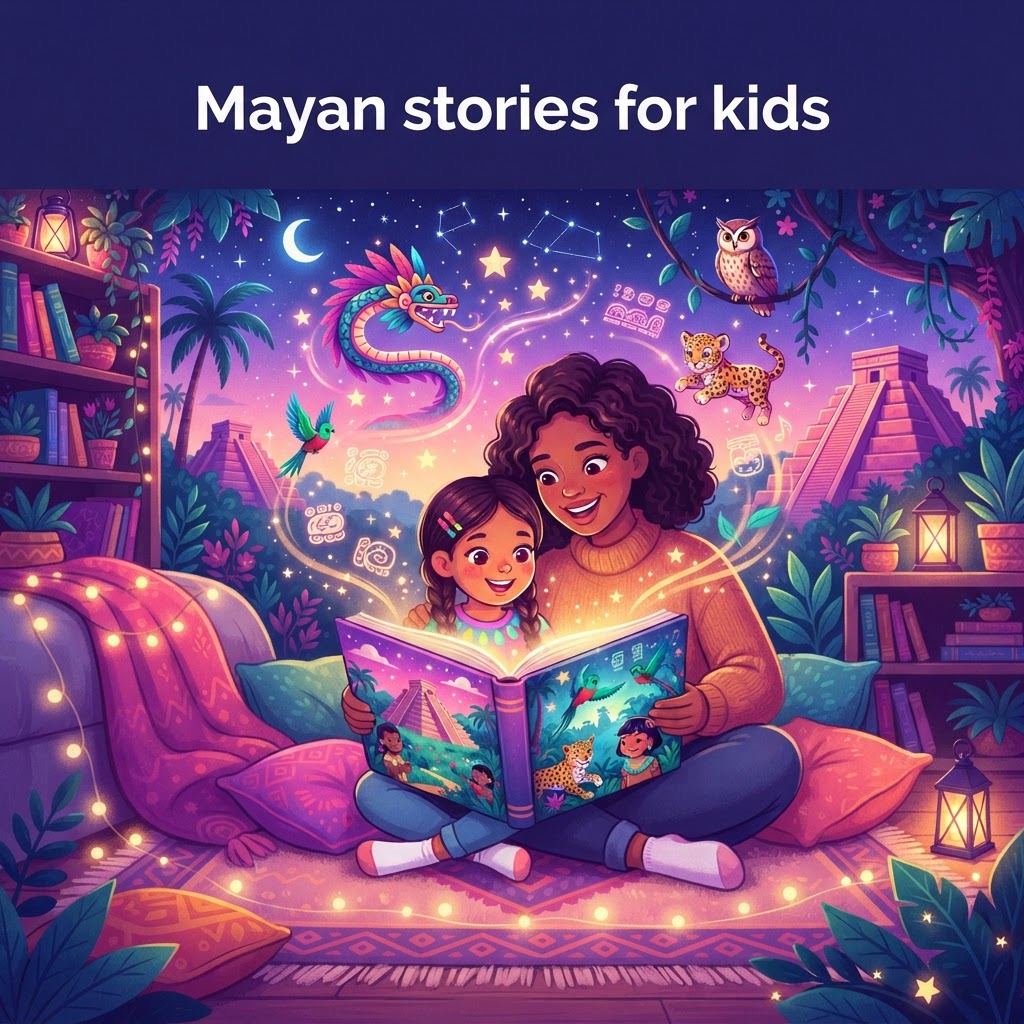
If you are looking for Mayan stories for kids, start with wonder, not fear. The best retellings keep the rich world of Maya mythology—corn gods, clever heroes, rain bringers, jaguars, stars, and the moon—while making the stories calm enough for bedtime and clear enough for ages 5-8.
These tales can be a beautiful entry point into Indigenous storytelling from Mesoamerica. They also work well for shared reading, which the American Academy of Pediatrics links to stronger language and bonding, and for back-and-forth conversation, which the Harvard Center on the Developing Child describes as essential for learning through “serve and return” interactions. When families read kids Mayan stories together, children get both imagination and connection.
What are Mayan stories for kids?
Mayan stories for kids are child-friendly retellings of Maya myths, legends, and folklore from ancient and living Maya cultures. They usually focus on adventure, creation, nature, and clever problem-solving rather than frightening or violent details.
A quick note on language: scholars often use Maya for the people and culture, while Mayan is more common for languages. Because many parents search for “Mayan mythology children” or “Mayan tales,” you will see both forms online.
Many well-known stories come from the Popol Vuh, a sacred K’iche’ Maya text. For a family-friendly background on the Maya world, the Penn Museum’s Maya overview is a helpful starting point.
What makes these stories so appealing to children?
- Clear heroes and villains
- Strong links to animals, weather, and the sky
- Repetition and patterns children can remember
- Big emotions like bravery, curiosity, jealousy, and kindness
- Magical settings that still feel rooted in nature
If your child enjoys world mythology, you might also like these Native American stories for kids, which can open respectful conversations about different Indigenous traditions.
Which Mayan gods, heroes, and creatures should children know?
The best characters to introduce first are the Hero Twins, the maize-centered creators, rain gods, moon figures, and symbolic animals like jaguars and birds. These figures give children a strong feel for Mayan mythology without overwhelming them.
Here are the key names and ideas to know:
-
The Hero Twins, Hunahpu and Xbalanque
These are the stars of many child-friendly Maya adventures. They are clever, brave, and good at outsmarting boastful or dangerous beings. -
Heart of Sky and the makers of the world
In creation stories, divine beings shape the earth, animals, and eventually human beings. These stories are ideal for children because they focus on making, learning, and trying again. -
Maize or corn figures
Corn is central in Maya belief and daily life. Many Mayan tales for children work well when they explain that people are connected to the earth and to the food that helps communities live. -
Chaac, the rain god
Chaac is often linked to storms, rain, and crops. For kids, Chaac stories can become gentle tales about dry fields, thunder, and long-awaited rain. -
Itzamna and Ix Chel
These are often associated with wisdom, healing, the sky, the moon, and knowledge. In children’s versions, they can appear as guides, protectors, or teachers. -
Seven Macaw and other proud creatures
Boastful birds, jaguars, monkeys, and underworld beings give Maya stories drama. For younger readers, keep them more mischievous than terrifying.
What themes make Mayan tales so memorable for children?
Mayan tales stay with children because they combine nature, identity, and adventure in ways young minds easily understand. They answer big questions—Where did people come from? Why does rain matter? Why are the sun and moon important?—through vivid storytelling.
The strongest themes to highlight are:
-
Creation and belonging
Children love origin stories. Maya creation stories help them think about how people belong to the earth, food, family, and community. -
Cleverness over strength
In many Mayan mythology children retellings, the hero wins by thinking, noticing, and working together. -
Respect for nature
Forests, caves, rivers, animals, stars, and crops are never “just background.” They matter. That can support early ecological awareness. -
Cycles and change
Rain follows drought. Day follows night. Seeds become food. These repeating patterns feel reassuring to children. -
Family and cooperation
Stories are often best when shared aloud, and research supports that. The Harvard Center on the Developing Child explains that conversation-rich shared experiences help build language and understanding.
For parents, this means Mayan stories for kids are not only entertaining. They can also support vocabulary, memory, sequencing, and empathy when adults pause to ask simple questions like, “What do you think will happen next?” or “Why was that character proud?”
Which Mayan stories for kids work best for ages 5-8?
The best Mayan stories for ages 5-8 are short, visual, and emotionally clear. Choose tales with one main problem, a brave or clever helper, and an ending that feels safe and satisfying.
Here are 7 age-appropriate story ideas:
-
The Hero Twins and the Boastful Bird
A gentle retelling of the Twins meeting Seven Macaw, a flashy bird who thinks he is greater than the sun. Children enjoy the humor and the lesson about pride. -
How People Were Made from Corn
A warm creation story about the makers of the world trying different materials until they create humans from maize dough. This is one of the best entry points for kids Mayan stories. -
Chaac Brings the Rain
Villagers wait through a dry season until the rain god hears their songs. This works beautifully as a calming bedtime story about patience and hope. -
The Moon’s Healing Light
A moon-inspired tale featuring a caring goddess figure who helps a child, animal, or village feel safe at night. This is more mythology-inspired than strictly traditional, but it fits the themes well. -
The Jaguar Who Guarded the Forest Path
A respectful, symbolic story about courage and nighttime fears. The jaguar becomes a wise guardian rather than a predator. -
The Corn Seed’s Long Journey
Follow one seed from planting to harvest. This kind of Mayan tale helps children connect myth, food, and gratitude. -
The Twins and the Noisy Underworld Game
Inspired by the Hero Twins’ challenges, but softened into a puzzle-filled contest with trick doors, echoing caves, and teamwork instead of danger.
If your child enjoys myth-inspired bedtime tales from other cultures too, the InstaTales blog has more ideas to explore.
What should adults adapt when retelling Mayan mythology for children?
Adults should keep the symbols and values of Maya stories, but soften violence, fear, and complex sacred material for young listeners. The goal is not to erase meaning. It is to make the story developmentally appropriate.
For ages 5-8, adapt these carefully:
-
Human sacrifice and graphic violence
Replace explicit scenes with contests, disappearances, magical transformations, or symbolic defeats. -
Frightening underworld episodes
Turn them into dark caves, trick houses, or mystery journeys with safe endings. -
Revenge-heavy plots
Shift the lesson toward humility, fairness, or restoring balance. -
Dense genealogy and long cosmology passages
Simplify the cast. Young children do best with one or two central characters. -
“Ancient people only” framing
Avoid speaking about the Maya as if they vanished. Maya communities are living cultures today.
This matters because young children process stories literally. The American Academy of Pediatrics notes that warm, responsive shared reading helps children make sense of content more securely, especially when adults explain new ideas in simple language. Their reading guidance on HealthyChildren.org is a useful reference for families.
A good rule is simple: keep the heart of the myth, but change the parts that may confuse or frighten a young child.
How can you create personalized Mayan-inspired stories with InstaTales?
You can use InstaTales to turn Maya-inspired themes into gentle, custom bedtime stories that match your child’s age, interests, and comfort level. Personalized storytelling is especially helpful when a child loves one topic—like jaguars, stars, or rainstorms—and wants it again and again.
When you create your own personalized bedtime story, try prompts like these:
- “Write a calm bedtime story inspired by Maya mythology for a 6-year-old about two clever siblings, a friendly jaguar, and a moonlit forest.”
- “Tell a gentle story based on the Hero Twins, with no scary scenes, lots of teamwork, and a happy ending.”
- “Create a Mayan tales adventure about Chaac bringing rain to a village garden, with simple language for early readers.”
- “Write a Maya-inspired story about a child discovering that people are connected to corn, stars, and family.”
To get the best result, include:
- Your child’s age
- Preferred tone: calm, funny, adventurous, sleepy
- Favorite themes: animals, weather, moon, jungle, friendship
- Boundaries: no monsters, no battles, no sadness
- Reading level: read-aloud or independent reading
You can also start faster with story templates, save favorites in your story library, or use InstaTales for teachers if you want mythology-themed literacy activities in a classroom.
Frequently Asked Questions
Are Mayan stories too scary for young children?
Not when they are retold thoughtfully. Choose versions that keep the magic, nature, and clever problem-solving while removing graphic or intense scenes.
What is the Popol Vuh?
The Popol Vuh is a foundational K’iche’ Maya text that includes creation stories and the adventures of the Hero Twins. Many popular Mayan stories for kids are adapted from it in simplified form.
Which Mayan story is best to start with?
A creation story about people being made from corn is usually the easiest starting point. It is imaginative, meaningful, and not as intense as some hero tales.
How can I make Mayan mythology respectful for children?
Use accurate cultural context, avoid stereotypes, and remember that Maya communities are living cultures today. It also helps to say when a story is “inspired by” Maya themes rather than a direct traditional retelling.
Can teachers use kids Mayan stories in class?
Yes, especially in units on world cultures, mythology, agriculture, astronomy, or storytelling. Short retellings work well for reading comprehension, compare-and-contrast activities, and creative writing.
Ready to Create a Personalized Bedtime Story?
Use our free AI bedtime story generator to create a personalized illustrated story for your child in 30 seconds — no credit card needed.
Popular story types:
Maya Rodriguez
Lead Content Editor & Early Literacy Specialist
Maya is a former early childhood educator and literacy specialist with over a decade of experience helping children develop a love of reading. She leads content at InstaTales, where she writes about the science of storytelling, child development, and how families can use personalized AI stories to build literacy and emotional resilience.
instatales.ai