Morning vs Bedtime Stories: Best Time to Read?
Does the time of day affect how much kids learn from stories? We look at the research on morning vs bedtime reading.
✦ Key Takeaways
- •Yes, the time of day can affect how much children attend to, remember, and engage with stories.
- •Circadian rhythms affect reading by shaping when children feel most alert, calm, or tired.
- •Often, yes—morning stories are usually better for focus, discussion, and learning new material.
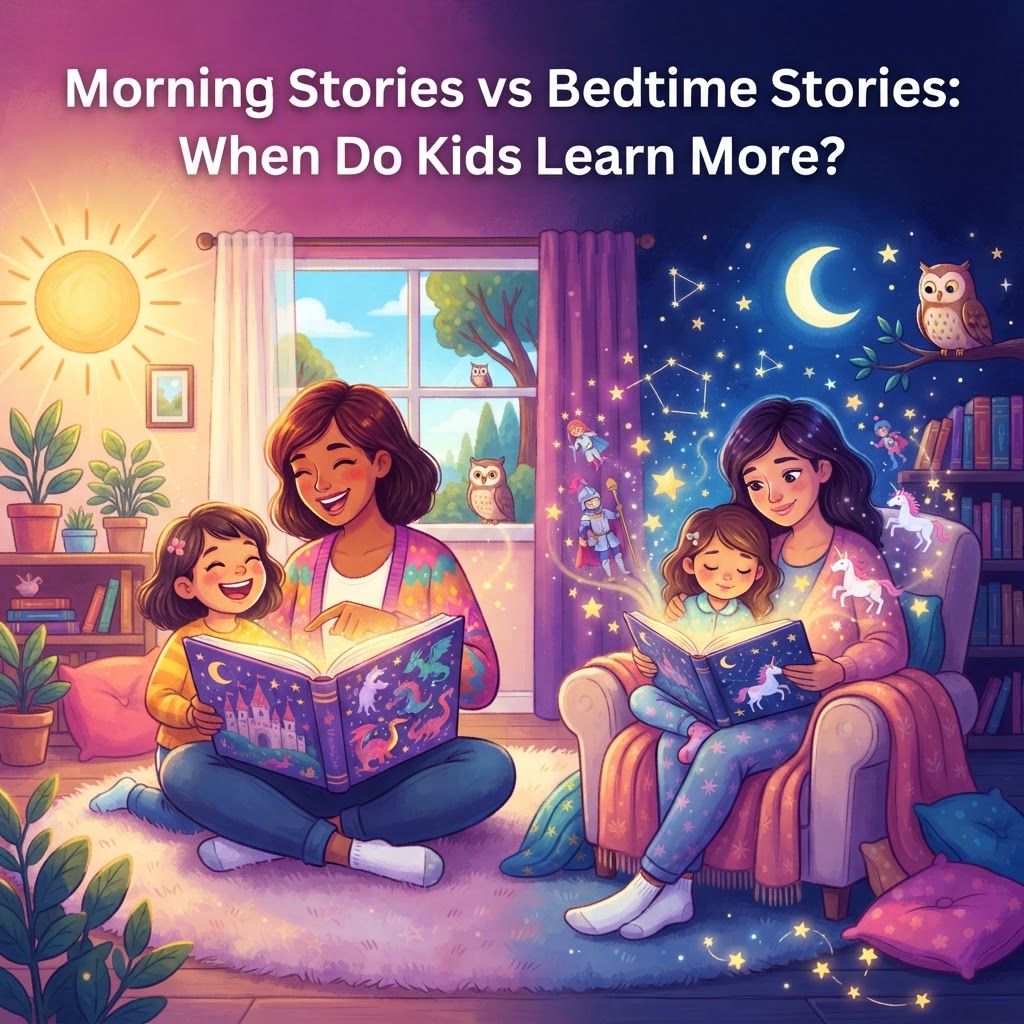
Parents often ask whether morning vs bedtime stories make a real difference in learning. The short answer is yes—but not in a simple “one time is always better” way. Research on circadian rhythm, attention, sleep, and language development suggests that the best time to read to kids depends on what kind of learning you want to support: alert thinking, memory, emotional connection, or a calming routine.
If your goal is to improve reading time and learning, it helps to match story time to your child’s energy level. Morning reading can boost focus and conversation, while bedtime reading can support bonding and memory consolidation after a calm, predictable routine. For many families, the winning approach is not choosing one over the other—it is using each time of day on purpose.
Does the time of day really change how children learn from stories?
Yes, the time of day can affect how much children attend to, remember, and engage with stories. That happens because learning is shaped by alertness, mood, and biological rhythms, not just by the book itself.
Children do not learn in a vacuum. Their brains are influenced by sleep pressure, hunger, stress, and circadian timing. The body’s internal clock, explained by the National Institute of General Medical Sciences, helps regulate when we feel most awake and ready to focus.
That means a child may be more ready to answer questions and notice new vocabulary at one time of day, and more open to soothing, repetitive stories at another. In practical terms:
- Morning stories often support attention and active participation
- Bedtime stories often support routine, comfort, and quieter language learning
- Consistency matters as much as timing for long-term literacy growth
So when parents compare morning vs bedtime stories, the research-based answer is: both can help, but they help in different ways.
How do circadian rhythms affect attention during reading time?
Circadian rhythms affect reading by shaping when children feel most alert, calm, or tired. In general, kids learn best when story time matches their natural energy pattern.
Young children are often more mentally fresh earlier in the day, especially after enough sleep. Attention, impulse control, and listening tend to be stronger when a child is not fighting fatigue. That matters because story-based learning is not only about hearing words—it also depends on looking at pictures, answering questions, predicting what comes next, and making connections.
Research on sleep and learning consistently shows that tired brains struggle with attention and new information. The CDC’s sleep guidelines for children also remind us that sleep needs are high in early childhood, and too little sleep can affect learning and behavior.
Parents can use this insight in simple ways:
- Read new or more challenging books when your child is most alert
- Save familiar, soothing books for times when energy is lower
- Watch your own child’s signals rather than relying only on the clock
If your child is sharp and chatty after breakfast, that may be the best time to read to kids for vocabulary and comprehension. If they are grumpy and foggy in the morning, another window may work better.
Are morning stories better for focus and active learning?
Often, yes—morning stories are usually better for focus, discussion, and learning new material. That is especially true if a child is well-rested and not rushed.
Morning reading can be a great fit for interactive learning. Children may be more likely to point at pictures, ask questions, repeat new words, and talk about the story. This kind of back-and-forth conversation is one of the strongest ways to build language.
Morning story sessions work especially well for:
- New vocabulary
- Prediction and comprehension questions
- Nonfiction or concept books
- School-readiness skills, like sequencing and retelling
For preschoolers and early elementary children, a short story before school or during a calm mid-morning break can act like a warm-up for the brain. Teachers often use this principle during circle time, and families can adapt it at home too. If you want to vary story formats, our guide to storytelling apps vs AI story generators can help you choose tools that support learning rather than distraction.
Morning stories are especially useful when you want your child to do more than listen. If the goal is conversation, recall, or practicing early literacy skills, morning often has the edge.
Do bedtime stories help memory and emotional connection?
Yes, bedtime stories are excellent for emotional security, language exposure, and memory support after sleep. While tired children may not discuss a story as deeply, bedtime reading still offers powerful learning benefits.
One reason is that sleep helps the brain process and store information. The NIH has highlighted how sleep supports overall brain function, including learning and memory. A story heard before sleep may benefit from this overnight consolidation—especially if the child is calm, connected, and not overstimulated.
Bedtime reading also supports learning in a different way: through repetition. Re-reading familiar stories builds vocabulary, narrative understanding, and confidence. It can also lower stress, which helps children stay open to language and connection.
Bedtime stories are often best for:
- Bonding and attachment
- Repetition of favorite books
- Calming transitions to sleep
- Gentle language exposure, even for very young children
The style of story matters here. Silly, high-energy books can be fun, but many families do better with calmer choices at night. If that sounds familiar, you may enjoy our article on funny versus calming bedtime stories.
So, in the debate about morning vs bedtime stories, bedtime does not lose on learning. It simply supports a different kind of learning—one tied to routine, emotion, and rest.
What is the best time to read to kids at different ages?
The best reading time changes with age, temperament, and schedule. Babies, toddlers, preschoolers, and school-age children all respond differently to story time.
Babies and toddlers
For babies and toddlers, consistency matters more than clock time. Short reading moments after naps, in the morning, and before bed all work well. Bedtime stories are often effective because they become part of a comforting routine.
Preschoolers
Preschoolers often do well with two kinds of reading: an alert-time story for learning and a bedtime story for winding down. This age group can handle more questions, richer vocabulary, and more imaginative play around stories.
Early elementary children
School-age kids may benefit from morning or after-school reading when they can discuss plot, characters, and facts. Bedtime reading still matters, especially for independent readers who enjoy shared reading as connection time.
The type of book matters too. If your child is moving from simple picture books to longer narratives, this guide on when to switch from picture books to chapter books can help.
How can parents build a reading routine that supports learning?
The best reading routine is one your family can keep, and one that matches story choice to your child’s energy. In other words, optimize the routine before you obsess over the perfect time.
A practical approach is to think in terms of purpose:
- Read in the morning for discussion, curiosity, and new ideas
- Read at bedtime for comfort, repetition, and connection
- Keep sessions short enough that your child stays engaged
- Re-read favorites without guilt—repetition is real learning
- Choose stories that fit your child’s current developmental stage
If you want more flexibility, personalized stories can help you match the mood and goal of the moment. You can create your own personalized bedtime story for a calm nighttime routine, then save favorites in your story library for easy re-reading later. Some families also like using weekly reading challenges to make daytime reading more consistent.
The biggest takeaway from reading time and learning research is simple: the best time to read is when your child is emotionally available and your routine is sustainable. A perfect plan you cannot keep is less useful than a good-enough routine you repeat every day.
What should parents remember when comparing morning and bedtime stories?
Parents should remember that there is no single universal winner in the morning vs bedtime stories debate. Morning often supports stronger attention and active learning, while bedtime supports bonding, repetition, and sleep-linked memory benefits.
If your schedule allows, use both. A short morning story can spark language and thinking, and a bedtime story can close the day with comfort and connection. That combination gives children the widest range of literacy benefits.
For most families, the question is not “Which time is best forever?” It is “What does my child need from stories right now?” When you answer that, the right reading routine becomes much easier to build.
Frequently Asked Questions
Are morning stories better than bedtime stories for learning?
Morning stories are often better for focus, conversation, and learning new concepts because children may be more alert. Bedtime stories are still valuable because they support bonding, repetition, and memory after sleep.
What is the best time to read to kids?
The best time to read to kids is when they are calm, receptive, and not overly tired or rushed. For many families, that means one interactive reading time earlier in the day and one soothing story before bed.
Do bedtime stories help children remember more?
Bedtime stories can help memory because sleep supports learning and consolidation. They are especially effective when the child is relaxed and the story is not too stimulating.
Should I read different types of books in the morning and at night?
Yes, that often works well. Try more interactive, information-rich, or discussion-based books in the morning, and calmer, familiar, or repetitive stories at bedtime.
Is it okay if we only read at bedtime?
Absolutely. A consistent bedtime story routine still offers strong language, emotional, and literacy benefits. If bedtime is the only realistic reading time, it is still a wonderful habit to keep.
Can personalized AI stories fit into a healthy reading routine?
Yes, as long as they are age-appropriate, calm enough for the moment, and shared with adult involvement. Personalized stories can be especially helpful when you want to match a story to your child’s mood, interests, or developmental needs.
Ready to Create a Personalized Bedtime Story?
Use our free AI bedtime story generator to create a personalized illustrated story for your child in 30 seconds — no credit card needed.
Popular story types:
Maya Rodriguez
Lead Content Editor & Early Literacy Specialist
Maya is a former early childhood educator and literacy specialist with over a decade of experience helping children develop a love of reading. She leads content at InstaTales, where she writes about the science of storytelling, child development, and how families can use personalized AI stories to build literacy and emotional resilience.
instatales.ai