Reading to Children vs Independent Reading: Why Both Matter
Should you read to your child or have them read themselves? Research says both are essential. Here's why and how to balance them.
✦ Key Takeaways
- •It is better to do both, because each supports different reading skills.
- •Shared reading research consistently shows that reading aloud supports vocabulary, comprehension, and emotional bonding.
- •Independent reading matters because it turns emerging skills into automatic ones.
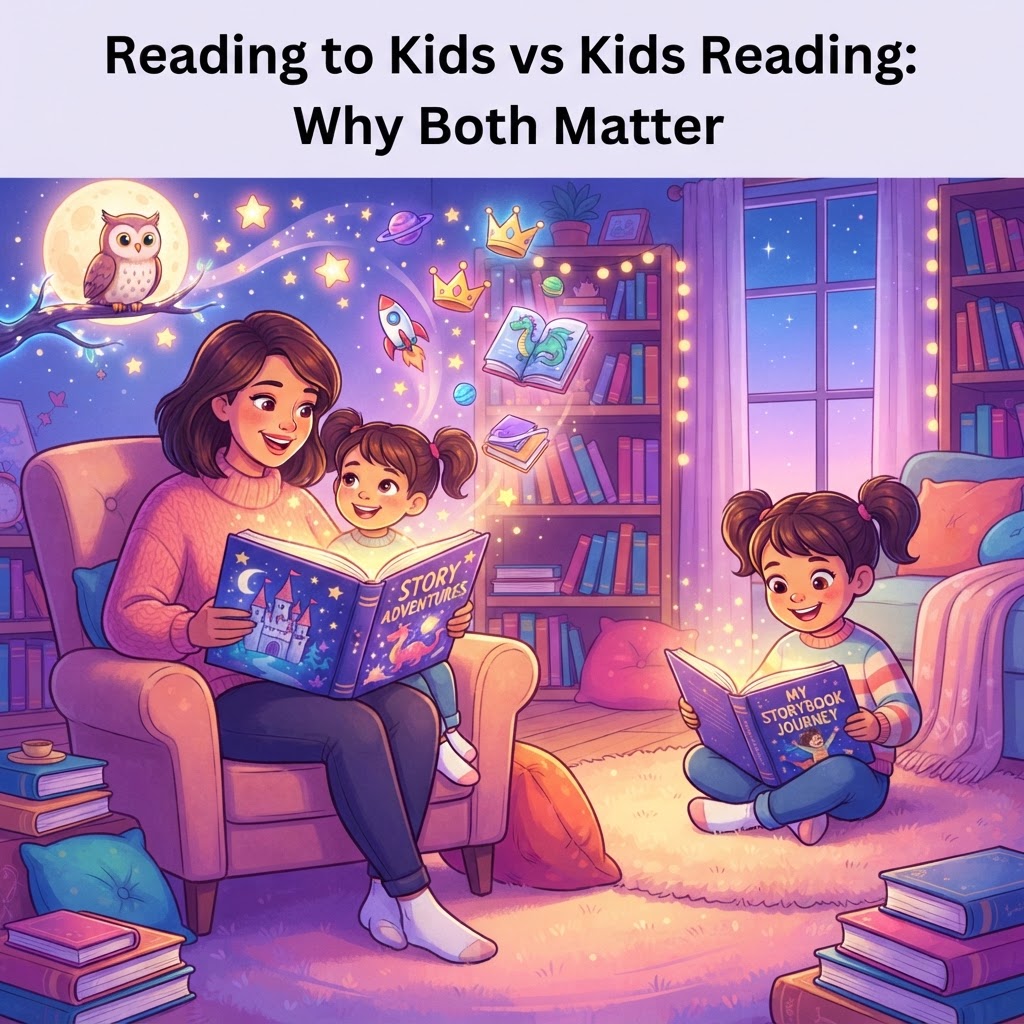
When parents ask about reading to children vs independent reading, the most accurate answer is simple: children need both. Read aloud vs self reading is not a competition. These two experiences build different parts of literacy, and together they help children become stronger, more joyful readers.
Reading aloud gives children language, background knowledge, and emotional connection. Independent reading builds fluency, stamina, confidence, and ownership. The best home reading routine does not choose one over the other. It uses both on purpose.
Is it better to read to children or have them read on their own?
It is better to do both, because each supports different reading skills. Reading aloud helps children understand richer language than they can yet read alone, while independent reading helps them practice the skills they are learning.
Think of it this way:
- Read-aloud builds the mind for reading
- Independent reading builds the habit and mechanics of reading
This is why literacy experts rarely frame the question as either-or. In fact, the American Academy of Pediatrics recommends reading together from infancy because it supports language, relationships, and later school success.
Even after a child can decode words, reading aloud still matters. Children often understand stories at a much higher level when they hear them than when they read them alone. That means a seven-year-old may be able to discuss a complex story during shared reading, even if their independent reading level is still much lower.
What does shared reading research show about reading aloud?
Shared reading research consistently shows that reading aloud supports vocabulary, comprehension, and emotional bonding. It is one of the most powerful and practical things adults can do to support early literacy.
Researchers have known this for decades. Studies by Grover Whitehurst on dialogic reading found that children learn more when adults make read-aloud interactive by asking questions, pausing, and talking about the story. A meta-analysis by Mol and Bus also found that shared book reading has a meaningful positive effect on children’s language growth, especially in the early years.
Read-aloud helps because it gives children access to language beyond their current reading level. When you read to a child, they hear:
- More complex vocabulary
- Longer, richer sentences
- Story structure and cause-and-effect
- New ideas about people, places, and feelings
It also creates what child development experts call serve-and-return interaction. When a child points, asks a question, or laughs, and the adult responds, the brain is building language and connection at the same time. The Harvard Center on the Developing Child highlights how these back-and-forth interactions support healthy development.
Just as important, reading aloud builds motivation. A child who feels safe, close, and interested during story time is more likely to see reading as something enjoyable rather than something they “have to do.”
If you are wondering whether digital stories can play a role here, they can. The key is interaction. A personalized story read together can work well, especially when the adult pauses to talk, predict, and connect the story to the child’s life. For more on this, our article on how personalized stories can boost engagement offers a helpful research-based overview.
Why does independent reading matter once children know the basics?
Independent reading matters because it turns emerging skills into automatic ones. Children become stronger readers by actually reading, not only by being read to.
Once children can decode with reasonable accuracy, self reading gives them vital practice in:
- Fluency: reading smoothly and with expression
- Stamina: staying with a text for longer periods
- Confidence: seeing “I can do this myself”
- Autonomy: choosing books and developing taste
- Knowledge growth: learning from wider reading
This is where read aloud vs self reading becomes a false choice. Read-aloud builds understanding, but independent reading gives children the repetitions they need to become efficient readers. Keith Stanovich’s well-known “Matthew effect” theory explains that children who read more tend to gain vocabulary and knowledge faster, which then makes future reading easier.
That said, independent reading works best when the text is a good match. If a book is too hard, children may guess, tire out, or avoid reading altogether. The Institute of Education Sciences emphasizes the importance of explicit foundational reading support; independent reading should reinforce skills, not replace instruction.
A good rule of thumb: self reading should feel like practice, not constant struggle.
How can parents balance read aloud vs self reading at different ages?
The right balance changes with age, but read-aloud should continue longer than many parents expect. Most children benefit from being read to well into the elementary years, even as independent reading grows.
Here is a simple age-by-age guide:
Ages 1-3: mostly read-aloud
At this stage, nearly all reading is shared. Focus on short books, repetition, naming pictures, and letting your child turn pages or finish familiar lines.
Try to:
- Read daily, even for 5-10 minutes
- Reread favorites often
- Talk about pictures, sounds, and feelings
Ages 4-6: shared reading plus early practice
Children begin joining in. They may recognize letters, memorize phrases, or read simple patterned text.
Try to:
- Keep daily read-aloud
- Let your child “read” parts they know
- Use echo reading or choral reading
- Offer short, decodable, or predictable books for self reading
Ages 6-8: a true mix of both
This is often the sweet spot for balancing reading to children vs independent reading. Children still need rich read-aloud for comprehension, but they also need daily time to read alone at their own level.
Try to:
- Read aloud a harder, interesting book
- Set 10-20 minutes for independent reading
- Let your child reread familiar books to build fluency
- Talk briefly after both kinds of reading
Ages 8-10: keep read-aloud, grow independence
Older children may read more on their own, but read-aloud still matters. It exposes them to advanced vocabulary, complex plots, and family discussion that their solo reading may not yet provide.
Try to:
- Alternate who reads pages or chapters
- Keep one family read-aloud going
- Encourage independent reading choice
- Discuss characters, themes, and opinions
One more important point: independent reading does not always have to be silent. Reading aloud to a parent, buddy, or teacher can support fluency too. In classrooms, InstaTales for teachers can be used for low-pressure reading practice, retelling, and response activities.
How can AI stories support both shared reading and independent reading?
AI stories can support both, especially when they are personalized, flexible, and used with intention. They work best as a tool that helps adults create the right kind of reading experience for the child in front of them.
For read-aloud, AI stories help when adults want a story that matches a child’s interests right now. A child who loves trains, dragons, or soccer may be more engaged when the story feels made for them. That engagement makes shared reading more interactive and enjoyable.
For independent reading, AI stories can help by generating texts at the right length, tone, or difficulty. Familiar themes can lower resistance and boost confidence, which is especially helpful for reluctant readers.
Here are practical ways AI stories can help both kinds of reading:
- Create a personalized story around your child’s current interest
- Generate shorter stories for early independent readers
- Reuse favorite characters to encourage rereading
- Adjust topics to support social-emotional learning
- Save favorite texts in your story library for easy rereads
At home, you can create your own personalized bedtime story and use it in two ways: first as a warm shared read-aloud, then later as a familiar text for your child to read independently. That rereading is not a shortcut. It is excellent reading practice.
AI tools should still be balanced with print books, library visits, and human conversation. If you want ideas for blending formats well, this guide on how AI stories and library books can work together is a useful next read. And if you are comparing formats, our piece on AI stories compared with audiobooks explains why listening and reading each offer different benefits.
What does a healthy home reading routine actually look like?
A healthy reading routine includes both shared reading and independent reading in small, doable ways. It does not need to be long, expensive, or perfect to be effective.
A simple routine might look like this:
- 10 minutes read-aloud together
- 10-15 minutes independent reading
- 2 minutes of conversation after
- Regular rereading of favorites
You can also vary the purpose:
- Read aloud at bedtime for connection
- Use self reading after school for practice
- Save special interest stories for weekends
- Revisit favorite stories across the week
The biggest goal is consistency. Children make more progress with short daily reading than with occasional long sessions.
Frequently Asked Questions
Should I stop reading aloud once my child can read?
No. Children often understand more complex language through listening than through solo reading, so read-aloud still supports growth after decoding begins. Many children benefit from being read to through the elementary years.
How much independent reading should kids do each day?
It depends on age and reading stage, but 10-20 minutes is a strong starting point for many early elementary children. The text should be manageable enough that reading feels productive, not frustrating.
Does listening to a story count as reading?
Listening builds vocabulary, comprehension, and love of stories, so it absolutely has value. But it does not replace the decoding and fluency practice that comes from a child reading text independently.
Are AI-generated stories good for reluctant readers?
They can be, especially when the story matches a child’s interests and reading level. Personal relevance often increases attention, willingness, and rereading, which are all helpful for literacy growth.
What if my child only wants to reread the same story?
That is usually a good sign, not a bad one. Rereading builds fluency, confidence, comprehension, and memory for language patterns, especially in younger readers.
What matters most in reading to children vs independent reading?
The most important thing is balance. Shared reading builds language and connection, while independent reading builds skill and confidence, and children thrive when they get both.
Ready to Create a Personalized Bedtime Story?
Use our free AI bedtime story generator to create a personalized illustrated story for your child in 30 seconds — no credit card needed.
Popular story types:
Maya Rodriguez
Lead Content Editor & Early Literacy Specialist
Maya is a former early childhood educator and literacy specialist with over a decade of experience helping children develop a love of reading. She leads content at InstaTales, where she writes about the science of storytelling, child development, and how families can use personalized AI stories to build literacy and emotional resilience.
instatales.ai