Solo vs Paired Reading: What Works Best?
Should kids read alone or with a parent? Research shows both build reading skills differently. Here's how to balance them.
✦ Key Takeaways
- •Neither is “better” in every situation.
- •Solo reading is especially powerful for fluency, independence, and confidence.
- •Paired reading is especially strong for comprehension, vocabulary, and emotional connection.
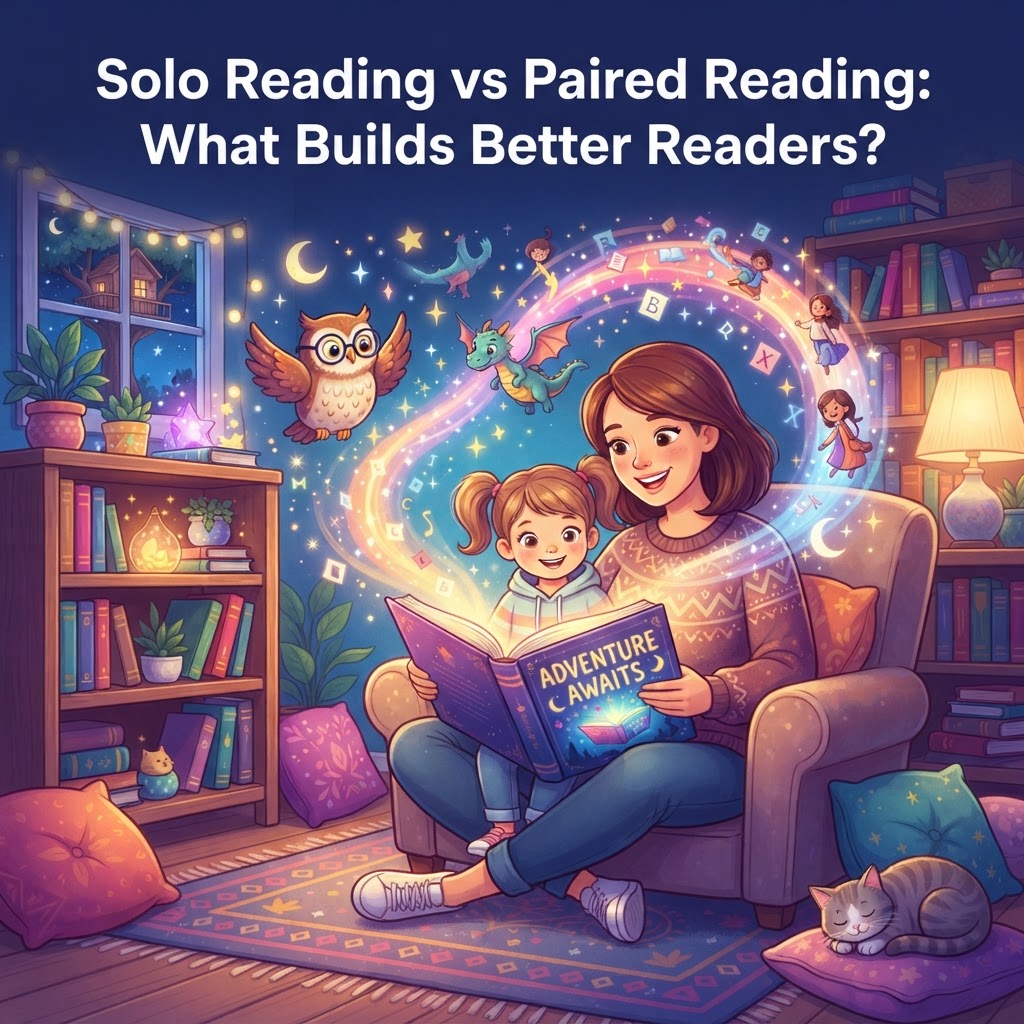
If you have ever wondered whether your child should read alone or cuddle up with you and read together, the short answer is: both matter. In the debate around solo vs paired reading, research shows that children build different reading muscles in each setting.
That is why the best plan is not choosing one over the other. It is knowing when independent reading vs shared reading supports the skill your child needs most, then using both as part of a healthy reading routine.
Is solo or paired reading better for building strong readers?
Neither is “better” in every situation. Strong readers usually grow through a mix of solo reading for fluency and confidence, and paired reading for comprehension, vocabulary, and connection.
Child development research supports this balanced view. The American Academy of Pediatrics recommends shared reading from infancy because it supports language development and relationships. At the same time, guidance from the What Works Clearinghouse shows that structured reading practice, including repeated oral reading, helps children build accuracy and fluency.
So when families compare independent reading vs shared reading, the real question is not “Which one wins?” It is:
- What is my child working on right now?
- Is the text easy enough to read independently?
- Does my child need more support, or more ownership?
A child who is learning to decode may need more paired reading. A child who can already read simple books may benefit from extra solo practice. Most children need both across the week.
What does solo reading teach that paired reading cannot?
Solo reading is especially powerful for fluency, independence, and confidence. When children read on their own, they practice making meaning without immediate adult help, and that is a big step toward becoming lifelong readers.
Here is what solo reading does well:
- Builds fluency: Children learn to read smoothly when they reread familiar, manageable texts.
- Strengthens stamina: Reading alone teaches kids to stay with a story for longer.
- Develops independence: Children learn to solve small reading problems on their own.
- Boosts confidence: Finishing a book independently gives children a real sense of mastery.
This works best when the book is not too hard. In early elementary years, a text that is slightly easy often helps more than one that is challenging. If a child is stopping on every line, guessing wildly, or becoming frustrated, that is not productive independent reading yet.
For younger children, solo reading can also mean “picture reading,” retelling from memory, or turning pages alone. That still counts. Early independence often starts with handling books, noticing print, and feeling like reading belongs to them.
A helpful rule for parents: solo reading should feel successful most of the time. If it feels like a struggle session, move that book back into the paired-reading pile.
What does paired reading teach that solo reading cannot?
Paired reading is especially strong for comprehension, vocabulary, and emotional connection. When an adult reads with a child, the child can think above their independent reading level because the decoding load is shared.
That matters because understanding stories is more than saying the words correctly. During shared reading, adults naturally model what strong readers do:
- Explain unfamiliar words
- Ask prediction questions
- Connect the story to real life
- Notice feelings, motives, and cause-and-effect
- Show how tone and expression carry meaning
Research on dialogic reading, including studies by Grover Whitehurst and colleagues, found that active back-and-forth reading supports children’s language growth, especially in the preschool years. Shared reading also exposes children to richer language than everyday conversation, a major reason it helps vocabulary grow. Reach Out and Read and similar literacy organizations have highlighted these benefits for years.
Paired reading also supports something parents sometimes overlook: bonding. A warm, responsive read-aloud helps children associate books with safety, attention, and pleasure. That emotional layer can shape reading motivation just as much as skill instruction does.
So if your goal is deep talk, new words, or meaningful connection, paired reading often does the job better than solo reading alone.
How should independent reading vs shared reading change by age?
The balance should shift as children grow, but shared reading should not disappear once a child can decode. In fact, older children still benefit from being read with and talked to about books.
A simple age-by-age guide can help:
Ages 1-3
Most reading should be paired. Babies and toddlers learn through lap reading, pointing, naming, repetition, and playful interaction.
Solo reading at this stage looks like:
- Holding board books
- Turning pages
- Looking at pictures
- “Reading” familiar books from memory
Ages 4-6
Paired reading is still the foundation, but short independent reading can begin. This is a great time for children to reread books they already know well.
Try:
- Adult reads one page, child reads one page
- Echo reading, where the child repeats after you
- Brief solo rereads of predictable books
Ages 7-8
This is often the sweet spot for a true mix. Children can do more independent reading, but they still need discussion and support with harder texts.
A healthy pattern might be:
- Independent reading for practice
- Paired reading for new or complex books
- Conversation after reading to build comprehension
Ages 9-10
Many children can handle longer solo reading stretches, but shared reading still matters. Reading together can now focus more on discussion, inference, themes, and character thinking.
If you want to shape a routine, it can also help to think about the best time to read. Some children concentrate better in the morning, while others open up most during bedtime reading.
One important note: go by reading stage, not just age. A 9-year-old who struggles with fluency may still need the same supportive paired-reading strategies as a younger child.
Which reading strategies for kids make both approaches work better?
The most effective reading routines are simple, consistent, and matched to the child’s level. Good reading strategies for kids do not have to be complicated to work.
Here are practical strategies that improve both solo and paired reading:
For solo reading
- Choose books the child can read with success
- Encourage rereading, which builds fluency
- Let children pick topics they genuinely enjoy
- Keep sessions short enough to end on a win
- Ask for a quick retell after reading
For paired reading
- Pause to ask open questions like “Why do you think that happened?”
- Explain one or two new words in context
- Use expression so meaning comes through
- Let the child join in on repeated lines
- Talk after reading, not just during it
For both
- Revisit favorite stories often
- Match the reading format to the goal
- Stop before frustration takes over
- Keep reading emotionally positive
If you are also weighing home reading formats, our guide to individual and group reading can help clarify when each setup works best. And if screen time is part of the bigger picture, it is worth looking at how stories compare with videos for attention, language, and imagination.
How can AI stories support both solo and paired reading?
AI stories can support both styles of reading when they are personalized, age-appropriate, and used intentionally. The biggest advantage is flexibility: the same story can be used for a supported read-together session or an easier solo reread later.
For solo reading, personalized stories can increase motivation. A child is often more willing to read independently when the story features their name, favorite animal, or a topic they already love. That makes it easier to create your own personalized bedtime story that feels just right for their age and interests.
For paired reading, AI stories give adults a fresh text to discuss. Parents can pause to talk about characters, feelings, and new vocabulary, just as they would with any picture book or early reader. When children want repetition, saved stories in your story library make rereading simple, which is excellent for fluency.
AI stories can also help in classrooms and small groups. Teachers can use personalized prompts, differentiated text levels, and follow-up discussion through InstaTales for teachers, especially when students need a mix of guided and independent practice.
The key is to treat AI as a reading tool, not a replacement for adult interaction. The strongest results still come from a balance of human connection, thoughtful conversation, and child-led reading practice.
Frequently Asked Questions
Should my child read alone every day?
Yes, if the text is at the right level. Even 5-10 minutes of successful solo reading can build fluency, confidence, and reading stamina.
Is shared reading still important once my child can read independently?
Absolutely. Shared reading keeps building comprehension, vocabulary, and motivation long after a child can decode words on their own.
What if my child hates reading aloud to me?
Try lower-pressure options like echo reading, taking turns by page, or having your child retell the story instead. Resistance often means the text feels too hard or the format feels too stressful.
How long should paired reading last?
Quality matters more than length. For many children, 10-20 focused minutes of warm, interactive reading is more effective than a longer session that feels rushed or tense.
Can the same book be used for solo and paired reading?
Yes, and that is often ideal. A child might first read a book with support, then reread it alone later for fluency and confidence.
Are AI-generated stories good for reluctant readers?
They can be very helpful when the content matches a child’s interests and reading level. Personalized stories often increase curiosity and make independent reading feel more inviting.
Ready to Create a Personalized Bedtime Story?
Use our free AI bedtime story generator to create a personalized illustrated story for your child in 30 seconds — no credit card needed.
Popular story types:
Maya Rodriguez
Lead Content Editor & Early Literacy Specialist
Maya is a former early childhood educator and literacy specialist with over a decade of experience helping children develop a love of reading. She leads content at InstaTales, where she writes about the science of storytelling, child development, and how families can use personalized AI stories to build literacy and emotional resilience.
instatales.ai