Gravity Stories for Kids That Make Science Fun
Make science fun with stories that teach kids about gravity — imagination meets real science in these engaging tales.
✦ Key Takeaways
- •Gravity stories for kids are effective because they turn an abstract idea into something concrete, visual, and emotional.
- •The best gravity story ideas use action, wonder, and a problem children can picture right away.
- •The easiest way to make gravity memorable is to personalize the story and keep the science goal very small.
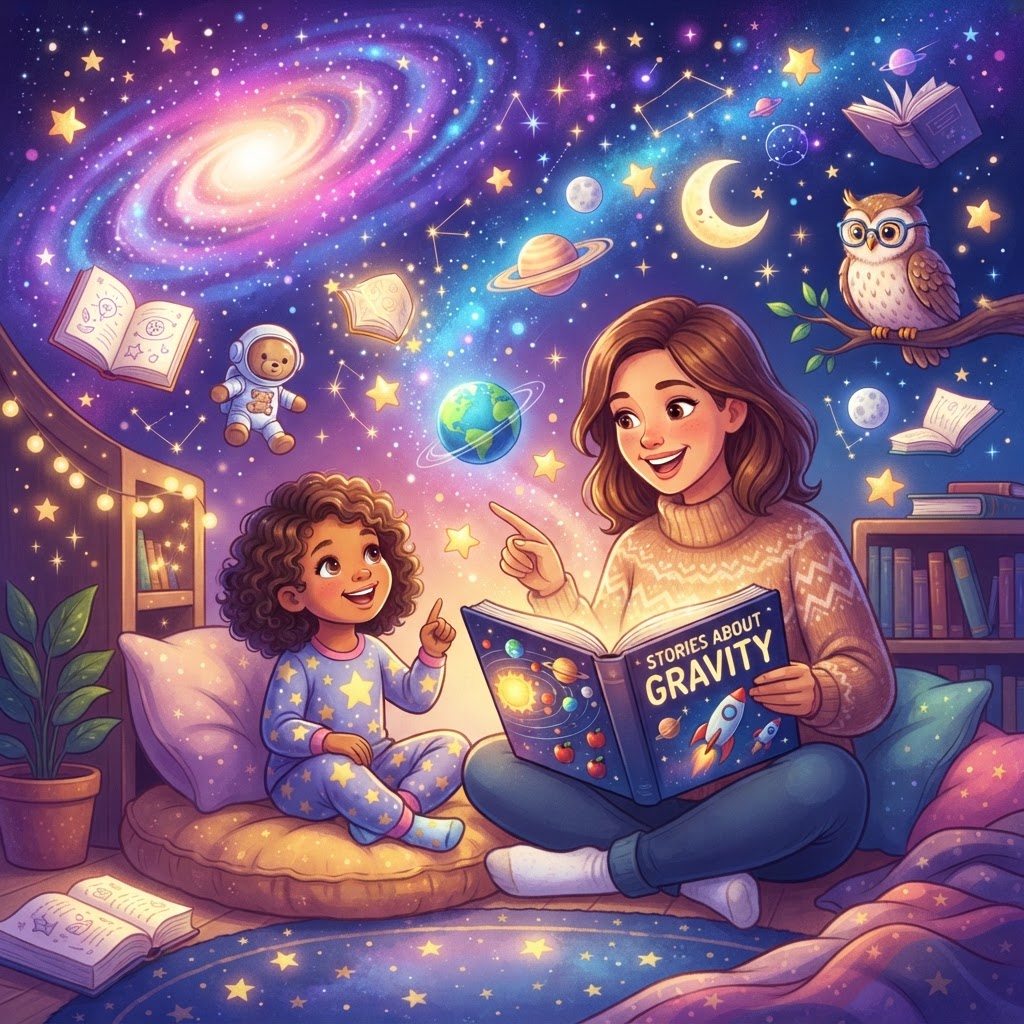
Gravity is one of the first science ideas children can feel long before they can define it. Balls drop, cups tip, leaves fall, and jumpers always come back down. That is why gravity stories for kids work so well: they connect a child’s everyday world with imagination, emotion, and real science. If you are teaching gravity to children at home or in the classroom, a good story can make an invisible force easier to understand and much more fun to remember.
Why are gravity stories for kids such an effective way to teach science?
Gravity stories for kids are effective because they turn an abstract idea into something concrete, visual, and emotional. Children learn best when new concepts are tied to familiar experiences, playful language, and repetition.
Early childhood experts such as the National Association for the Education of Young Children (NAEYC) consistently emphasize hands-on, language-rich learning. Storytelling supports that beautifully. When a child hears about a pebble dropping into a pond or an astronaut floating in space, they are building both vocabulary and scientific understanding.
This approach also fits how young children learn science. Instead of memorizing a definition, they notice patterns:
- Things fall down
- Bigger jumps still end on the ground
- The Moon stays near Earth
- Space feels different from Earth
If you want to teach gravity to children without making it feel like a formal lesson, stories are one of the best starting points. You can also pair them with simple experiments, like dropping two safe objects together or watching leaves fall outside.
For a child-friendly explanation of the concept, NASA Space Place’s gravity guide is a helpful reference.
What are some engaging gravity story ideas children can understand?
The best gravity story ideas use action, wonder, and a problem children can picture right away. These kids gravity stories work especially well because each one connects a playful plot with a real science fact.
The Bunny Who Could Not Stay on the Trampoline
- Story concept: A cheerful bunny thinks one extra-big bounce will send him flying forever. Instead, he learns that no matter how high he hops, Earth always pulls him back for bedtime.
- Real gravity facts: Gravity is the force that pulls objects toward Earth. Even when something goes up, gravity keeps pulling it down.
- AI prompt: Write a gentle educational bedtime story for a 4-year-old about a bunny who wants to bounce into the clouds but learns that gravity always brings him safely back down. Include simple repetition and a cozy ending.
The Moon Jumping Contest
- Story concept: Two friends imagine a jumping contest on Earth and then on the Moon. On the Moon, their leaps are slow, floaty, and much higher than expected.
- Real gravity facts: The Moon has less gravity than Earth, so people would jump higher there. Gravity depends on the mass of an object, and Earth’s mass is much greater than the Moon’s.
- AI prompt: Create an educational story for a 6-year-old where two children compare jumping on Earth and the Moon. Explain the difference in gravity using simple language and lots of sensory detail.
Captain Feather and the Falling Apple Race
- Story concept: A feather, an apple, and a paper airplane hold a silly race to the ground. The child hero discovers that gravity pulls on all of them, but air changes how they fall.
- Real gravity facts: Gravity pulls all objects downward. Air resistance can slow some objects more than others, which is why a feather falls differently from an apple.
- AI prompt: Write a fun story for a 5-year-old about a child watching a feather and an apple fall. Teach the difference between gravity and air resistance in a playful, easy-to-follow way.
The Lost Kite and the Invisible Pull
- Story concept: A kite wants to stay in the sky forever, but when the wind calms, it drifts down to a waiting child. The story shows that wind can lift, but gravity is always there.
- Real gravity facts: Gravity acts all the time, even when something looks like it is floating. Other forces, like wind, can briefly push against gravity.
- AI prompt: Tell a calming bedtime story about a kite that loves the sky but learns how wind and gravity work together. Make it educational, age 5 to 7, with a warm family ending.
The Astronaut Who Felt Weightless
- Story concept: A young astronaut thinks gravity disappears in space. A wise robot explains that astronauts feel weightless because they are falling around Earth while orbiting it.
- Real gravity facts: Gravity is still present in orbit. Astronauts feel weightless because spacecraft and astronauts are in continuous free fall around Earth.
- AI prompt: Write an educational space story for a 7-year-old about a child astronaut who learns why astronauts float. Use vivid imagery and one simple science explanation.
For extra accuracy, the Smithsonian National Air and Space Museum explains why astronauts float in child-friendly terms.
The Ocean That Followed the Moon
- Story concept: A curious child notices that the beach looks different every afternoon. A grandmother explains that the Moon’s gravity helps pull ocean water, creating tides.
- Real gravity facts: The Moon’s gravity plays a major role in Earth’s tides. The Sun also affects tides, but the Moon has the biggest everyday effect.
- AI prompt: Create a soothing educational story for a 7- to 9-year-old about a child learning how the Moon helps create ocean tides. Include a beach setting and clear, simple science.
If this topic sparks wider science curiosity, children often also enjoy connected themes like water cycle stories, where Earth systems become just as story-friendly.
How can parents and teachers use InstaTales to create better gravity stories?
The easiest way to make gravity memorable is to personalize the story and keep the science goal very small. With InstaTales, you can choose the educational story type and shape the tale around your child’s age, interests, and attention span.
A strong setup usually includes:
- The child’s name or favorite character type
- One clear gravity idea, such as falling, jumping, orbit, or tides
- An age-appropriate setting, like a playground, moon base, or beach
- A gentle explanation built into the plot, not added as a lecture
When you create your own personalized bedtime story, aim for one main science takeaway per story. Younger children ages 3 to 5 may do best with “gravity pulls things down.” Older children can handle richer ideas like “gravity in orbit” or “the Moon affects tides.”
If you want a faster start, use story templates and adapt the prompt with:
- Age
- Favorite animal or character
- Science topic: gravity
- Tone: bedtime, funny, adventurous, or classroom-friendly
For teachers, the educational story type is especially useful before a mini science lesson or writing activity. InstaTales for teachers can support read-alouds, station work, or take-home literacy connections. After you generate a story, save versions in your story library so children can revisit the same concept through repetition, which supports comprehension and recall.
How can you turn kids gravity stories into real learning after the story ends?
Children understand gravity better when they hear it in a story and then see it in real life. A quick follow-up activity helps move the idea from “interesting” to “I get it.”
Try one of these simple extensions:
- Drop a soft ball and a crumpled paper ball together
- Jump and ask, “What brought us back down?”
- Toss a scarf and a block to compare falling speed
- Watch birds, leaves, or rain outside
- At the beach, talk about how water levels change over time
Keep the language simple: “Gravity is the pull.” Then ask open questions:
- What happened?
- Did everything fall the same way?
- What do you think gravity was doing?
This kind of playful science talk supports early inquiry skills. It also pairs well with other story-based science themes on the InstaTales blog, especially when children begin connecting gravity to weather, plants, or Earth science.
Frequently Asked Questions
What is the simplest way to explain gravity to a child?
Gravity is the force that pulls things toward Earth. A simple way to say it is: “Gravity is why things fall down and why we stay on the ground.”
At what age can children start learning about gravity?
Children can start noticing gravity as toddlers because they see dropping, falling, and jumping every day. Formal explanations can become more detailed between ages 4 and 8, depending on language and attention span.
Are gravity stories good for bedtime?
Yes, as long as the story stays calm and age-appropriate. Bedtime stories can teach science very effectively when they use gentle pacing, cozy endings, and one clear idea.
What science facts about gravity should young children learn first?
Start with the basics: gravity pulls things down, it keeps us on Earth, and it affects how objects move. Older children can then learn about the Moon, orbit, and tides.
How do I make an AI gravity story feel educational but not too heavy?
Use one key fact, one memorable problem, and lots of child-friendly imagery. The science should appear naturally inside the action, not as a separate lecture.
Can gravity stories be used in the classroom?
Absolutely. They work well for read-alouds, writing prompts, and simple experiments. Teachers often get the best results when they pair a short story with one hands-on demonstration and a few discussion questions.
Ready to Create a Personalized Bedtime Story?
Use our free AI bedtime story generator to create a personalized illustrated story for your child in 30 seconds — no credit card needed.
Popular story types:
Maya Rodriguez
Lead Content Editor & Early Literacy Specialist
Maya is a former early childhood educator and literacy specialist with over a decade of experience helping children develop a love of reading. She leads content at InstaTales, where she writes about the science of storytelling, child development, and how families can use personalized AI stories to build literacy and emotional resilience.
instatales.ai