7 Water Cycle Stories for Kids That Teach Science
Make science fun with stories that teach kids about the water cycle — imagination meets real science in these engaging tales.
✦ Key Takeaways
- •Stories work because they give abstract science ideas a shape children can understand.
- •The best water cycle story ideas are simple, visual, and grounded in real science.
- •The easiest way to make personalized science stories is to start with a clear learning goal.
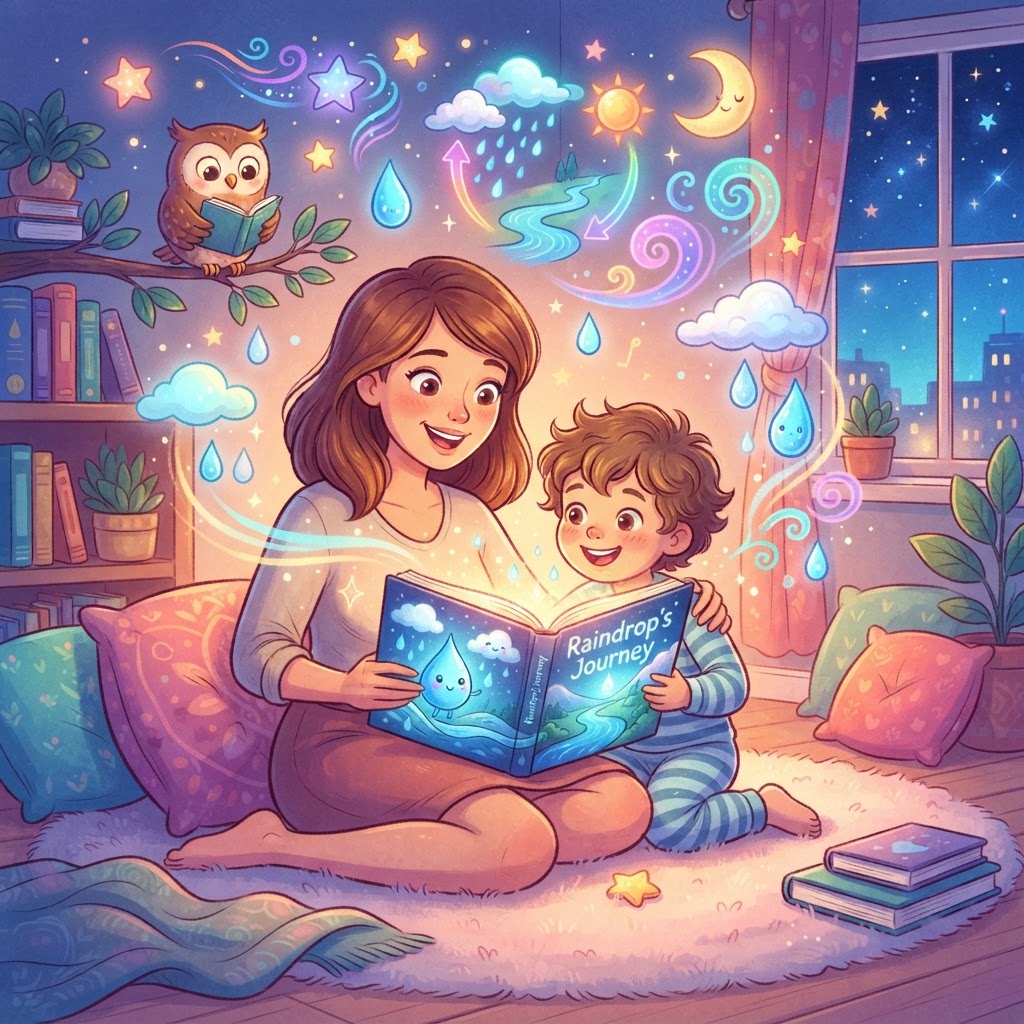
If you want to make science stick, stories are one of the best tools you can use. The water cycle stories for kids turn evaporation, clouds, rain, and rivers into adventures children can picture, remember, and talk about long after bedtime. In this guide, you’ll find story-based ways of teaching the water cycle to children, along with real science facts, simple AI prompts, and practical tips for using InstaTales to create personalized learning stories.
Why are stories such an effective way of teaching the water cycle to children?
Stories work because they give abstract science ideas a shape children can understand. Instead of memorizing vocabulary, kids follow a raindrop, a cloud, or a puddle through a clear sequence of events.
That matters for child development. The National Association for the Education of Young Children (NAEYC) has long emphasized that young children learn best through meaningful, playful experiences. The American Academy of Pediatrics also highlights the value of interactive reading and conversation for language growth and comprehension. When you pair a science concept with characters, repetition, and questions, children are more likely to remember both the story and the facts.
For the water cycle, stories are especially useful because the process is cyclical and hard to see all at once. A good story can help children connect:
- Evaporation: water warms up and becomes vapor
- Condensation: vapor cools and forms clouds
- Precipitation: water falls as rain, snow, or hail
- Collection: water gathers in rivers, lakes, soil, and oceans
If you want to check the science as you go, kid-friendly resources from NASA Climate Kids and NOAA explain the water cycle clearly and accurately.
What are the best the water cycle story ideas for young children?
The best water cycle story ideas are simple, visual, and grounded in real science. Start with one character and one clear journey, then add just 1-2 accurate facts so the story stays fun without becoming a lecture.
Penny the Raindrop’s Big Sky Trip
- Story concept: Penny is a tiny raindrop resting in a pond. On a warm day, she rises into the air, joins a fluffy cloud, and later falls back to Earth in a gentle rainstorm.
- Real science facts: The sun’s heat causes evaporation, turning liquid water into water vapor. When water vapor cools, it forms tiny droplets in clouds through condensation.
- AI prompt: “Write a gentle bedtime story for a 4-year-old about a raindrop named Penny who starts in a pond, evaporates into the sky, becomes part of a cloud, and falls as rain. Include the words evaporation and condensation in a simple, friendly way.”
The Cloud Post Office
- Story concept: A busy cloud delivers water letters to farms, forests, and cities. The cloud must decide when it is full enough to let the letters fall as rain.
- Real science facts: Clouds form when tiny droplets collect in the air. Precipitation happens when droplets become too heavy to stay suspended.
- AI prompt: “Create a playful story for ages 5-7 about a cloud that works like a post office, delivering rain to different places. Explain that clouds release rain when water droplets get too heavy.”
Max and the Magic Puddle
- Story concept: After a rainy day, Max finds a puddle that seems to shrink each afternoon. He imagines the puddle taking secret flying lessons with the sun.
- Real science facts: Even when children cannot see it happen, puddles disappear because water evaporates into the air. Warmer, sunnier weather speeds up evaporation.
- AI prompt: “Write a short story for a 3- to 6-year-old about a child named Max who notices a puddle shrinking in the sun. Explain evaporation in a concrete, age-appropriate way with repetition.”
The Mountain with a Snow Hat
- Story concept: A mountain wears a white snow hat in winter. In spring, the hat melts, feeding streams that travel downhill to villages and rivers.
- Real science facts: Precipitation is not always rain; it can fall as snow when air is cold. Melted snow becomes runoff, helping fill streams, lakes, and rivers.
- AI prompt: “Tell a cozy story for ages 6-8 about a mountain that wears a snow hat. Show how snow falls, melts in spring, and becomes water in streams and rivers.”
River’s Long Trip to the Ocean
- Story concept: A curious river wants to know where all water goes. Along the way, it meets forests, animals, and towns before finally reaching the sea.
- Real science facts: Water collects in rivers, lakes, and oceans as part of the cycle. Much of Earth’s evaporation begins in the ocean, which is why ocean science stories can connect beautifully with water-cycle learning.
- AI prompt: “Write an adventure story for a 7-year-old about a river traveling to the ocean. Include the idea that water collects in rivers and oceans before starting the cycle again.”
If your child loves connected science themes, pairing this with stories about oceans can deepen understanding.
Lila the Garden Leaf
- Story concept: Lila is a leaf in a vegetable garden who helps water travel back into the air. She feels sunshine, drinks through her roots, and sends tiny invisible bits of water skyward.
- Real science facts: Plants release water vapor through a process called transpiration. This helps move water from the soil back into the atmosphere.
- AI prompt: “Create an educational story for ages 7-9 about a garden leaf named Lila who helps water return to the air through transpiration. Keep it imaginative but scientifically accurate.”
The Rainy Day Band
- Story concept: Sun, wind, cloud, and rain are band members who can only make music when they work together. Each one plays a different role in moving water around Earth.
- Real science facts: The water cycle is a continuous system powered mainly by the sun. Wind helps move clouds from place to place, affecting where precipitation falls.
- AI prompt: “Write a musical story for a 5- to 8-year-old where Sun, Wind, Cloud, and Rain are a band. Teach that the sun powers the water cycle and wind moves clouds.”
These kids the water cycle stories work best when you match the complexity to the child’s age. Younger children usually enjoy repetition and clear sequences, while older children are ready for terms like precipitation, runoff, and transpiration.
How can you use InstaTales’ educational story type to create water cycle stories for kids?
The easiest way to make personalized science stories is to start with a clear learning goal. With InstaTales’ educational story type, you can ask the AI to build a bedtime story around the water cycle while tailoring the tone, reading level, and characters to your child.
A practical way to do it is:
- Choose the educational story type
- Add your child’s age and interests
- Name the science goal, such as “understand evaporation and rain”
- Request 2-3 accurate facts woven into the plot
- Ask for a warm bedtime tone with simple repetition
For example, you might ask the AI to create a story about a child who loves frogs, rainboots, or gardens. That makes teaching the water cycle to children feel personal, which boosts attention and recall. If you want a fast start, browse story templates or go straight to create your own personalized bedtime story.
In classrooms, teachers can turn these prompts into differentiated reading tasks, science journal starters, or small-group discussion texts. That is especially helpful for mixed ages or reading levels, and it fits well with InstaTales for teachers. If your child wants to revisit favorite stories, save them in your story library for re-reading, which is one of the best ways to reinforce vocabulary.
For cross-topic science learning, you can also connect weather and Earth science with volcano stories, dinosaur science stories, or human body learning stories.
What simple follow-up activities help children remember the water cycle?
The best follow-up activities are short, hands-on, and tied directly to the story. After reading, ask one question, do one observation, and repeat one key word from the story.
Try simple ideas like these:
- Draw Penny the raindrop moving from pond to cloud to rain
- Put water in a clear cup by a sunny window and talk about evaporation
- Watch weather changes and ask, “Where is the water now?”
- Act out the cycle with body movements: rise, gather, fall, flow
For older children, compare your story details with the real science from the USGS Water Science School. This helps children enjoy the imaginative part while learning that science has observable patterns and vocabulary.
Frequently Asked Questions
What age is best for water cycle stories for kids?
Children as young as 3 can enjoy simple the water cycle stories for kids with puddles, clouds, and rain. By ages 6-10, most children can understand vocabulary like evaporation, condensation, and precipitation with story support.
How do I explain evaporation to a child simply?
Say that the sun warms water and turns it into an invisible gas that floats into the air. A puddle disappearing after rain is one of the easiest real-life examples for children to notice.
Can AI stories really help with science learning?
Yes, when the prompt is clear and the facts are checked. AI stories are especially helpful because they can personalize the lesson to a child’s interests, which improves engagement and makes re-reading more likely.
How many science facts should I include in one story?
For most young children, 1-2 facts per story is enough. Too many facts can make the story feel like a lesson instead of a narrative, which reduces attention.
What should I include in an AI prompt about the water cycle?
Include the child’s age, the main character, the science goal, and 1-3 target words such as evaporation or rain. Also ask for a bedtime tone and simple explanations to keep the story both accurate and soothing.
How can parents and teachers tell if a water cycle story is accurate?
Check whether the story shows the basic sequence correctly: evaporation, condensation, precipitation, and collection. It also helps to compare details with trusted sources like NASA, NOAA, or USGS.
Ready to Create a Personalized Bedtime Story?
Use our free AI bedtime story generator to create a personalized illustrated story for your child in 30 seconds — no credit card needed.
Popular story types:
Maya Rodriguez
Lead Content Editor & Early Literacy Specialist
Maya is a former early childhood educator and literacy specialist with over a decade of experience helping children develop a love of reading. She leads content at InstaTales, where she writes about the science of storytelling, child development, and how families can use personalized AI stories to build literacy and emotional resilience.
instatales.ai