Stories that teach teamwork to kids
Help your child learn teamwork through the power of storytelling. Tips, story ideas, and discussion questions for parents and teachers.
✦ Key Takeaways
- •Stories are effective because they let children practice social thinking in a safe, memorable way.
- •A good teamwork story shows children that success happens because characters combine strengths, not because one hero does everything alone.
- •The best teamwork stories for kids use simple, relatable situations where every character matters.
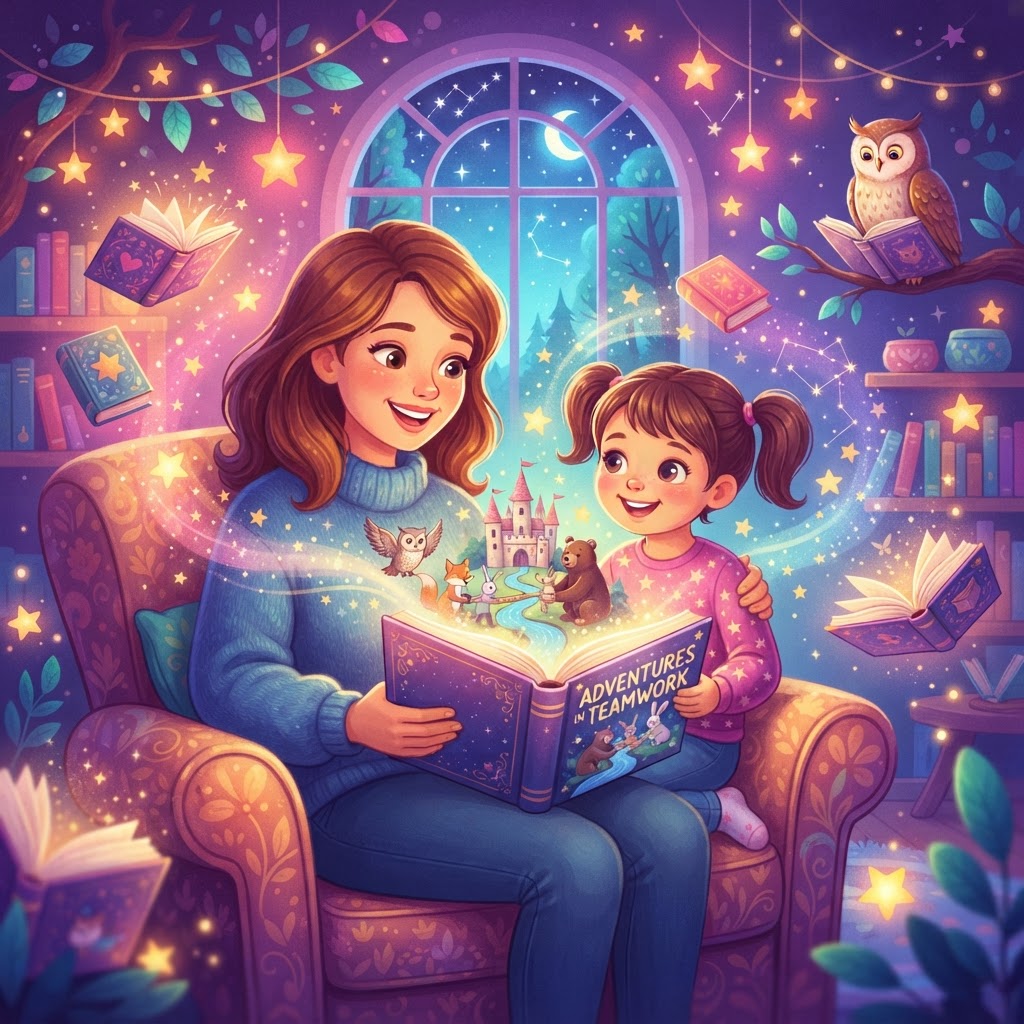
Children learn teamwork best when they can see it, feel it, and talk about it—and stories make all three possible. Whether you are looking for teamwork stories for kids at bedtime or classroom read-alouds that support social-emotional learning, the right story can turn “work together” from a rule into a skill a child actually understands.
Why are stories so effective for teaching teamwork to children?
Stories are effective because they let children practice social thinking in a safe, memorable way. Instead of hearing a lecture about cooperation, kids watch characters face a problem, make mistakes, listen to others, and succeed together.
This matters because young children learn values through repetition, modeling, and emotional connection. When a child hears a story about friends building something together or siblings solving a problem as a team, they begin to imagine themselves doing the same. That is one reason storytelling works so well for teaching teamwork to children.
Research supports this approach. The CASEL framework identifies relationship skills—such as communication, cooperation, and conflict resolution—as a core part of social-emotional learning. Child development experts at the Center on the Developing Child at Harvard University also emphasize that children build important social skills through responsive interactions and practice. Even the CDC’s guidance on child development highlights the role of social and emotional growth in everyday learning.
Stories help children learn teamwork because they:
- make abstract values concrete
- show cause and effect
- build empathy for different characters
- create easy openings for discussion
- give children language they can use later, like “Let’s do this together”
For parents and teachers, that makes teamwork bedtime stories more than entertainment. They become a simple, repeatable teaching tool.
What makes a good teamwork story for kids?
A good teamwork story shows children that success happens because characters combine strengths, not because one hero does everything alone. The clearest moral stories about teamwork include a shared goal, a challenge, different roles, and a satisfying result.
Look for or create stories with these features:
-
A problem that is too big for one character alone
This helps children see why teamwork matters. -
Characters with different strengths
One child may be brave, another organized, another kind, another creative. -
Moments of listening and compromise
Teamwork is not just helping. It is also taking turns, adjusting plans, and respecting others. -
A small conflict or mistake
Children learn a lot when a character tries to lead alone, ignores a friend, or gives up too early. -
A clear emotional payoff
Relief, pride, gratitude, and joy help the lesson stick.
This is also a great place to connect teamwork with related values. Working together often depends on inclusion, patience, and self-control. If you want to expand the lesson, the InstaTales blog has helpful reads on stories about inclusion.
Which story scenarios can show children how teamwork works?
The best teamwork stories for kids use simple, relatable situations where every character matters. Below are five story setups you can use at home, in class, or when you create your own personalized bedtime story.
1. How can a broken bridge teach teamwork?
A group of animal friends needs to cross a stream after a bridge breaks. One friend gathers sticks, another ties vines, another tests the path, and another keeps everyone calm.
Teamwork lesson: Big problems become manageable when everyone contributes in different ways.
Discussion questions:
- Why couldn’t one character fix the bridge alone?
- What did each friend do to help?
- Have you ever helped solve a problem with other people?
2. How can a lost baby animal show the value of cooperation?
A baby duck, fox, or bunny gets separated from its family. Several characters search together, each using a different skill—sharp eyes, fast feet, a loud voice, or knowledge of the forest.
Teamwork lesson: Teams work best when members notice and value different strengths.
Discussion questions:
- Which character’s skill was most helpful, and why?
- Did anyone help in a quiet way?
- What strengths do you bring when you help others?
3. How can a class garden become a teamwork story?
A classroom or neighborhood wants to grow a garden, but the work is too much for one child. Some dig, some water, some make signs, and some remember to care for the plants each day.
Teamwork lesson: Teamwork is not only about exciting moments. It also includes planning, consistency, and shared responsibility.
Discussion questions:
- Which jobs in the garden seemed small but were important?
- What would happen if nobody watered the plants?
- How do teams depend on people who do everyday tasks?
4. How can an adventure quest teach children to rely on others?
A pirate crew, space team, or group of young explorers must solve clues to find treasure or get home. One character wants to do everything alone at first, but the team only succeeds when everyone shares ideas.
Teamwork lesson: Listening to others is part of leadership.
Discussion questions:
- Why did the first plan not work?
- What changed when the characters started listening?
- How can someone be a good leader and a good teammate at the same time?
5. How can preparing for a performance show real teamwork?
A group of children gets ready for a school play, dance, or music show. One child forgets lines, another gets nervous, and another feels left out, but the group supports each other so everyone can participate.
Teamwork lesson: Great teams encourage one another, especially when someone struggles.
Discussion questions:
- How did the team help the nervous character?
- What does kindness have to do with teamwork?
- How can we make sure everyone feels included?
How can parents and teachers prompt InstaTales for teamwork-themed stories?
The best prompts are specific about the child, the teamwork challenge, and the value you want to highlight. When you ask for teamwork bedtime stories, include the child’s age, favorite theme, and the exact social skill you want to practice.
A strong prompt usually includes:
- the child’s name and age
- favorite characters, animals, or settings
- a teamwork challenge
- the desired lesson
- tone and length
Here are a few plug-and-play examples:
Prompt example for bedtime
“Write a gentle bedtime story for a 5-year-old named Maya about three forest friends who must work together to rebuild a bridge. Focus on listening, taking turns, and using different strengths. End with a warm, reassuring message.”
Prompt example for siblings
“Create a personalized story for brothers ages 4 and 7 who sometimes argue. The story should show two characters learning to cooperate to rescue a lost kitten. Include a clear moral about teamwork and kindness.”
Prompt example for classroom use
“Write a story for first graders about a class preparing a garden for spring. Show how each child contributes in a different way. Emphasize inclusion, patience, and teamwork.”
If you want a faster starting point, browse the InstaTales story templates. Teachers can also adapt prompts for group discussions, writing centers, or SEL lessons with InstaTales for teachers.
After you find a story your child connects with, save it in your story library so you can reread it. Repetition helps children notice new details and practice the teamwork language again.
How can adults help children carry teamwork lessons from stories into real life?
The fastest way to deepen the lesson is to connect the story to a real situation right after reading. A short conversation, a pretend-play activity, or one small “team job” can turn story understanding into real behavior.
Try these simple follow-ups:
- Ask, “When did the team work well together?”
- Ask, “What could the characters have done differently?”
- Use role-play with stuffed animals or toys
- Give siblings or classmates a small shared task
- Praise specific teamwork behaviors like waiting, listening, or sharing ideas
Keep your feedback concrete. Instead of saying, “Good job,” try:
- “You listened to your sister’s idea.”
- “You both helped clean up.”
- “You stayed calm and solved it together.”
This is also where teamwork connects with other social skills. Children often need patience, inclusion, and self-control before they can truly collaborate. If you want to build those supporting skills too, explore more resources on the InstaTales blog.
Frequently Asked Questions
What age are teamwork stories best for?
Teamwork stories can work for children as young as 2 or 3 when the plot is simple and repetitive. For older children, more complex stories with group problem-solving and character conflict are especially useful.
What should moral stories about teamwork teach?
The best moral stories about teamwork teach that everyone has something valuable to offer. They also show that listening, sharing jobs, and encouraging others are just as important as finishing the task.
How long should teamwork bedtime stories be?
For toddlers and preschoolers, 3-5 minutes is often enough. For children ages 6-10, a 5-10 minute story with a clear challenge and discussion afterward usually works well.
Can teamwork stories help in the classroom?
Yes. Teachers often use teamwork stories to introduce group norms, discuss friendship skills, and prepare students for partner or small-group work. They work especially well in SEL blocks, morning meetings, and literacy lessons.
What if my child prefers stories with one big hero?
That is very common. Start with a strong main character, but make the problem impossible to solve without help so your child can still enjoy the adventure while seeing the value of cooperation.
Ready to Create a Personalized Bedtime Story?
Use our free AI bedtime story generator to create a personalized illustrated story for your child in 30 seconds — no credit card needed.
Popular story types:
Maya Rodriguez
Lead Content Editor & Early Literacy Specialist
Maya is a former early childhood educator and literacy specialist with over a decade of experience helping children develop a love of reading. She leads content at InstaTales, where she writes about the science of storytelling, child development, and how families can use personalized AI stories to build literacy and emotional resilience.
instatales.ai