7 Story-Based Math Games for Kids
Combine storytelling with math games — fun, educational activities that extend the story experience and build skills.
✦ Key Takeaways
- •Story-based math games work because they give abstract math ideas a concrete, emotional context.
- •You can turn almost any InstaTales story into math play by pulling out objects, actions, and problems from the plot.
- •A treasure-counting quest is one of the easiest math games for kids because it builds one-to-one correspondence, number recognition, and early addition.
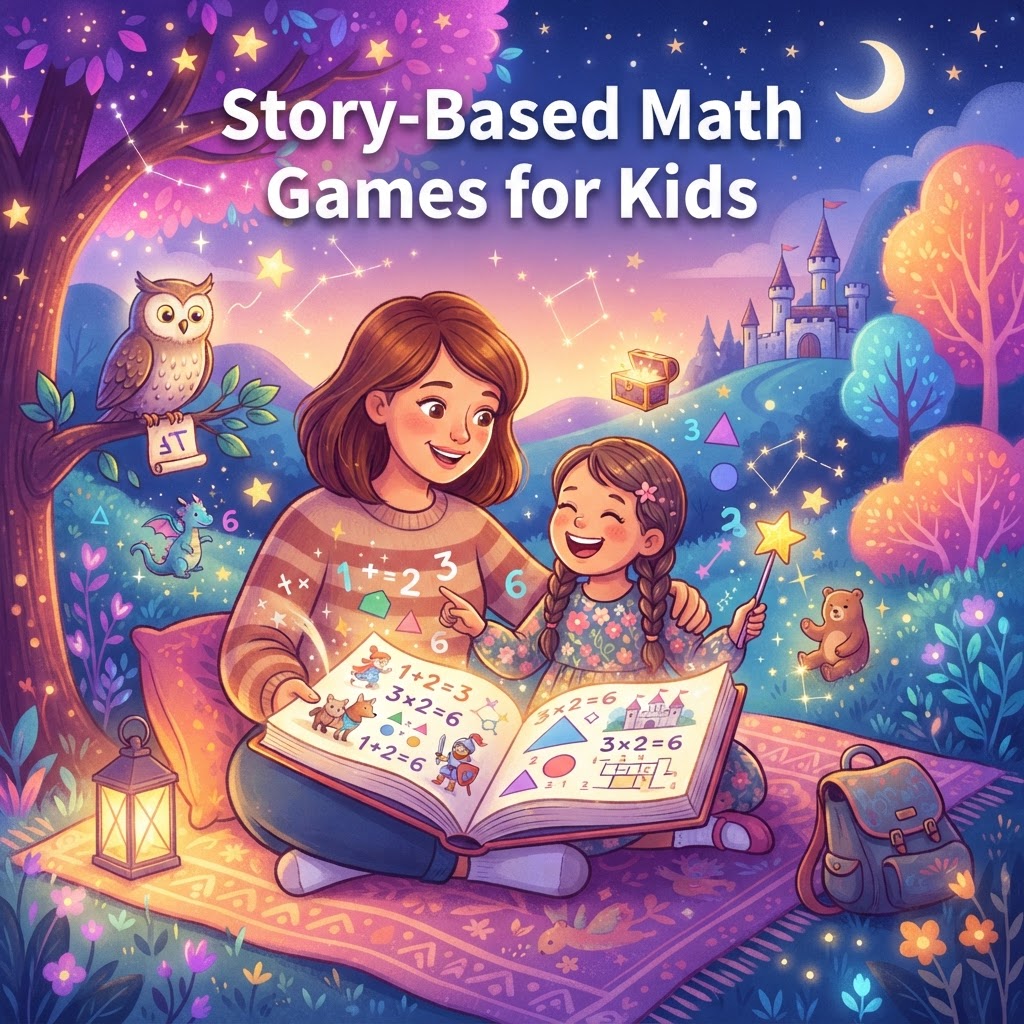
Story-based math games for kids turn numbers into something children can picture, act out, and remember. When a counting task is part of a dragon rescue or a treasure hunt, kids are often more willing to try, repeat, and enjoy it.
That matters because early math skills are strongly linked to later school success. A widely cited study by Greg Duncan and colleagues found that early math knowledge predicts later academic achievement even more strongly than many other early skills. Play-based learning organizations like NAEYC and researchers at the Harvard Center on the Developing Child also emphasize that young children learn best through meaningful, engaging experiences.
With InstaTales, parents and teachers can create your own personalized bedtime story and then turn that same story into hands-on story-based math-games the next day. Below, you’ll find practical math-games activities children can do at home or in the classroom using favorite characters, settings, and plot points from an InstaTales story.
Why do story-based math games work so well for children?
Story-based math games work because they give abstract math ideas a concrete, emotional context. Children are more likely to understand counting, comparing, patterns, and simple operations when those skills help a character solve a problem.
A story gives math a purpose. Instead of “count these blocks,” the task becomes “help the fox count berries for the winter feast.” That small shift boosts attention and persistence, especially for children ages 1-10.
Stories also support language development alongside math. When children explain what happened first, next, and last, or describe why they added two more shells, they are building both reasoning and vocabulary. For more cross-curricular ideas, the InstaTales blog has related literacy and play activities.
How can you turn an InstaTales story into a math activity?
You can turn almost any InstaTales story into math play by pulling out objects, actions, and problems from the plot. Look for things a child can count, sort, compare, measure, or share.
A simple formula helps:
- Choose a favorite InstaTales story from your story library
- Identify 1 math skill: counting, patterns, addition, shapes, measurement, or graphing
- Pull out story elements: stars, animals, snacks, treasure, footsteps, castle windows
- Create a quick hands-on challenge connected to the plot
For teachers, this works especially well in centers, small groups, or early finisher bins. If you want classroom-friendly story use, InstaTales for teachers makes it easier to organize prompts by age and theme.
What is a treasure-counting quest children can play after a story?
A treasure-counting quest is one of the easiest math games for kids because it builds one-to-one correspondence, number recognition, and early addition. It works best after any InstaTales adventure story featuring pirates, explorers, mermaids, or hidden gems.
Story prompt
“In tonight’s InstaTales story, Maya the pirate must collect 10 gold coins before the moon sets. Can you help her find, count, and sort the treasure?”
Materials needed
- Toy coins, buttons, pom-poms, or paper circles
- Small bowls or cups
- Number cards 1-10
- Optional: treasure map on paper
Instructions
- Hide the “treasure” around the room.
- Ask your child to find a set number of coins, such as 5 or 10.
- Have them place coins under matching number cards.
- For older children, create simple addition tasks: “You found 3 coins under the chair and 2 by the door. How many altogether?”
- For ages 7-10, add values: copper = 1, silver = 5, gold = 10.
This activity becomes even stronger when children retell the story while they count. You can extend the fun with story-inspired art using these story-based drawing activities.
How can a snack-shop story build addition and subtraction skills?
A pretend snack shop is a practical way to teach addition and subtraction because children can see quantities change in real time. It fits beautifully with stories about cafés, markets, picnics, fairs, or forest parties.
Story prompt
“In the InstaTales story, Leo runs a woodland snack stand. Three rabbits buy apple slices, and then two more customers arrive. Does Leo have enough snacks?”
Materials needed
- Crackers, fruit slices, or pretend food
- Paper plates
- Small sticky notes for prices or quantities
- Pencil and paper
Instructions
- Set up a “shop” based on the story setting.
- Start with a small number of items on a plate, such as 8 crackers.
- Act out customers arriving and buying or receiving snacks.
- Ask math questions: “If 2 crackers are gone, how many are left?” or “If we add 4 more, how many now?”
- For older children, assign simple prices and let them total orders.
This is one of the best math-games activities children can repeat often because the numbers can grow with the child. Research summarized by the What Works Clearinghouse supports explicit practice with foundational math concepts, and playful routines like this provide that practice without making it feel like a worksheet.
What is a pattern parade and why is it useful for early math?
A pattern parade teaches children to notice, copy, and extend repeating sequences. Patterning is an important early math skill because it supports prediction, logic, and later algebraic thinking.
Story prompt
“In the story, the princess must cross the rainbow bridge by stepping only on the correct color pattern: red, blue, red, blue. Can you continue the parade path?”
Materials needed
- Colored paper, blocks, beads, or socks
- Floor space or table space
- Optional music for marching
Instructions
- Pull a repeating pattern from the story: color, shape, movement, or sound.
- Build the first part of the pattern together: red-blue-red-blue.
- Ask your child to continue it.
- Make it physical by turning it into a march: clap-stomp-clap-stomp.
- For older children, try more complex patterns such as AAB, ABC, or growing patterns.
If your child likes creating their own story worlds, pair this activity with story-based writing prompts for kids so they can invent a parade or festival and then design the matching pattern.
How can a giant’s footprint game teach measurement?
A footprint measurement game introduces comparison, nonstandard measurement, and estimation in a playful way. Children quickly understand “longer,” “shorter,” and “how many blocks long” when they are tracking a giant through a story.
Story prompt
“In the InstaTales story, a friendly giant walks through the village, leaving huge footprints. The children must measure the prints to find out where the giant went.”
Materials needed
- Paper footprints or chalk outlines
- Unifix cubes, paper clips, string, or building blocks
- Recording sheet
Instructions
- Create different-sized “footprints” around the room or playground.
- Ask your child to measure each one using the same item, such as cubes or paper clips.
- Record the results: “This footprint is 7 cubes long.”
- Compare measurements: Which is longest? Which is shortest?
- For older children, estimate first and measure second.
This kind of hands-on measuring helps children connect math words to real objects. It also gives active children a movement break, which is especially useful in classrooms.
What shape-hunt adventure helps children notice geometry in stories?
A shape hunt works well because geometry is everywhere in illustrations and story settings. Castles, rockets, sandwiches, wheels, windows, and shields all give children a reason to spot circles, squares, triangles, and rectangles.
Story prompt
“In the story, Zara the knight needs a map made of magical shapes. She can only unlock the castle if she finds three circles, two triangles, and one rectangle.”
Materials needed
- Shape cards
- Household objects or classroom items
- Clipboard or simple checklist
Instructions
- Read or revisit an InstaTales story and identify shapes from the setting.
- Give your child a mission list, such as “find 4 circles.”
- Hunt for matching shapes in the room, book illustrations, or outdoors.
- Sort objects by shape.
- For older children, discuss attributes: number of sides, corners, curved edges.
This activity is especially helpful for preschool and kindergarten children. If you want another creative extension, acting out the quest can pair nicely with these story-based acting games.
How can a character graphing game teach data skills?
A character graphing game teaches sorting, tallying, and basic data interpretation. It is a simple way to introduce graphing without formal worksheets.
Story prompt
“In the InstaTales story, the animal parade includes bears, foxes, owls, and rabbits. Which animal appeared the most?”
Materials needed
- Printed or drawn pictures of story characters
- Sticky notes or counters
- Paper for a bar graph or pictograph
Instructions
- List 3-5 character types from the story.
- Give your child one counter for each time a character appears, or let them sort character cards into groups.
- Build a simple graph with columns.
- Ask questions: “Which group has more?” “How many more rabbits than foxes?”
- For older children, let them create the graph independently.
Graphing helps children organize information visually. It also strengthens careful listening if you do it while rereading a story aloud.
How can parents and teachers keep story-based math games simple and effective?
The best story-based math-games stay short, playful, and matched to the child’s age. You do not need elaborate prep; you just need a familiar story, a clear math goal, and a few everyday materials.
Keep these tips in mind:
- Start with one skill at a time
- Use real objects children can move
- Repeat favorite story themes for confidence
- Ask open-ended questions: “How do you know?” “What happens if we add one more?”
- Stop while the child is still engaged
For toddlers, focus on counting, matching, and simple shape language. For older children, add multi-step problems, money, elapsed time, or data collection. If you want to branch into other subjects, story-based STEM ideas like science experiments tied to stories can build the same sense of playful learning.
Frequently Asked Questions
What age are story-based math games best for?
Story-based math games can work for ages 1-10 when the activity matches the child’s developmental level. Toddlers may sort and count objects, while older children can solve addition, subtraction, measurement, or graphing challenges.
How long should a story-based math activity last?
For most children, 10-20 minutes is enough. Short, repeated activities are usually more effective than long sessions, especially for preschoolers and early elementary students.
Do I need to make a new story every time?
No. Reusing a favorite story often works better because children already know the characters and plot. That familiarity frees up mental energy for the math task itself.
Can teachers use these math games in the classroom?
Yes. These activities work well for math centers, morning tubs, small-group instruction, and literacy-math integration. Teachers can also adapt one class story into several leveled tasks.
What if my child resists math?
Start with a story theme your child already loves, such as dinosaurs, unicorns, trucks, or space. When math helps a favorite character solve a problem, it often feels less intimidating and more like play.
Are story-based math games enough for early math learning?
They are a strong supplement, especially for building confidence and conceptual understanding. Children still benefit from a mix of playful practice, everyday math talk, and, when appropriate, structured instruction.
Explore More Stories
Ready for more? - free AI bedtime story generator
Get a new bedtime story every week
Free, personalized, and delivered to your inbox. No spam, ever.
Ready to Create a Personalized Bedtime Story?
Use our free AI bedtime story generator to create a personalized illustrated story for your child in 30 seconds — no credit card needed.
Popular story types:
Maya Rodriguez
Lead Content Editor & Early Literacy Specialist
Maya is a former early childhood educator and literacy specialist with over a decade of experience helping children develop a love of reading. She leads content at InstaTales, where she writes about the science of storytelling, child development, and how families can use personalized AI stories to build literacy and emotional resilience.
instatales.ai