6 Story-Based Poetry Activities for Kids
Combine storytelling with poetry activities — fun, educational activities that extend the story experience and build skills.
✦ Key Takeaways
- •Story-based poetry activities help kids learn because they connect new language skills to a familiar narrative.
- •You can turn an InstaTales story into a poetry lesson by choosing one small part of the story and building a short activity around it.
- •A character acrostic poem helps children describe a story character using clear, simple words.
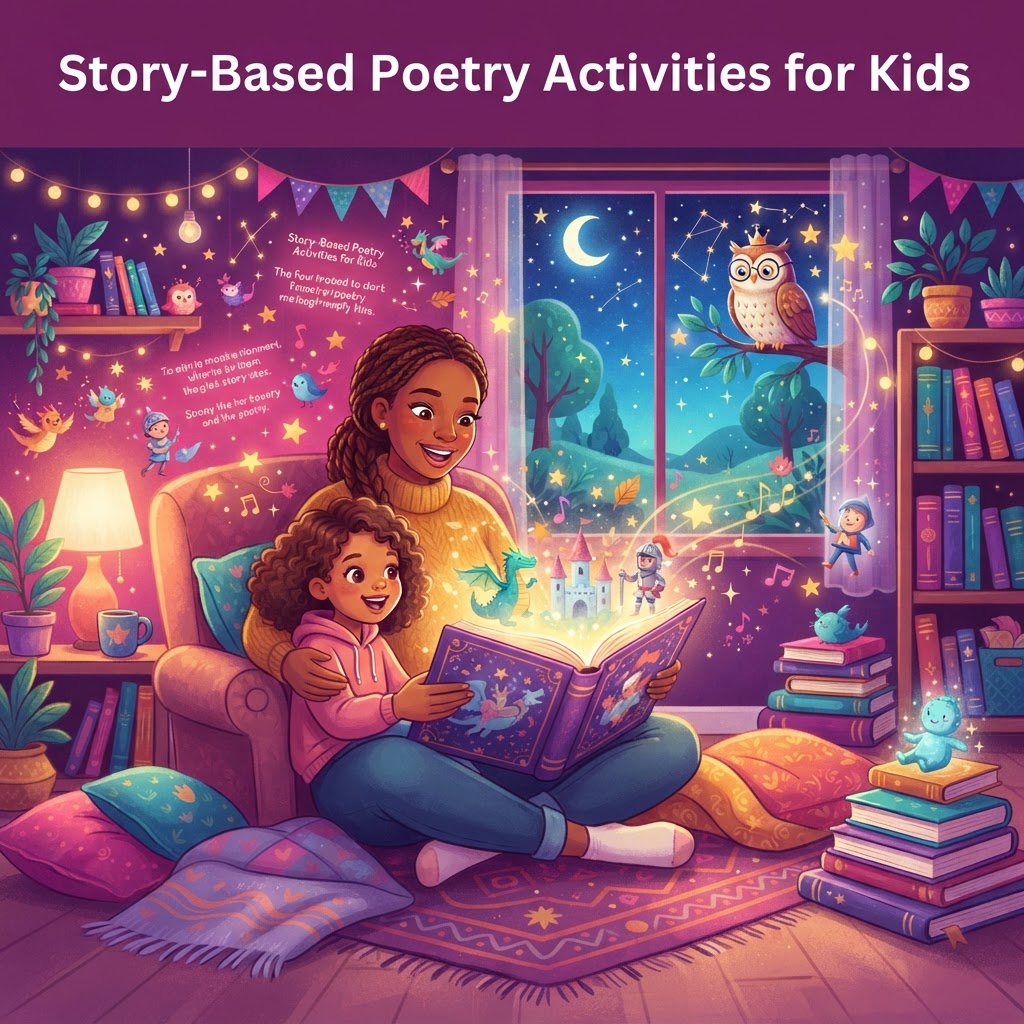
If you're looking for poetry-activities for kids that feel playful, calm, and genuinely educational, start with a story your child already loves. Stories give children characters, settings, and emotions to talk about, while poetry adds rhyme, rhythm, and word choice. Together, they create meaningful story-based poetry-activities that build language, listening, and early literacy skills without feeling like a worksheet.
For parents and teachers, InstaTales makes this even easier. You can create your own personalized bedtime story, revisit favorites in your story library, and turn each story into a simple poetry lesson that fits bedtime, centers, or language arts time.
Why do story-based poetry activities help kids learn?
Story-based poetry activities help kids learn because they connect new language skills to a familiar narrative. Children understand the story first, so they can focus on rhyme, rhythm, description, and expression without starting from scratch.
This approach also fits what child development experts recommend. The Center on the Developing Child at Harvard University highlights how back-and-forth language interactions support brain development, and the NAEYC emphasizes developmentally appropriate, play-based learning. Poetry adds sound play, and sound play matters: Reading Rockets notes that rhyme and phonological awareness support early reading development.
In practice, poetry activities based on stories help children:
- Retell events in sequence
- Notice rhyming words and sound patterns
- Build vocabulary from a meaningful context
- Express feelings safely through characters
- Strengthen memory and oral language
How can you turn an InstaTales story into a poetry lesson?
You can turn an InstaTales story into a poetry lesson by choosing one small part of the story and building a short activity around it. The best starting points are a character, a setting, a repeated event, or a strong emotion.
Before you begin, read the story once for enjoyment. Then reread and ask:
- Who stands out most?
- Where does the story happen?
- What line or moment repeats?
- What feeling is strongest?
For home use, pick one favorite tale from your story library. For classrooms, InstaTales for teachers can help you organize story-based assignments and keep activities consistent across age groups. If you want even more extensions, pair these ideas with story-inspired crafts or music extensions.
How can kids write a character acrostic poem?
A character acrostic poem helps children describe a story character using clear, simple words. It is one of the easiest poetry activities for children because the name itself provides the structure.
Story prompt
Choose the main character from an InstaTales story, such as Luna, Max, or a custom hero your child created.
Materials needed
- Printed or handwritten character name
- Paper
- Pencil, crayons, or markers
Instructions
- Write the character's name vertically down the page.
- Help children think of one word or short phrase for each letter.
- Encourage them to use details from the story: brave, sleepy, sparkly, kind, fast.
- Read the poem aloud together with expression.
For younger children, you can supply the words and let them decorate the page. For older children, ask them to find evidence in the story for each choice. This works especially well after rereading a personalized InstaTales story, because children already feel connected to the character.
How can children build a rhyme trail from a story?
A rhyme trail builds phonological awareness by linking story words to families of rhyming words. It works well for preschool and early elementary learners because it turns listening into a game.
Story prompt
Pick 3-5 key words from the story, such as moon, star, cat, tree, boat, or night.
Materials needed
- Story text
- Index cards or sticky notes
- Markers
Instructions
- Pull out one story word at a time.
- Ask children to say as many rhymes as they can: moon, spoon, tune.
- Place each rhyming word in a "trail" across the table or floor.
- Invite children to clap each word as they say it.
If a word has no easy rhyme, that is fine. The goal is playful sound awareness, not perfection. When using InstaTales, you can choose stories with clear, image-rich vocabulary to make rhyme hunting easier.
How can you create a five-senses poem about a story setting?
A five-senses poem helps children describe a setting in vivid, concrete language. It is especially useful for building vocabulary and comprehension because it asks children to imagine being inside the story world.
Story prompt
Choose a strong setting from the story: a forest, castle, beach, spaceship, or snowy hill.
Materials needed
- Paper with five prompts: I see, I hear, I smell, I feel, I taste
- Crayons or pencils
Instructions
- Reread the part of the InstaTales story that describes the setting.
- Ask children what they would notice there with each sense.
- Write one line for each sense.
- Read the finished poem slowly and ask if they want to add more detail.
Example:
- I see silver stars.
- I hear owls whisper.
- I smell pine trees.
- I feel cool wind.
- I taste hot cocoa.
This is one of the most flexible story-based poetry activities because it works for both fiction and themed classroom units.
How can kids make a repeated-line bedtime poem?
A repeated-line poem helps children practice rhythm and prediction. Repetition also gives young children confidence, because they quickly learn what comes next.
Story prompt
Choose a comforting line or big idea from the story, such as "Goodnight, little dragon" or "The stars watched over us."
Materials needed
- Story text
- Paper
- Optional: bedtime-themed stickers
Instructions
- Pick one repeated line to use as the anchor.
- Add 3-5 new lines between repetitions.
- Keep each line short and gentle.
- Chant or whisper-read the poem together.
Example:
- Goodnight, little dragon.
- The moon is high.
- Your wings are warm.
- The clouds drift by.
- Goodnight, little dragon.
This activity is excellent for bedtime routines and transitions. It also pairs nicely with calm-down reading or weekly reading challenges if you want a simple habit to repeat at home.
How can children write a dialogue poem between two characters?
A dialogue poem helps children explore perspective by giving each character a voice. It strengthens comprehension because children must think about what each character feels, wants, and says.
Story prompt
Choose two characters from an InstaTales story who solve a problem together, disagree, or comfort one another.
Materials needed
- Paper folded into two columns
- Pencil
- Optional puppets
Instructions
- Write one character's name at the top of each column.
- Let children create one short line for each speaker.
- Alternate the lines to sound like a conversation.
- Perform it aloud with two readers.
Keep the lines brief, such as:
- Fox: I heard a sound.
- Bear: I felt afraid.
- Fox: Let's take a light.
- Bear: I'll stay with you.
Teachers can use this in pairs during literacy centers, and parents can act it out at home. If a child enjoys dramatic play, you can extend it later with story-based movement games.
How can kids turn a story moment into a short syllable poem?
A short syllable poem teaches children to listen to the beats in words. It does not need to be a perfect haiku to be useful; the real learning comes from counting syllables and choosing precise language.
Story prompt
Pick one memorable moment from the story, such as spotting a rainbow, meeting a dragon, or falling asleep under the stars.
Materials needed
- Paper
- Pencil
- Fingers or blocks for counting syllables
Instructions
- Ask children to describe the moment in 3 short lines.
- Count the syllables together.
- Revise the words until the lines feel smooth and simple.
- Read the poem aloud more than once.
A sample could be:
- Soft stars fill the sky
- Teddy curls under moonlight
- Night sings us to sleep
For younger children, focus only on "short lines with counted beats." For older children, you can introduce the 5-7-5 haiku pattern. Because InstaTales stories are personalized, children often have stronger motivation to revise the lines carefully.
How can parents and teachers keep poetry activities simple and successful?
Poetry activities work best when they are short, oral, and tied to joy rather than correction. Ten focused minutes is often enough, especially for ages 1-7.
A few practical tips:
- Start with a story the child already enjoys
- Model one example before asking for independent work
- Accept invented spelling and imperfect rhymes
- Let children draw if they are not ready to write much
- End by reading the poem aloud together
If a child seems tired, stop after one line. If they want more, extend the story world through sensory play ideas or simple family talk prompts from the InstaTales blog. The goal is not to produce polished poetry. The goal is to deepen language, imagination, and connection.
Frequently Asked Questions
What age are these poetry activities best for?
These activities work well for ages 3-10, with adult support. Younger children can dictate lines, while older children can write more independently.
Do children need to know how to rhyme first?
No. Adults can model rhymes and let children join in gradually. Listening and playing with sounds is the first step.
Can I use these activities in a classroom?
Yes. They are easy to adapt for whole group, small group, or centers. Dialogue poems and acrostics work especially well in partner or independent tasks.
What if my child does not want to write?
Writing is optional at first. Let your child speak the poem, act it out, or draw the lines while you write them down.
How often should we do story-based poetry activities?
Two or three short sessions a week is plenty. Consistency matters more than length, especially for young children.
How does InstaTales make this easier?
InstaTales gives you personalized, reusable stories that children already care about. That familiarity makes it much easier to turn story moments into meaningful poetry activities for kids.
Ready to Create a Personalized Bedtime Story?
Use our free AI bedtime story generator to create a personalized illustrated story for your child in 30 seconds — no credit card needed.
Popular story types:
Maya Rodriguez
Lead Content Editor & Early Literacy Specialist
Maya is a former early childhood educator and literacy specialist with over a decade of experience helping children develop a love of reading. She leads content at InstaTales, where she writes about the science of storytelling, child development, and how families can use personalized AI stories to build literacy and emotional resilience.
instatales.ai